A theory of bundles over posets
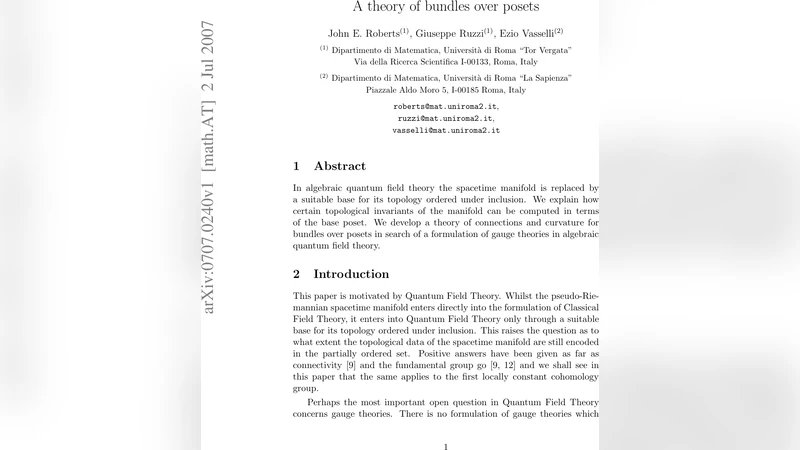
In algebraic quantum field theory the spacetime manifold is replaced by a suitable base for its topology ordered under inclusion. We explain how certain topological invariants of the manifold can be computed in terms of the base poset. We develop a theory of connections and curvature for bundles over posets in search of a formulation of gauge theories in algebraic quantum field theory.
💡 Research Summary
The paper proposes a fully discrete framework for gauge theory within algebraic quantum field theory (AQFT) by replacing the underlying spacetime manifold with a partially ordered set (poset) that encodes the inclusion relations of a suitable open cover. The authors first construct the nerve of the poset, obtaining a simplicial complex whose chain and co‑chain complexes reproduce the Čech cohomology of the original manifold. By proving that the 0‑th and 1‑st cohomology groups of the poset coincide with the connected components and the fundamental group of the manifold, and that higher cohomology groups capture the same topological invariants (e.g., Chern classes), they establish that all relevant topological data can be read directly from the poset.
Next, they define a “Frenel bundle” over the poset: to each element p of the poset (representing an open set Oₚ) they assign a fiber F(p) (typically a vector space, Hilbert space, or C*‑algebra) together with a family of transition maps φ_{pq}: F(p) → F(q) for every order relation p ≤ q. The maps satisfy the usual compatibility φ_{qr}∘φ_{pq}=φ_{pr}, and local triviality is imposed along maximal chains, ensuring that the bundle looks flat when restricted to any chain. This construction mirrors the standard definition of a fiber bundle but is entirely combinatorial.
The authors then introduce a discrete connection. For each 1‑simplex (p ≤ q) they assign a group‑valued 1‑form A(p ≤ q) which can be thought of as the logarithm of the transition map. The curvature on a 2‑simplex (p ≤ q ≤ r) is defined by the familiar formula
F(p ≤ q ≤ r)=A(p ≤ q)+A(q ≤ r)−A(p ≤ r).
This curvature is precisely the coboundary dA in the co‑chain complex, so flatness (F=0) is equivalent to the vanishing of all 2‑cocycles. The discrete Bianchi identity follows automatically from d²=0.
Having set up bundles, connections and curvature, the paper shows how to embed gauge theory into AQFT. The local observable algebras A(O) for each open set O∈P are equipped with a G‑valued bundle (G a Lie group such as U(1) or SU(2)). The connection A provides a prescription for parallel transport between algebras associated with nested regions, while gauge transformations are encoded as 0‑cochains g(p)∈G acting on the fibers. Global gauge transformations correspond to 1‑cocycles in the poset cohomology, reproducing the usual classification of principal bundles by Čech cohomology. The authors work out two explicit examples: a torus T² and a sphere S², each triangulated as a poset. For T² they recover the integer‑valued first Chern class of an electromagnetic U(1) bundle; for S² they obtain the SU(2) instanton number via the second Chern class, all computed purely combinatorially.
The significance of the work lies in providing a mathematically rigorous, purely combinatorial description of gauge fields that fits naturally into the AQFT paradigm, where locality and isotony are already expressed in terms of inclusion of algebras. By avoiding differential geometry, the framework is well‑suited for situations where a smooth manifold is unavailable or undesirable—such as causal sets, spin‑network models of quantum gravity, or lattice simulations of gauge theories. Moreover, the discrete curvature and Bianchi identities suggest a natural discretization of Yang–Mills equations, opening the door to new non‑perturbative computational schemes.
In conclusion, the paper demonstrates that all essential topological and geometric ingredients of gauge theory—bundles, connections, curvature, and characteristic classes—can be reconstructed from the order structure of a poset. This establishes a solid bridge between the algebraic approach to quantum field theory and the geometric language of gauge fields, and it points toward promising applications in quantum gravity, lattice gauge theory, and the study of quantum fields on non‑manifold backgrounds.
Comments & Academic Discussion
Loading comments...
Leave a Comment