Anisotropic Norm Bounded Real Lemma for Linear Discrete Time Varying Systems
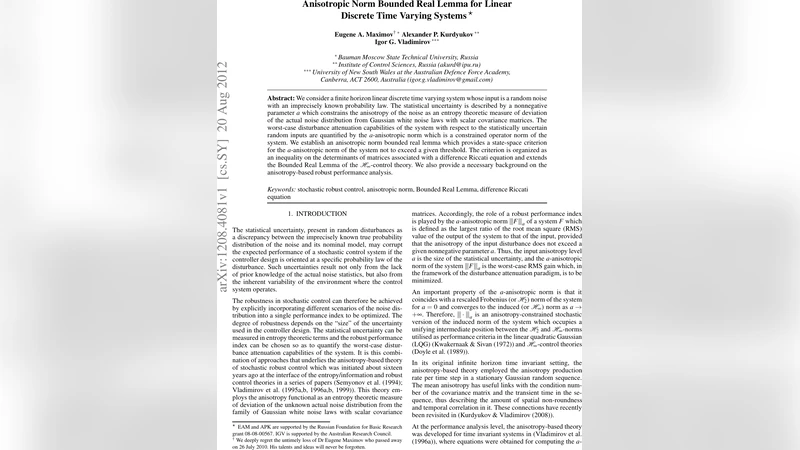
We consider a finite horizon linear discrete time varying system whose input is a random noise with an imprecisely known probability law. The statistical uncertainty is described by a nonnegative parameter a which constrains the anisotropy of the noise as an entropy theoretic measure of deviation of the actual noise distribution from Gaussian white noise laws with scalar covariance matrices. The worst-case disturbance attenuation capabilities of the system with respect to the statistically uncertain random inputs are quantified by the a-anisotropic norm which is an appropriately constrained operator norm of the system. We establish an anisotropic norm bounded real lemma which provides a state-space criterion for the a-anisotropic norm of the system not to exceed a given threshold. The criterion is organized as an inequality on the determinants of matrices associated with a difference Riccati equation and extends the Bounded Real Lemma of the H-infinity-control theory. We also provide a necessary background on the anisotropy-based robust performance analysis.
💡 Research Summary
The paper addresses performance analysis of finite‑horizon linear discrete‑time varying (LDTV) systems when the input disturbance is a random process whose probability distribution is not exactly known. To model this statistical uncertainty, the authors adopt the concept of anisotropy, an entropy‑theoretic measure that quantifies how far a given distribution deviates from a Gaussian white‑noise law with a scalar covariance matrix. A non‑negative scalar parameter (a) bounds the admissible anisotropy: (a=0) corresponds to pure Gaussian white noise, while larger values allow increasingly non‑Gaussian, directionally biased disturbances.
Using this framework, the paper defines the (a)-anisotropic norm of the system, denoted (|G|{a}). This norm can be viewed as a constrained operator norm: it is the worst‑case gain from the disturbance to the output when the disturbance belongs to the set of random signals whose anisotropy does not exceed (a). Consequently, (|G|{a}) interpolates between the familiar (\mathcal{L}{2}) (energy) norm (when (a) is very small) and the (\mathcal{H}{\infty}) norm (when (a) tends to infinity). The central problem is to determine whether (|G|_{a}) stays below a prescribed threshold (\gamma).
The main theoretical contribution is the Anisotropic Norm Bounded Real Lemma (AN‑BRL), which extends the classical Bounded Real Lemma of (\mathcal{H}_{\infty}) control to the anisotropic setting. For the LDTV system described by \
Comments & Academic Discussion
Loading comments...
Leave a Comment