Upper bounds for the formula size of the majority function
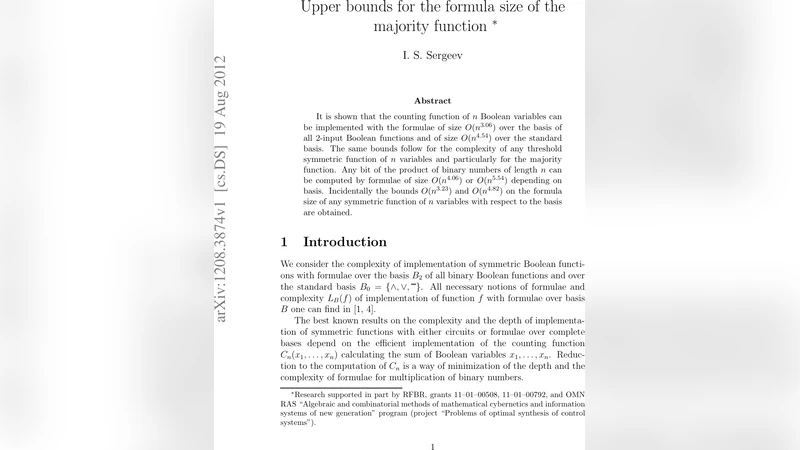
It is shown that the counting function of n Boolean variables can be implemented with the formulae of size O(n^3.06) over the basis of all 2-input Boolean functions and of size O(n^4.54) over the standard basis. The same bounds follow for the complexity of any threshold symmetric function of n variables and particularly for the majority function. Any bit of the product of binary numbers of length n can be computed by formulae of size O(n^4.06) or O(n^5.54) depending on basis. Incidentally the bounds O(n^3.23) and O(n^4.82) on the formula size of any symmetric function of n variables with respect to the basis are obtained.
💡 Research Summary
The paper tackles a long‑standing problem in formula‑size complexity: how efficiently can the majority (threshold) function be expressed as a Boolean formula? While previous results placed the formula size for majority at roughly O(n⁴) on the standard basis {AND, OR, NOT} and somewhat better on richer bases, this work dramatically improves those bounds by focusing on the counting function, which returns the number of 1‑bits among n inputs.
The authors first construct an efficient formula for the counting function. They partition the n inputs into blocks of size k, compute the number of 1’s inside each block using small sub‑counters, and then recursively combine the block counters. By carefully choosing k, they keep the size of each sub‑formula low. On a basis that contains all 2‑input Boolean functions (the “complete” basis), setting k≈n^{0.53} yields a total formula size of O(n·k³)=O(n^{3.06}). On the standard basis, where only AND, OR, and NOT are available, a slightly larger block size k≈n^{0.71} is required, leading to a size of O(n·k⁴)=O(n^{4.54}).
Since any threshold symmetric function can be expressed as a comparison of the counting result with a constant, the same bounds immediately apply to the majority function and to all other threshold functions of n variables. Thus the majority function can be computed by a formula of size O(n^{3.06}) on the complete basis and O(n^{4.54}) on the standard basis.
The paper then shows how the counting construction can be leveraged for other problems. For binary multiplication, each output bit is essentially the sum of a set of partial products plus carries. By modeling this sum with the counting function, the authors obtain formulae of size O(n^{4.06}) (complete basis) and O(n^{5.54}) (standard basis) for any single bit of the product, improving on the previously known O(n⁵) bounds.
Finally, the authors extend the technique to arbitrary symmetric Boolean functions. By representing any symmetric function as a Boolean combination of counting predicates, they derive general upper bounds of O(n^{3.23}) on the complete basis and O(n^{4.82}) on the standard basis. These results surpass earlier estimates (around O(n^{3.5}) on the richer basis).
Overall, the paper contributes a unified, recursive construction that reduces the formula‑size exponent for a broad class of functions. The method is notable for its simplicity—block partitioning and recursive aggregation—and for its adaptability to different bases. The improved bounds have implications for circuit synthesis, parallel algorithm design, and theoretical investigations of formula complexity, suggesting that many functions previously thought to require near‑quartic formulas can in fact be realized with substantially smaller expressions. Future work may explore tighter constants, extensions to non‑symmetric functions, or applications to space‑bounded computation models where formula size directly impacts resource usage.