Local well-posedness of the KdV equation with quasi periodic initial data
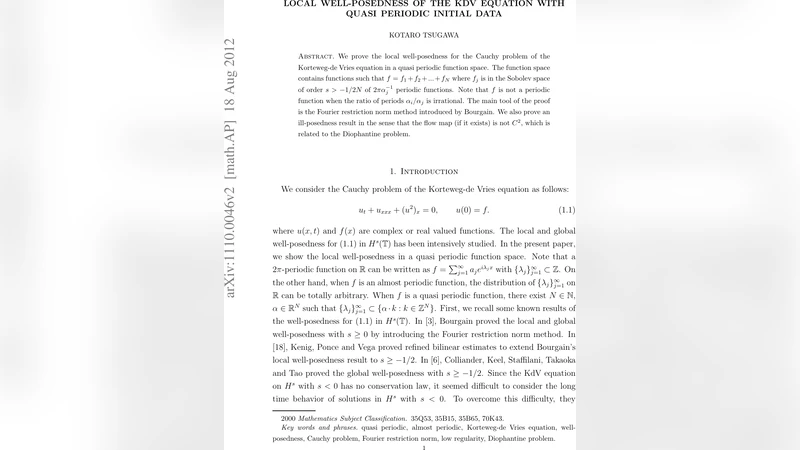
We prove the local well-posedness for the Cauchy problem of the Korteweg-de Vries equation in a quasi periodic function space. The function space contains functions such that f=f_1+f_2+…+f_N where f_j is in the Sobolev space of order s>-1/2N of a_j periodic functions. Note that f is not a periodic function when the ratio of periods a_i/a_j is irrational. The main tool of the proof is the Fourier restriction norm method introduced by Bourgain. We also prove an ill-posedness result in the sense that the flow map (if it exists) is not C^2, which is related to the Diophantine problem.
💡 Research Summary
The paper studies the Cauchy problem for the Korteweg‑de Vries (KdV) equation
u_t + u_{xxx} + (u^2)_x = 0, u(0)=f,
in a function space that accommodates quasi‑periodic initial data rather than purely periodic ones. A quasi‑periodic function is expressed as a finite sum f = f_1 + … + f_N, where each component f_j is 2π α_j‑periodic and belongs to a Sobolev space \dot H^{σ_j}(ℝ/2π α_jℤ). The vector of periods α = (α_1,…,α_N) is assumed to satisfy a non‑resonance condition α·k ≠ 0 for every non‑zero integer vector k∈ℤ^N.
To capture the anisotropic regularity of each component, the author introduces a Banach space G_{σ,a} equipped with the norm
‖f‖{G{σ,a}} = (∑{k≠0} |α·k|^{2a} ∏{j=1}^N⟨k_j⟩^{2σ_j} |b_f(k)|^2)^{1/2},
where b_f(k) are the Fourier coefficients of f with respect to the basis {e^{iα·k x}}. The exponent a is taken to be –½, which heavily penalises frequencies near the origin (α·k≈0) and therefore controls the interaction between very low and very high modes—a difficulty unique to the quasi‑periodic setting.
The main regularity hypothesis (condition (A)) requires the multi‑index σ = (σ_1,…,σ_N) to belong to a certain convex set Λ_s. In concrete terms this means σ_1 ≥ 0 and for each j≥2, the cumulative sum σ_1+…+σ_j exceeds (j‑1)/2. Under this assumption the series defining G_{σ,‑½} converges in the distribution sense, and the space embeds continuously into the space of tempered distributions.
The core result (Theorem 1.1) states that if (A) holds, then the integral formulation
u(t) = e^{-t∂_x^3}f – ∫0^t e^{-(t–t′)∂x^3}∂x(u^2)(t′)dt′
has a unique solution u belonging to the Bourgain‑type space Z{σ,‑½}=X{σ,‑½}^{½}∩Y{σ,‑½}^{0} on a short time interval
Comments & Academic Discussion
Loading comments...
Leave a Comment