Dynamical energy analysis for built-up acoustic systems at high frequencies
Standard methods for describing the intensity distribution of mechanical and acoustic wave fields in the high frequency asymptotic limit are often based on flow transport equations. Common techniques
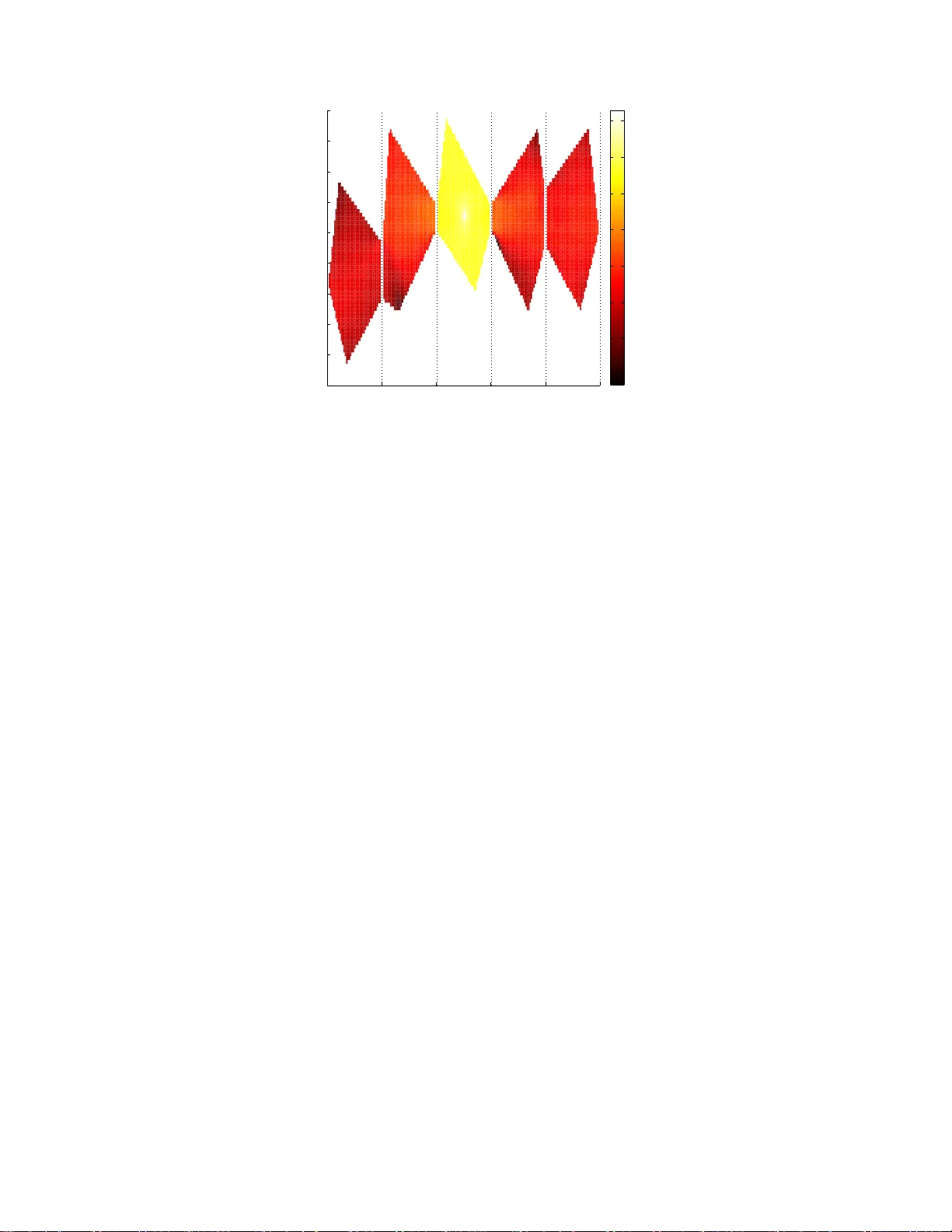
Standard methods for describing the intensity distribution of mechanical and acoustic wave fields in the high frequency asymptotic limit are often based on flow transport equations. Common techniques are statistical energy analysis, employed mostly in the context of vibro-acoustics, and ray tracing, a popular tool in architectural acoustics. Dynamical energy analysis makes it possible to interpolate between standard statistical energy analysis and full ray tracing, containing both of these methods as limiting cases. In this work a version of dynamical energy analysis based on a Chebyshev basis expansion of the Perron-Frobenius operator governing the ray dynamics is introduced. It is shown that the technique can efficiently deal with multi-component systems overcoming typical geometrical limitations present in statistical energy analysis. Results are compared with state-of-the-art hp-adaptive discontinuous Galerkin finite element simulations.
💡 Research Summary
The paper introduces Dynamical Energy Analysis (DEA), a hybrid high‑frequency wave‑energy prediction method that bridges the gap between Statistical Energy Analysis (SEA) and conventional ray tracing. In the high‑frequency limit, mechanical and acoustic fields can be described by transport equations for ray trajectories. SEA treats a complex structure as a set of coupled subsystems and uses averaged transmission coefficients to model energy exchange; it is computationally cheap but loses accuracy when geometry, material heterogeneity, or boundary conditions become complicated. Ray tracing, on the other hand, follows individual rays and captures detailed spatial variations, yet the required sampling of the high‑dimensional phase space becomes prohibitive at very high frequencies.
DEA resolves this trade‑off by focusing on the Perron‑Frobenius operator, which governs the evolution of ray densities in phase space. The authors approximate this linear operator using a Chebyshev polynomial basis. Chebyshev polynomials are optimal in the minimax sense on the interval (
📜 Original Paper Content
🚀 Synchronizing high-quality layout from 1TB storage...