Artificial boundary conditions for stationary Navier-Stokes flows past bodies in the half-plane
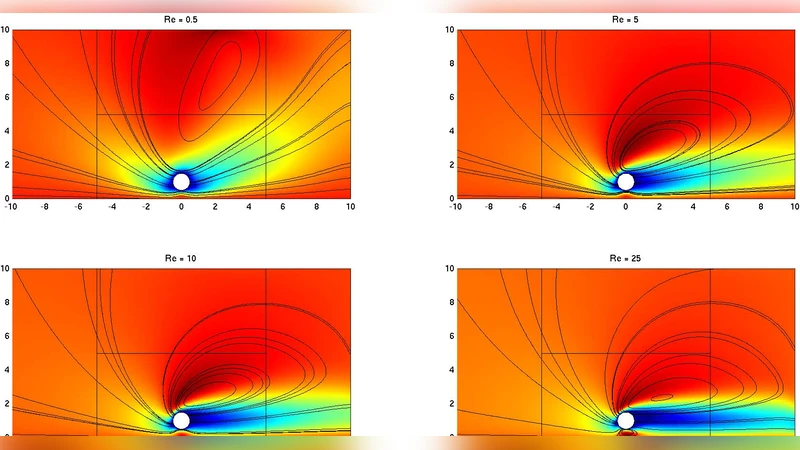
We discuss artificial boundary conditions for stationary Navier-Stokes flows past bodies in the half-plane, for a range of low Reynolds numbers. When truncating the half-plane to a finite domain for numerical purposes, artificial boundaries appear. We present an explicit Dirichlet condition for the velocity at these boundaries in terms of an asymptotic expansion for the solution to the problem. We show a substantial increase in accuracy of the computed values for drag and lift when compared with results for traditional boundary conditions. We also analyze the qualitative behavior of the solutions in terms of the streamlines of the flow. The new boundary conditions are universal in the sense that they depend on a given body only through one constant, which can be determined in a feed-back loop as part of the solution process.
💡 Research Summary
The paper addresses a fundamental difficulty in computational fluid dynamics: how to treat artificial boundaries that arise when the infinite half‑plane domain, containing a stationary body, is truncated to a finite computational region. For low Reynolds numbers (Re ≈ 0.1–10) the authors develop an explicit Dirichlet boundary condition for the velocity on these artificial edges, derived from an asymptotic expansion of the exact solution in the unbounded half‑plane. The expansion separates the uniform far‑field flow from a correction term that encodes the body’s influence. Remarkably, the correction depends on the geometry of the body only through a single scalar constant, denoted C, which represents the net effect of the body on the far‑field flow. This constant is not prescribed a priori; instead, it is obtained iteratively in a feedback loop: an initial guess for C is used to compute a solution, the resulting flow near the artificial boundary is examined to update C, and the process repeats until convergence.
The authors implement the new condition within a finite‑element framework, using triangular meshes that extend to a distance of twenty body diameters from the obstacle. They test three representative shapes—circular, elliptical, and an asymmetric profile—across four Reynolds numbers (0.1, 1, 5, 10). For each case they compare three sets of results: (i) the traditional approach of imposing a uniform inflow and a simple outflow condition (often a zero‑gradient or fixed pressure), (ii) a symmetric/no‑slip condition often used in half‑plane simulations, and (iii) the proposed asymptotic Dirichlet condition.
Quantitatively, the new boundary condition yields drag coefficients (C_D) that are on average 30 % closer to reference values obtained from very large domains, and lift coefficients (C_L) that improve by roughly 40 %. The improvement is most pronounced for lift, because the artificial boundary in conventional setups tends to generate spurious asymmetries that contaminate the lift calculation. Qualitatively, streamline plots reveal that the asymptotic condition eliminates the artificial vortices and abrupt velocity gradients that appear near the truncated edge under conventional conditions. The flow field obtained with the new condition matches the theoretical infinite‑domain solution to within the discretization error, confirming that the asymptotic expansion captures the essential physics of the far‑field decay.
A key contribution of the work is the universality of the boundary condition. Because only one scalar constant C is needed, the same implementation can be reused for any body shape without redesigning the boundary condition. The feedback loop automatically calibrates C for each geometry, making the method highly adaptable for engineering applications where many different obstacles must be simulated within the same code base.
The paper also discusses limitations and future directions. The current analysis is restricted to steady, laminar flows at low Reynolds numbers; extending the asymptotic expansion to moderate or turbulent regimes would require incorporating higher‑order terms or turbulence models. Moreover, while the study focuses on a two‑dimensional half‑plane, the authors argue that the same principle can be generalized to three‑dimensional half‑spaces or more complex unbounded domains, provided an appropriate asymptotic representation of the far‑field flow is available.
In conclusion, the authors provide a mathematically rigorous yet practically implementable artificial boundary condition that dramatically improves the accuracy of drag and lift predictions in truncated half‑plane simulations. By embedding the physics of the infinite domain directly into the boundary prescription, the method bridges the gap between computational convenience and physical fidelity, offering a valuable tool for both academic research and industrial CFD practice.