The Degasperis-Procesi equation on the half-line
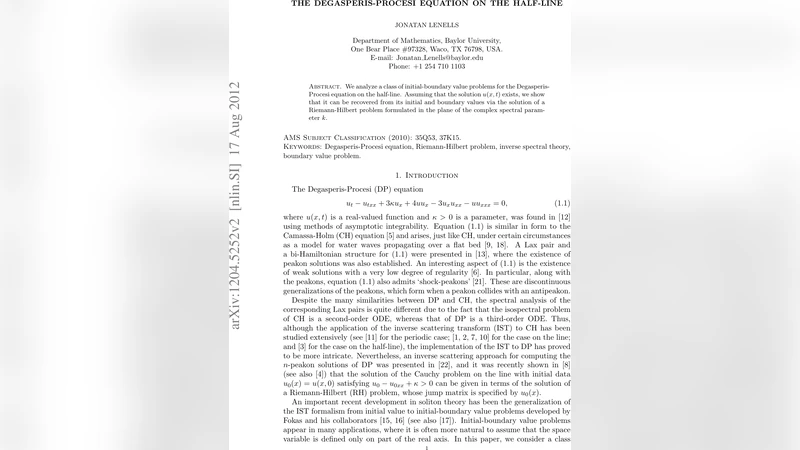
We analyze a class of initial-boundary value problems for the Degasperis-Procesi equation on the half-line. Assuming that the solution $u(x,t)$ exists, we show that it can be recovered from its initial and boundary values via the solution of a Riemann-Hilbert problem formulated in the plane of the complex spectral parameter $k$.
💡 Research Summary
The paper addresses the initial‑boundary value problem (IBVP) for the Degasperis‑Procesi (DP) equation on the half‑line (x>0). The DP equation, a third‑order nonlinear wave equation known for its peakon solutions, is integrable and possesses a Lax pair consisting of two (3\times3) matrix operators. By exploiting this Lax pair, the authors formulate a spectral problem in the complex plane of the spectral parameter (k).
The analysis proceeds within the framework of the unified transform method (also called the Fokas method). First, the authors introduce eigenfunctions (\Phi(x,t,k)) that solve the Lax pair and are normalized at the initial line (t=0) and at the boundary (x=0). From these eigenfunctions they define spectral functions (a(k), b(k)) (associated with the initial data) and (A(k), B(k)) (associated with the boundary data). The crucial step is the derivation of the global relation, an algebraic identity that links the initial‑ and boundary‑spectral data. This relation eliminates redundant information and shows that the solution is completely determined by the initial profile (u(x,0)) and the three boundary values (u(0,t), u_x(0,t), u_{xx}(0,t)).
Next, the complex (k)‑plane is partitioned into six sectors according to the analyticity properties of the eigenfunctions. In each sector the eigenfunctions are analytic and bounded, while across the sector boundaries they satisfy jump conditions encoded in a matrix (J(k)). The jump matrix is explicitly expressed in terms of the spectral functions and the global relation, ensuring that all dependence on the original physical data is captured.
The central contribution is the formulation of a Riemann–Hilbert (RH) problem for a matrix‑valued function (M(x,t,k)). The RH problem consists of: (i) analyticity of (M) in each sector; (ii) prescribed jumps across the sector boundaries given by (J(k)); (iii) normalization (M\to I) as (k\to\infty); and (iv) appropriate behavior near the possible singularity at (k=0). Standard theory guarantees that, under suitable smoothness assumptions on the data (e.g., initial data in a Sobolev space (H^s) with (s\ge3) and compatible boundary data), this RH problem has a unique solution.
Having solved the RH problem, the original solution (u(x,t)) is recovered from the large‑(k) expansion of (M). In particular, the coefficient of (k^{-1}) in the ((1,3)) entry of (M) yields (u(x,t)) directly, mirroring the reconstruction formula in the classical inverse scattering transform. This provides an explicit, algorithmic procedure: given the initial and boundary data, compute the spectral functions, set up the jump matrix, solve the RH problem, and finally extract (u).
The paper also discusses the assumptions required for the method to be valid. The existence of a sufficiently smooth solution is taken as a hypothesis; under this hypothesis the spectral analysis and RH formulation are rigorous. The authors note that if the data contain singularities or insufficient regularity, the analyticity domains of the eigenfunctions may shrink, and the RH problem would need to be modified accordingly.
In the concluding section, the authors emphasize the broader significance of their work. By extending the inverse scattering framework to a half‑line geometry, they provide a template that can be adapted to other integrable third‑order equations such as the Camassa‑Holm and Novikov equations. They also outline future directions, including the development of numerical algorithms for solving the RH problem, the study of long‑time asymptotics via nonlinear steepest‑descent techniques, and the investigation of stability and blow‑up phenomena within the half‑line setting. Overall, the paper delivers a comprehensive and rigorous pathway from initial‑boundary data to the explicit solution of the DP equation on the half‑line.