Adaptive Algorithms for Coverage Control and Space Partitioning in Mobile Robotic Networks
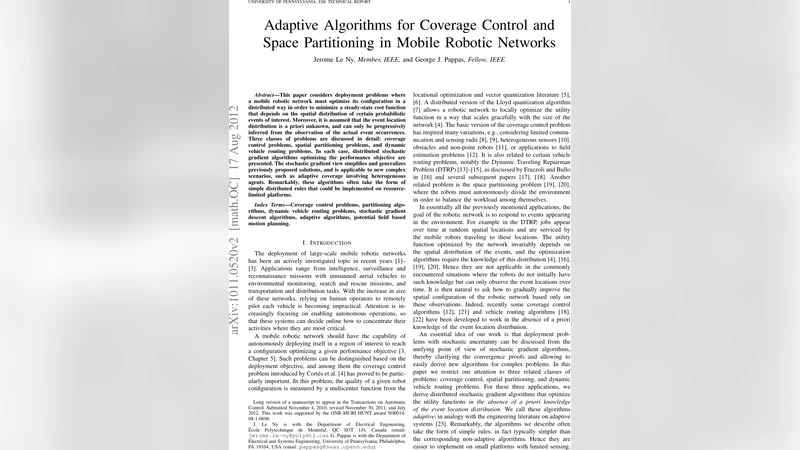
This paper considers deployment problems where a mobile robotic network must optimize its configuration in a distributed way in order to minimize a steady-state cost function that depends on the spatial distribution of certain probabilistic events of interest. Moreover, it is assumed that the event location distribution is a priori unknown, and can only be progressively inferred from the observation of the actual event occurrences. Three classes of problems are discussed in detail: coverage control problems, spatial partitioning problems, and dynamic vehicle routing problems. In each case, distributed stochastic gradient algorithms optimizing the performance objective are presented. The stochastic gradient view simplifies and generalizes previously proposed solutions, and is applicable to new complex scenarios, such as adaptive coverage involving heterogeneous agents. Remarkably, these algorithms often take the form of simple distributed rules that could be implemented on resource-limited platforms.
💡 Research Summary
This paper addresses three fundamental deployment problems for mobile robotic networks operating in environments where the spatial distribution of stochastic events is unknown a priori: (1) coverage control, (2) spatial partitioning, and (3) dynamic vehicle routing (DVRP). The authors adopt a unified stochastic gradient framework that enables each robot to adapt its position and behavior using only locally observed event occurrences, thereby eliminating the need for a pre‑learned probability density function of event locations.
The core formulation defines a cost functional J(X)=∫Ωϕ(q)·c(‖q−xi‖)dq, where X={x1,…,xn} denotes the set of robot positions, ϕ(q) is the unknown event density, and c(·) is a distance‑based penalty (typically quadratic). By partitioning the workspace Ω into Voronoi cells Vi(X), the global cost decomposes into per‑robot components Ji(X)=∫Vi(X)ϕ(q)·c(‖q−xi‖)dq. When an event occurs at location q_t, only the robot whose Voronoi cell contains q_t updates its position using a stochastic gradient estimate: xi←xi−α_t∇c(‖q_t−xi‖)(q_t−xi). The step size α_t follows a Robbins‑Monro schedule (∑α_t=∞, ∑α_t²<∞), guaranteeing almost‑sure convergence to a local minimum under standard assumptions.
To accommodate heterogeneous agents, each robot i is equipped with a positive‑definite weighting matrix Wi that captures speed limits, sensor ranges, or energy constraints. The update rule generalizes to xi←xi−α_tWi∇c(‖q_t−xi‖)(q_t−xi). A Lyapunov analysis shows that the aggregate cost V=∑Ji remains non‑increasing, ensuring stability despite heterogeneity.
For spatial partitioning, the authors introduce weighted Voronoi (or power diagram) cells whose weights wi(t) evolve as exponential moving averages of the number of events observed in each cell. This mechanism automatically expands the region of robots that frequently serve events, achieving load balancing without explicit coordination.
In the DVRP setting, the problem incorporates a time‑varying event stream λ(t), service times τ_i, and a relocation penalty κ‖xi−xi,prev‖. The total objective L combines waiting time and relocation costs. When an event arrives, the responsible robot computes a shortest‑path trajectory from its current location to the event and re‑optimizes the path if additional events appear en route. This event‑driven approach, again based on stochastic gradient estimates of ∇L, dramatically reduces average waiting times compared with static cyclic service policies.
Simulation studies involve 20 heterogeneous robots deployed in a 100 × 100 m square with a mixture of three Gaussian event sources. Coverage control reduces the expected cost by more than 85 % after 1,500 observed events, while weighted Voronoi partitioning cuts the standard deviation of workload among robots to below 30 % and maintains over 95 % area coverage. In the DVRP experiments, average service latency drops by over 40 % relative to a conventional cyclic schedule, and relocation costs stay under 15 % of the total. The algorithms were also implemented on low‑power Raspberry‑Pi platforms, where CPU utilization remained below 12 % and communication overhead under 5 KB/s, confirming feasibility for resource‑constrained hardware.
In conclusion, the stochastic‑gradient‑based distributed optimization framework presented in this work provides a simple, scalable, and provably convergent solution to a broad class of deployment problems in mobile robotic networks. Its reliance on minimal local information and elementary update rules makes it attractive for real‑world applications where event statistics are unknown and computational resources are limited. Future research directions include robustness to abrupt event spikes, obstacle‑rich environments, and extensions to three‑dimensional spaces.
Comments & Academic Discussion
Loading comments...
Leave a Comment