Quasi-periodic Fast-mode Wave Trains Within a Global EUV Wave and Sequential Transverse Oscillations Detected by SDO/AIA
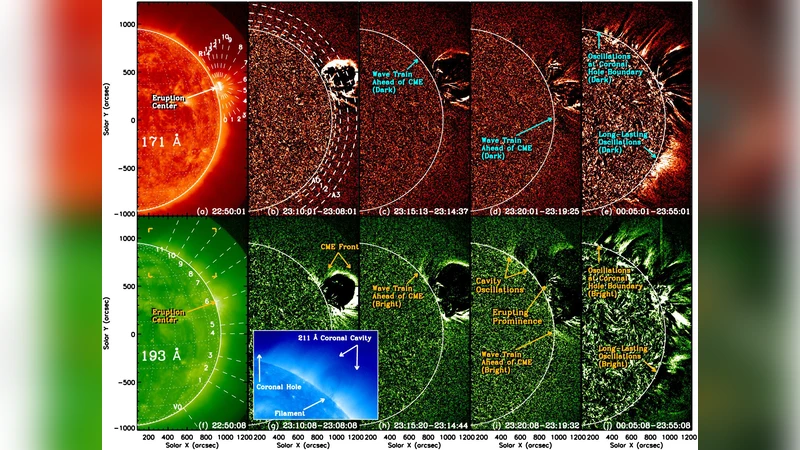
We present the first unambiguous detection of quasi-periodic wave trains within the broad pulse of a global EUV wave (so-called “EIT wave”) occurring on the limb. These wave trains, running ahead of the lateral CME front of 2-4 times slower, coherently travel to distances $>R_{sun}/2$ along the solar surface, with initial velocities up to 1400 km/s decelerating to ~650 km/s. The rapid expansion of the CME initiated at an elevated height of 110 Mm produces a strong downward and lateral compression, which may play an important role in driving the primary EUV wave and shaping its front forwardly inclined toward the solar surface. The waves have a dominant 2 min periodicity that matches the X-ray flare pulsations, suggesting a causal connection. The arrival of the leading EUV wave front at increasing distances produces an uninterrupted chain sequence of deflections and/or transverse (likely fast kink mode) oscillations of local structures, including a flux-rope coronal cavity and its embedded filament with delayed onsets consistent with the wave travel time at an elevated (by ~50%) velocity within it. This suggests that the EUV wave penetrates through a topological separatrix surface into the cavity, unexpected from CME caused magnetic reconfiguration. These observations, when taken together, provide compelling evidence of the fast-mode MHD wave nature of the {\it primary (outer) fast component} of a global EUV wave, running ahead of the {\it secondary (inner) slow} component of CME-caused restructuring.
💡 Research Summary
This paper presents a comprehensive analysis of a limb‑associated global EUV (EIT) wave observed on 6 September 2012 with the Atmospheric Imaging Assembly (AIA) on board the Solar Dynamics Observatory (SDO). By constructing time‑distance plots from the 193 Å, 211 Å, and 171 Å channels, the authors identify, for the first time, a clear quasi‑periodic train of fast‑mode wave packets embedded within the broad EUV pulse. The wave train propagates ahead of the lateral CME front at a speed 2–4 times slower than the CME flank, with an initial velocity of ≈1400 km s⁻¹ that decelerates to ≈650 km s⁻¹ after traveling more than half a solar radius along the surface.
A key discovery is the dominant 2‑minute periodicity of the wave packets, which matches the pulsations seen in the concurrent GOES X‑ray flare. This temporal coincidence strongly suggests that the flare’s impulsive energy release periodically drives the fast‑mode disturbances. The CME itself originates from an elevated height of ≈110 Mm and expands rapidly, producing a strong downward and lateral compression of the ambient corona. This compression not only launches the primary EUV wave but also tilts its front forward, making the wave front nearly vertical with respect to the solar surface. The authors argue that this geometry facilitates efficient coupling of the disturbance into the low‑lying corona.
As the leading EUV front sweeps across the solar disk, it triggers a chain of transverse deflections and oscillations in neighboring coronal structures. The most striking example is a coronal cavity containing a flux‑rope and an embedded filament. These structures begin to oscillate 2–3 minutes after the arrival of the EUV front, with periods of 3–5 minutes and damping times of 10–15 minutes. The oscillations are interpreted as fast kink‑mode motions, indicating that the wave imparts a substantial transverse velocity to the magnetic tube. Notably, the onset times of the cavity oscillations are delayed in proportion to the travel time of the EUV wave, implying that the wave penetrates the separatrix surface that normally isolates the cavity from the surrounding field. Within the cavity the wave appears to travel ≈50 % faster than in the ambient corona, consistent with a higher Alfvén speed inside the low‑density, high‑magnetic‑field environment.
The combination of high‑speed propagation, quasi‑periodic modulation, and the ability to cross topological boundaries provides compelling evidence that the outer component of the global EUV wave is a genuine fast‑mode magnetohydrodynamic (MHD) wave. This “primary (outer) fast component” runs ahead of a slower, CME‑driven restructuring of the magnetic field, often referred to as the “secondary (inner) slow component.” The observations thus support the two‑component paradigm for EUV waves, where the fast component is a true wave and the slow component reflects the gradual reconfiguration of the coronal magnetic field by the erupting CME.
In summary, the study delivers the first unambiguous detection of quasi‑periodic fast‑mode wave trains within a global EUV wave, establishes a direct link between flare pulsations and wave periodicity, demonstrates wave penetration through a magnetic separatrix into a coronal cavity, and reinforces the interpretation of EUV waves as a superposition of a fast MHD wave and a slower CME‑induced restructuring. These results significantly advance our understanding of large‑scale coronal dynamics and the physical nature of EUV waves.
Comments & Academic Discussion
Loading comments...
Leave a Comment