Multiplicative Updates in Coordination Games and the Theory of Evolution
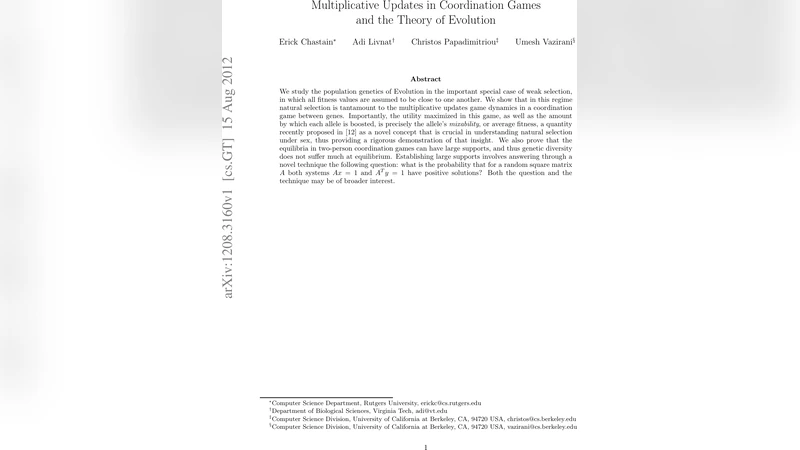
We study the population genetics of Evolution in the important special case of weak selection, in which all fitness values are assumed to be close to one another. We show that in this regime natural selection is tantamount to the multiplicative updates game dynamics in a coordination game between genes. Importantly, the utility maximized in this game, as well as the amount by which each allele is boosted, is precisely the allele’s mixability, or average fitness, a quantity recently proposed in [1] as a novel concept that is crucial in understanding natural selection under sex, thus providing a rigorous demonstration of that insight. We also prove that the equilibria in two-person coordination games can have large supports, and thus genetic diversity does not suffer much at equilibrium. Establishing large supports involves answering through a novel technique the following question: what is the probability that for a random square matrix A both systems Ax = 1 and A^T y = 1 have positive solutions? Both the question and the technique may be of broader interest. [1] A. Livnat, C. Papadimitriou, J. Dushoff, and M.W. Feldman. A mixability theory for the role of sex in evolution. Proceedings of the National Academy of Sciences, 105(50):19803-19808, 2008.
💡 Research Summary
The paper investigates evolutionary dynamics under the regime of weak selection, where all fitness values are close to one another and differences are only of order ε. In this setting the classic replication‑selection equations can be linearized, yielding a multiplicative update rule for allele frequencies. The authors reinterpret this rule as the dynamics of a two‑player coordination game: each gene (or locus) acts as a player, its strategies are the possible alleles, and the payoff each allele receives is its “mixability,” defined as the average fitness of all genotypes containing that allele. Consequently, natural selection in the weak‑selection limit is mathematically identical to a multiplicative‑weights update process that maximizes the sum of mixabilities. This provides a rigorous justification for the mixability concept introduced by Livnat et al. (2008) as the key quantity governing the advantage of sexual reproduction.
Beyond the conceptual mapping, the authors study the structure of Nash equilibria in two‑person coordination games. While pure‑strategy equilibria are trivial, the biologically relevant mixed‑strategy equilibria correspond to polymorphic populations where many alleles coexist. To assess how large the support of such equilibria can be, the paper poses a novel probabilistic question: for a random square matrix A with independent entries drawn from a continuous distribution, what is the probability that both linear systems Ax = 1 and Aᵀy = 1 admit strictly positive solutions? Using a new technique based on volume arguments and properties of random polytopes, they show that this probability remains bounded away from zero even as the dimension grows. Hence, with non‑negligible probability, a coordination game possesses mixed equilibria whose support includes a linear number of strategies.
The biological implication is that, even under weak selection, genetic diversity need not collapse to a single dominant allele; instead, a substantial fraction of alleles can be maintained at equilibrium. This challenges the intuition that weak selection inevitably leads to loss of polymorphism and supports the view that mixability, rather than raw fitness, drives the maintenance of variation.
Technically, the paper makes two main contributions. First, it bridges population genetics and algorithmic game theory by showing that weak‑selection dynamics are exactly multiplicative‑weights updates in a coordination game with mixability as the utility function. Second, it introduces a probabilistic analysis of random linear systems that yields lower bounds on the size of supports in mixed Nash equilibria of coordination games. Both contributions have broader relevance: the first provides a new analytical tool for evolutionary biologists studying sex and recombination, while the second offers a method that could be applied to the study of equilibria in other game‑theoretic models and to the analysis of random linear programming feasibility.
In summary, the work demonstrates that under weak selection natural selection behaves like a multiplicative‑updates process in a coordination game, that the payoff being maximized is precisely the allele’s mixability, and that mixed equilibria with large supports are not pathological but occur with appreciable probability. This unifies concepts from evolutionary theory, game theory, and random matrix analysis, and suggests that genetic diversity can be robustly maintained even when selective differences are minute.
Comments & Academic Discussion
Loading comments...
Leave a Comment