Atmospheric muons: experimental aspects
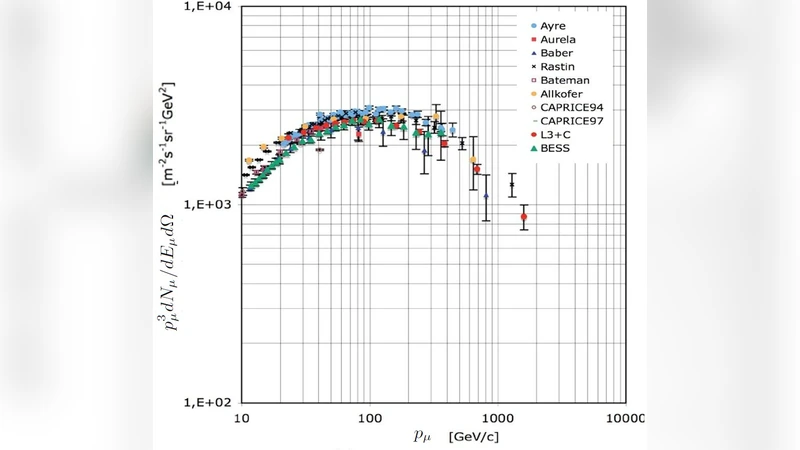
We present a review of atmospheric muon flux and energy spectrum measurements over almost six decades of muon momentum. Sea-level and underground/water/ice experiments are considered. Possible sources of systematic errors in the measurements are examinated. The characteristics of underground/water muons (muons in bundle, lateral distribution, energy spectrum) are discussed. The connection between the atmospheric muon and neutrino measurements are also reported.
💡 Research Summary
The paper provides a comprehensive review of experimental measurements of atmospheric muons, covering roughly six decades of data that span a wide range of muon momenta from a few hundred MeV/c up to several TeV/c. It begins by outlining the historical development of muon detection techniques, from early cloud‑chamber and magnetic spectrometer experiments at sea level to modern large‑scale surface detectors such as AMS‑02 and MINOS. The authors emphasize that sea‑level measurements are crucial for establishing the low‑energy part of the muon spectrum, while deep underground, underwater, and ice‑based detectors (e.g., MACRO, SNO, IceCube) extend the observable range to high energies by imposing a minimum energy threshold through overburden.
A central theme of the review is the identification and quantitative assessment of systematic uncertainties that affect muon flux and spectrum determinations. Four principal sources are discussed: (1) atmospheric conditions (pressure, temperature, seasonal variations) that modulate the production rate of muons in the upper atmosphere; (2) detector‑related uncertainties, including calibration of photomultiplier tubes, optical properties of the surrounding medium (water or ice), and the efficiency of trigger and reconstruction algorithms; (3) theoretical uncertainties in the modeling of cosmic‑ray interactions, hadronic production cross‑sections, and cascade development, which are typically addressed using simulation packages such as CORSIKA, FLUKA, or MCEq; and (4) analysis‑method biases arising from energy unfolding procedures, background subtraction, and the treatment of multiple scattering. The authors provide comparative tables that show how different experiments correct for these effects and how residual discrepancies can be traced back to specific assumptions.
The review then shifts focus to the characteristics of muons observed deep underground or underwater. Two phenomena receive particular attention: muon bundles and lateral (transverse) distribution. Muon bundles arise when a high‑energy cosmic‑ray primary initiates a hadronic shower that produces several pions which subsequently decay into muons that arrive at the detector within a narrow time window. Experimental data from IceCube, ANTARES, and the former MACRO experiment reveal that bundle multiplicities (typically 2–10 muons) and inter‑muon separations depend strongly on the primary energy and zenith angle. These bundle statistics are valuable for constraining models of ultra‑high‑energy cosmic‑ray composition and for estimating the atmospheric neutrino background in neutrino telescopes. The lateral distribution of muons, measured as the spread of muon tracks around the shower core, provides insight into multiple scattering and energy loss processes as muons propagate through rock, water, or ice. The authors compare measured distributions with GEANT4‑based Monte Carlo simulations, highlighting the sensitivity of the shape to the optical scattering length and absorption coefficient of the medium.
Finally, the paper discusses the intimate link between atmospheric muon measurements and atmospheric neutrino studies. Since muons and neutrinos are produced together in the decay of charged pions and kaons, a precise knowledge of the muon flux directly informs predictions of the atmospheric neutrino flux, which is a dominant background for neutrino oscillation and astrophysical neutrino searches. The authors argue that underground muon data, especially bundle information, can be used to reduce uncertainties in the neutrino flux by up to 10 % in the energy range most relevant for current neutrino telescopes. They also propose a coordinated global effort to standardize atmospheric corrections, incorporate the latest LHC hadronic interaction data into cascade models, and develop real‑time muon monitoring networks that would feed directly into neutrino analysis pipelines.
In summary, the review synthesizes a vast body of experimental work on atmospheric muons, critically evaluates systematic error sources, elucidates the physics of muon bundles and lateral distributions, and demonstrates how these measurements underpin and improve atmospheric neutrino research. The paper concludes with recommendations for future work, including the integration of next‑generation detector technologies, refined atmospheric modeling, and collaborative data sharing across the cosmic‑ray, muon, and neutrino communities.