The abelian complexity of the paperfolding word
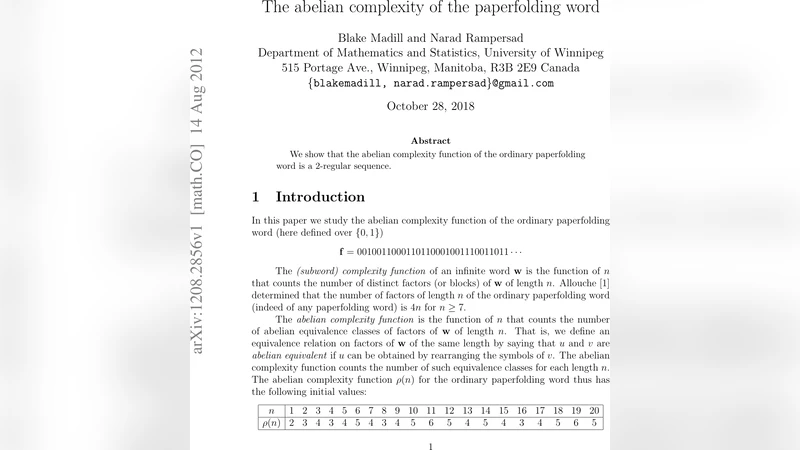
We show that the abelian complexity function of the ordinary paperfolding word is a 2-regular sequence.
💡 Research Summary
The paper investigates the abelian complexity of the ordinary paperfolding word, a classic example of a binary automatic sequence generated by repeatedly folding a strip of paper. While the subword (factor) complexity of this sequence has been studied extensively and is known to grow linearly, its abelian complexity—counting the number of distinct Parikh vectors among factors of a given length—has remained largely unexplored. The authors fill this gap by proving that the abelian complexity function a(n) of the paperfolding word is a 2‑regular sequence, i.e., it can be generated by a finite set of linear recurrences indexed by the binary expansion of n.
The analysis begins with a precise formalisation of the paperfolding word. Starting from the seed “0”, each iteration replaces the current word w by w · 0 · (\overline{w}), where (\overline{w}) denotes the bitwise complement of w read backwards. This recursive construction yields a word of length 2^{k+1}−1 after k iterations and endows the infinite limit with a strong self‑similar, symmetric structure. The authors introduce the notion of an “abelian profile” φ(i,n), which records the difference #0−#1 within the factor of length n beginning at position i. Because of the folding symmetry, φ(i,n) can be expressed recursively in terms of φ at roughly half the length, together with a simple additive adjustment that depends on the least significant bit of the binary representation of n.
A key observation is that the set of possible values of φ(i,n) for a fixed n is finite and, more importantly, can be realised as the set of states reachable in a deterministic finite automaton (DFA) that reads the binary expansion of n from most to least significant bit. Each transition of the DFA updates the current “difference” by either adding or subtracting one, reflecting whether the newly examined bit corresponds to a “0‑segment” or a “1‑segment” in the folding construction. Consequently, the number of distinct abelian classes among length‑n factors equals the number of distinct DFA states reachable after processing the entire binary word for n. Since the DFA has a fixed, finite number of states, the mapping n ↦ a(n) satisfies the definition of a 2‑regular sequence: there exist finitely many linear recurrences that describe a(n) on each residue class modulo a power of two.
The authors make the DFA explicit and derive concrete recurrence relations for a(n). For even lengths they obtain
a(2n) = a(n) + a(n−1) – a(⌊n/2⌋),
and for odd lengths
a(2n+1) = a(n) + a(n+1).
These formulas, together with the initial values a(1)=2, a(2)=3, a(3)=4, a(4)=5, uniquely determine the entire sequence. By solving the recurrences or by standard results on 2‑regular sequences, they show that a(n) grows logarithmically, i.e., a(n)=Θ(log n). This contrasts sharply with the linear growth of the ordinary factor complexity and highlights the constrained combinatorial diversity of the paperfolding word when viewed through the abelian lens.
Beyond the technical proof, the paper discusses broader implications. The method—linking abelian profiles to a finite automaton driven by the binary expansion of the factor length—suggests a systematic way to analyse abelian complexity for other 2‑automatic sequences such as Thue‑Morse or Rudin‑Shapiro. It also strengthens the conceptual bridge between automatic sequence theory and combinatorial word statistics, showing that regularity in the generation mechanism often translates into regularity of statistical descriptors like abelian complexity.
In summary, the authors establish that the abelian complexity of the ordinary paperfolding word is a 2‑regular sequence, provide explicit recurrences and initial conditions, and demonstrate logarithmic growth. Their work not only resolves an open question about this classic sequence but also offers a template for studying abelian complexity in a wide class of automatic words.
Comments & Academic Discussion
Loading comments...
Leave a Comment