Entry times in automata with simple defect dynamics
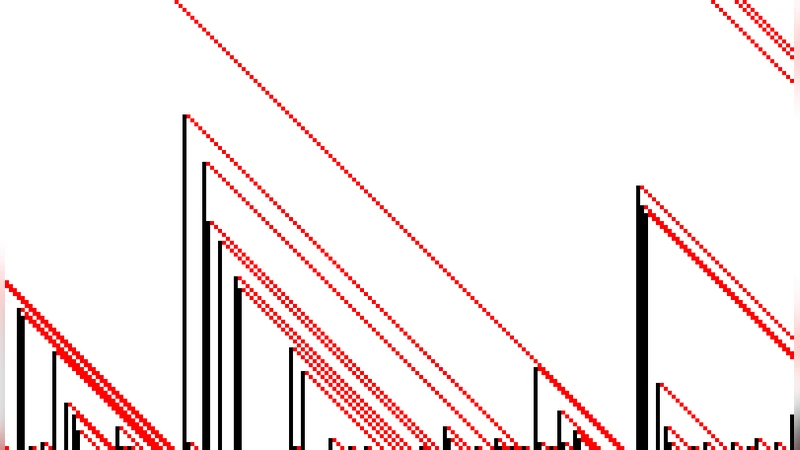
In this paper, we consider a simple cellular automaton with two particles of different speeds that annihilate on contact. Following a previous work by K\r urka et al., we study the asymptotic distribution, starting from a random configuration, of the waiting time before a particle crosses the central column after time n. Drawing a parallel between the behaviour of this automata on a random initial configuration and a certain random walk, we approximate this walk using a Brownian motion, and we obtain explicit results for a wide class of initial measures and other automata with similar dynamics.
💡 Research Summary
The paper investigates a simple one‑dimensional cellular automaton (CA) that contains two types of particles, A and B, moving with constant but different velocities (v_A > 0 and v_B < 0). When an A‑particle meets a B‑particle they annihilate instantly. The initial configuration is random: each lattice site independently receives state 0 (empty), A, or B according to a probability measure μ on ℤ. The authors introduce the notion of an “entry time” T_n, defined as the waiting time after a fixed observation time n until the first particle crosses the central column (site 0). This quantity captures the first‑passage dynamics of defects in the CA and is of interest both for theoretical understanding and potential applications such as signal propagation in discrete media.
The core of the analysis is a mapping from the CA dynamics to a one‑dimensional random walk S_k. By encoding the local state as +1 for A, –1 for B, and 0 for empty, the cumulative effect of particle motion and annihilation over time can be expressed as a sum of independent increments. Consequently, the event {T_n ≤ n + m} is equivalent to the event that the random walk S_k exceeds a certain threshold within the first m steps. This reduction allows the authors to apply classical probabilistic limit theorems.
Under fairly mild assumptions on μ (ergodicity and sufficient mixing), the increments of S_k have a well‑defined mean μ₁ and variance σ², which are functions of the initial densities p_A and p_B (for a Bernoulli product measure μ, μ₁ = p_A − p_B and σ² = p_A + p_B − (p_A − p_B)²). By Donsker’s invariance principle, the rescaled walk (S_{⌊nt⌋} − μ₁ nt)/(σ√n) converges in distribution to a standard Brownian motion B(t). In this scaling, the entry time T_n, after centering by n and normalising by √n, converges to the first‑passage time τ_a of B(t) above the level a = μ₁/σ. The distribution of τ_a is known explicitly: its density is
f_{τ_a}(t) = (a/√{2π t³}) exp(−a²/(2t)), t > 0.
Thus the paper provides an exact asymptotic law for the entry time, valid for a broad class of initial measures, not only the i.i.d. Bernoulli case. The authors verify the theoretical predictions with extensive Monte‑Carlo simulations, showing rapid convergence even for moderate n (e.g., n ≈ 10⁴).
Beyond the primary model, the authors demonstrate that the same methodology applies to other CAs exhibiting similar defect dynamics, such as variants of Rule 184 (traffic‑flow model) and Rule 110 (known for universal computation). In each case, the key ingredients are a conserved “particle number” and an annihilation rule that can be encoded as a signed increment. Consequently, the entry‑time statistics for these automata also converge to the same Brownian‑first‑passage distribution, with the parameter a determined by the specific particle densities and velocities.
The paper concludes with several avenues for future work. One direction is to extend the analysis to multi‑species particle systems, where interactions may be more complex (e.g., fusion or creation). Another is to consider higher‑dimensional lattices, where the geometry of defect propagation could lead to different scaling limits (potentially fractional Brownian motion). A third promising line is to study initial measures with long‑range correlations (e.g., Markov chains or Gibbs states) and to determine whether the Brownian approximation remains valid or requires correction terms. Finally, the authors suggest that entry‑time statistics could be exploited for designing robust information‑transfer protocols in discrete media, where the predictable first‑passage distribution offers a natural timing reference.
Overall, the work bridges cellular‑automaton defect dynamics with classical stochastic process theory, providing a clear probabilistic framework for understanding first‑passage phenomena in a wide family of discrete dynamical systems.
Comments & Academic Discussion
Loading comments...
Leave a Comment