How Many Vote Operations Are Needed to Manipulate A Voting System?
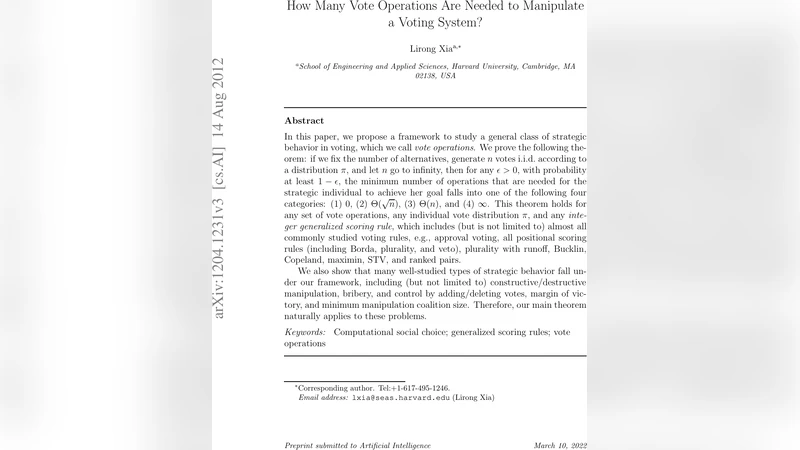
In this paper, we propose a framework to study a general class of strategic behavior in voting, which we call vote operations. We prove the following theorem: if we fix the number of alternatives, generate $n$ votes i.i.d. according to a distribution $\pi$, and let $n$ go to infinity, then for any $\epsilon >0$, with probability at least $1-\epsilon$, the minimum number of operations that are needed for the strategic individual to achieve her goal falls into one of the following four categories: (1) 0, (2) $\Theta(\sqrt n)$, (3) $\Theta(n)$, and (4) $\infty$. This theorem holds for any set of vote operations, any individual vote distribution $\pi$, and any integer generalized scoring rule, which includes (but is not limited to) almost all commonly studied voting rules, e.g., approval voting, all positional scoring rules (including Borda, plurality, and veto), plurality with runoff, Bucklin, Copeland, maximin, STV, and ranked pairs. We also show that many well-studied types of strategic behavior fall under our framework, including (but not limited to) constructive/destructive manipulation, bribery, and control by adding/deleting votes, margin of victory, and minimum manipulation coalition size. Therefore, our main theorem naturally applies to these problems.
💡 Research Summary
The paper introduces a unifying framework called “vote operations” to capture a broad class of strategic behaviors in elections, ranging from classic manipulation and bribery to control by adding or deleting votes, margin of victory calculations, and coalition size estimation. The authors focus on integer generalized scoring rules (IGSR), a family that includes virtually all commonly studied voting rules such as approval, all positional scoring rules (plurality, Borda, veto), plurality‑with‑runoff, Bucklin, Copeland, maximin, STV, and ranked pairs.
The central theorem states that, when the number of alternatives m is fixed and n votes are drawn i.i.d. from an arbitrary distribution π, the minimum number of vote‑operation actions required for a single strategic agent to achieve a given goal falls, with probability at least 1 − ε for any ε > 0, into exactly one of four asymptotic regimes as n → ∞:
- Zero operations – the goal is already satisfied.
- Θ(√n) operations – a sub‑linear amount, proportional to the standard deviation of the underlying score distribution, suffices.
- Θ(n) operations – a linear amount, essentially requiring a wholesale reshaping of the election outcome.
- Infinity – the goal is structurally impossible under the given rule and vote distribution.
The proof proceeds in two main steps. First, the authors invoke a multivariate central limit theorem to show that the vector of scores produced by an IGSR converges to a multivariate normal distribution whose covariance depends only on π and the rule. This yields a probabilistic description of the “gap” between the current winner’s score and the target candidate’s score. Second, they formulate the problem of closing this gap as a linear integer program whose variables correspond to the counts of each allowed vote operation. By analyzing the scaling of the optimal solution of this program with respect to n, they demonstrate that the optimal number of operations must belong to one of the four regimes above.
Because the analysis does not depend on the specific shape of π or on the particular IGSR, the result is remarkably general. Moreover, many well‑studied strategic problems are shown to be special cases of the vote‑operation framework:
- Constructive/Destructive Manipulation – operations are single‑vote changes; the goal is to make a designated candidate win or lose.
- Bribery – operations correspond to paying voters to change their ballots; cost constraints can be encoded as limits on the number of operations.
- Control by Adding/Deleting Votes – operations are the insertion or removal of whole ballots.
- Margin of Victory – the minimal number of operations needed to change the winner coincides with the margin.
- Minimum Manipulation Coalition Size – the smallest set of voters that must change their votes is exactly the optimal solution of the corresponding integer program.
The authors complement the theoretical findings with extensive simulations. Random profiles are generated for several IGSRs (plurality, Borda, Copeland, etc.) and for a variety of vote‑operation sets. Empirical measurements of the minimal operation count confirm the predicted concentration into the four regimes, and they illustrate how the probability of each regime depends on the initial advantage of the target candidate and on the rule’s sensitivity to score changes.
The significance of the work lies in its ability to provide a single, mathematically rigorous lens through which to view a wide spectrum of election‑manipulation phenomena. By reducing diverse strategic actions to a common linear‑integer‑program formulation, the paper offers a clear path to assess both the computational complexity and the practical feasibility of manipulation under realistic, large‑scale elections. The Θ(√n) regime, in particular, highlights that modest, sub‑linear interventions are often sufficient when the election is tightly contested, whereas the Θ(n) regime signals that only in extreme cases (e.g., a candidate with a massive initial lead) would an attacker need to overhaul a substantial fraction of the electorate.
Future research directions suggested by the authors include extending the framework to settings where operations have heterogeneous costs, to multi‑objective goals (e.g., promoting several candidates simultaneously), and to dynamic voting processes where ballots arrive sequentially. Overall, the paper makes a substantial contribution by unifying disparate lines of work on strategic voting and by delivering a robust asymptotic classification of the effort required to alter election outcomes.