The Generic Model of Computation
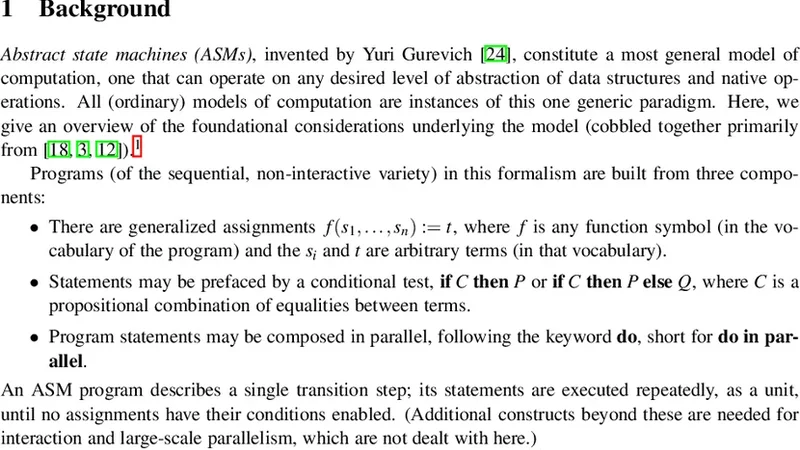
Over the past two decades, Yuri Gurevich and his colleagues have formulated axiomatic foundations for the notion of algorithm, be it classical, interactive, or parallel, and formalized them in the new generic framework of abstract state machines. This approach has recently been extended to suggest a formalization of the notion of effective computation over arbitrary countable domains. The central notions are summarized herein.
💡 Research Summary
The paper presents a comprehensive synthesis of Yuri Gurevich’s abstract state machine (ASM) framework and proposes a “generic model of computation” that unifies classical, interactive, and parallel algorithms under a single formalism. It begins by establishing two foundational axioms for algorithms: bounded exploration, which requires that each computational step inspect only a finite portion of the current state, and invariance, which guarantees that transition rules are preserved under structural isomorphisms. These axioms capture the essential constraints of any implementable procedure and enable a precise representation of sequential algorithms as ASMs.
Building on this base, the authors extend the ASM formalism to handle interaction with an external environment and concurrent execution. Interactive ASMs incorporate explicit input‑output events, allowing the model to describe continuous dialogue between a program and its surroundings—an essential feature for real‑time systems, network protocols, and human‑computer interfaces. Parallel ASMs introduce a mechanism for simultaneous updates, together with conflict‑resolution policies, thereby supporting both synchronous and asynchronous parallelism within the same theoretical language. The paper proves that these extensions retain the computational power of traditional models such as Turing machines, λ‑calculus, and process algebras while offering a more expressive and modular description of complex systems.
A major contribution of the work is the generalization of “effective computation” to arbitrary countable domains. The authors define effectiveness in terms of two conditions: (1) the initial state and the set of basic operations must be recursively enumerable, and (2) every transition rule must satisfy bounded exploration. Under these criteria, any algorithm operating on a countable structure—whether it manipulates rational approximations of real numbers, finite graphs, or infinite trees of strings—qualifies as effective. This broadens the classic Church‑Turing thesis, which is traditionally confined to integer‑based computation, and demonstrates that the generic model subsumes all known effective computational paradigms.
In the concluding discussion, the paper highlights the practical implications of the generic model. By providing a high‑level, mathematically rigorous language for algorithm specification, it facilitates formal verification, modular design, and reasoning about systems that combine interaction and parallelism. Moreover, the countable‑domain extension opens new avenues for complexity theory and the study of algorithmic feasibility beyond the integer realm. The authors outline future work that includes embedding the generic model into real programming languages, developing automated verification tools, and exploring extensions to uncountable domains such as the real continuum. Overall, the paper positions the generic model of computation as a unifying theoretical foundation capable of describing and analyzing the full spectrum of effective algorithms.
Comments & Academic Discussion
Loading comments...
Leave a Comment