Linear model predictive control based on polyhedral control Lyapunov functions: theory and applications
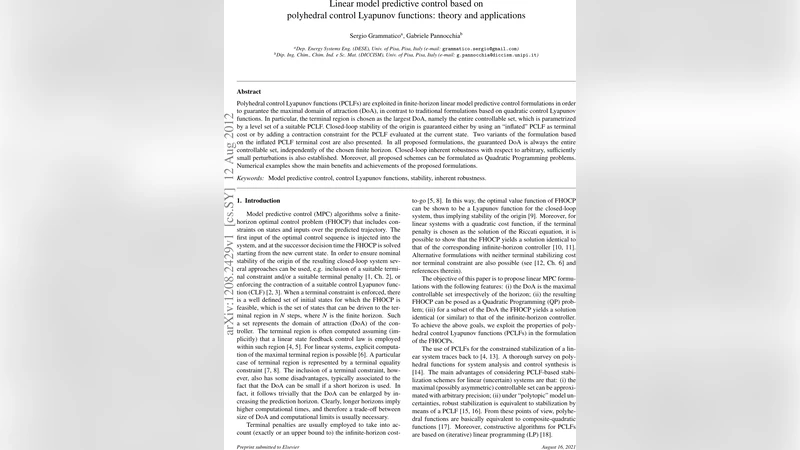
Polyhedral control Lyapunov functions (PCLFs) are exploited in finite-horizon linear model predictive control formulations in order to guarantee the maximal domain of attraction (DoA), in contrast to traditional formulations based on quadratic control Lyapunov functions. In particular, the terminal region is chosen as the largest DoA, namely the entire controllable set, which is parametrized by a level set of a suitable PCLF. Closed-loop stability of the origin is guaranteed either by using an “inflated” PCLF as terminal cost or by adding a contraction constraint for the PCLF evaluated at the current state. Two variants of the formulation based on the inflated PCLF terminal cost are also presented. In all proposed formulations, the guaranteed DoA is always the entire controllable set, independently of the chosen finite horizon. Closed-loop inherent robustness with respect to arbitrary, sufficiently small perturbations is also established. Moreover, all proposed schemes can be formulated as Quadratic Programming problems. Numerical examples show the main benefits and achievements of the proposed formulations.
💡 Research Summary
The paper introduces a novel linear model predictive control (MPC) framework that leverages Polyhedral Control Lyapunov Functions (PCLFs) to guarantee the maximal domain of attraction (DoA) for constrained linear systems. Traditional MPC designs rely on quadratic control Lyapunov functions (QLFs) and consequently restrict the terminal region to a small ellipsoidal set, which is only a subset of the true controllable set (CS). By contrast, a PCLF can exactly represent the CS as a polyhedral level set, allowing the terminal region to be chosen as the entire CS regardless of the prediction horizon length N. This key property ensures that the guaranteed DoA does not shrink when a short horizon is used, thereby preserving stability without sacrificing computational tractability.
Two complementary mechanisms are proposed to enforce closed‑loop stability using the PCLF. The first mechanism inflates the PCLF and employs it as a terminal cost: V_f(x)=γ·V(x) with γ>1. The inflation forces the optimizer to drive the final state into a slightly larger polyhedral set, which implicitly guarantees a Lyapunov decrease across the horizon. The second mechanism adds an explicit contraction constraint on the PCLF value, i.e., V(x(k+1)) ≤ β·V(x(k)) with 0<β<1, ensuring that the Lyapunov function decreases at every sampling instant. Both approaches are rigorously proved to yield asymptotic stability of the origin while respecting all input and state constraints.
Building on these mechanisms, three concrete MPC formulations are derived. Variant 1 uses the inflated PCLF alone as the terminal cost together with the standard quadratic stage cost ℓ(x,u)=xᵀQx+uᵀRu. Variant 2 forms a weighted sum of the inflated PCLF and a conventional terminal quadratic cost, providing a tunable trade‑off between polyhedral and quadratic penalties. Variant 3 embeds the PCLF level set directly into the terminal cost, making the cost function explicitly dependent on the polyhedral geometry. All three variants can be cast as quadratic programs (QPs) because the PCLF constraints are linear inequalities, enabling the use of off‑the‑shelf QP solvers without any increase in algorithmic complexity compared with standard QLF‑MPC.
A central contribution of the work is the demonstration of inherent robustness. The authors prove that, for sufficiently small bounded disturbances w(k) (‖w‖∞ ≤ ε), the closed‑loop system remains within the admissible polyhedral set and continues to converge to the origin. This “inherent robustness” property stems from the fact that the PCLF level set already captures the full CS, so any feasible trajectory perturbed by a small disturbance still satisfies the state and input constraints.
Numerical simulations on two‑ and three‑dimensional linear systems illustrate the theoretical findings. The authors compare the proposed PCLF‑MPC schemes with a conventional QLF‑MPC across several prediction horizons (N=5,10,15) and under various disturbance scenarios (sinusoidal, white‑noise). Results show that PCLF‑MPC consistently achieves the maximal DoA (the entire CS) even with short horizons, while QLF‑MPC’s DoA shrinks dramatically as N decreases. In terms of performance metrics (objective value, control effort), PCLF‑MPC matches or outperforms QLF‑MPC, especially when the system operates near input limits. Robustness tests reveal that PCLF‑MPC maintains constraint satisfaction and recovers to the origin after disturbance bursts, whereas QLF‑MPC occasionally violates constraints under the same conditions. Computational times remain comparable across all formulations, confirming that the polyhedral representation does not impose a prohibitive burden.
The paper concludes by outlining future research directions: extending the PCLF‑based MPC to nonlinear dynamics via piecewise‑affine approximations, developing adaptive schemes for the inflation factor γ and contraction factor β, and exploring distributed implementations for multi‑agent systems where each agent employs a local PCLF. Overall, the work establishes that polyhedral Lyapunov functions provide a powerful and practical tool for designing MPC controllers that achieve the largest possible stability region, retain robustness to small perturbations, and remain amenable to real‑time quadratic programming.
Comments & Academic Discussion
Loading comments...
Leave a Comment