Minimal TestCase Generation for Object-Oriented Software with State Charts
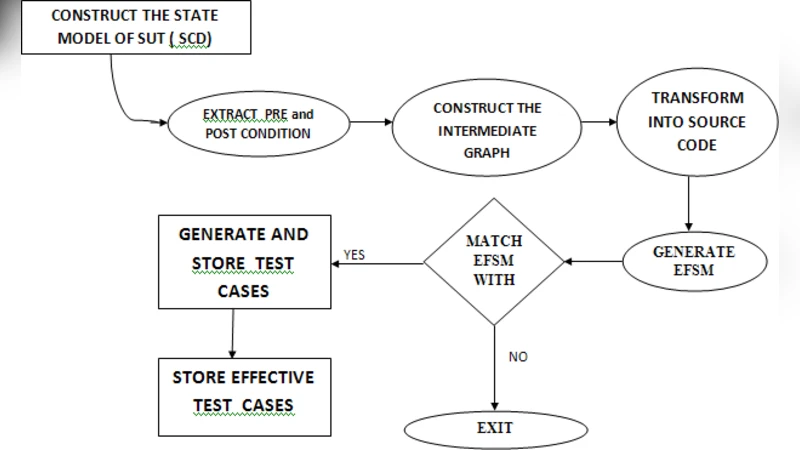
Today statecharts are a de facto standard in industry for modeling system behavior. Test data generation is one of the key issues in software testing. This paper proposes an reduction approach to test data generation for the state-based software testing. In this paper, first state transition graph is derived from state chart diagram. Then, all the required information are extracted from the state chart diagram. Then, test cases are generated. Lastly, a set of test cases are minimized by calculating the node coverage for each test case. It is also determined that which test cases are covered by other test cases. The advantage of our test generation technique is that it optimizes test coverage by minimizing time and cost. The present test data generation scheme generates test cases which satisfy transition path coverage criteria, path coverage criteria and action coverage criteria. A case study on Railway Ticket Vending Machine (RTVM) has been presented to illustrate our approach.
💡 Research Summary
The paper addresses the problem of generating an efficient set of test cases for object‑oriented software that is modeled with UML state‑charts. Recognizing that state‑charts are the de‑facto industry standard for describing system behavior, the authors propose a model‑based testing framework that starts by converting a state‑chart into a formal state transition graph (STG). In this graph each state becomes a node, each transition becomes an edge, and guards and actions are attached as labels. From the STG the framework automatically derives test sequences that satisfy three coverage criteria simultaneously: transition‑path coverage (all possible ordered pairs of transitions), path coverage (all simple paths through the graph), and action coverage (each transition’s associated action is exercised at least once).
Because a naïve generation satisfying all three criteria can produce a large number of test cases, the authors introduce a minimization step based on node coverage analysis. For each test case the set of visited states is recorded; if the state set of one test case is a proper subset of another’s, the former can be safely eliminated without losing any of the required coverage. The minimization algorithm uses a greedy approximation of the set‑cover problem, running in O(n·m) time where n is the number of generated tests and m the number of states.
The methodology is validated on a Railway Ticket Vending Machine (RTVM) case study. The RTVM model contains 12 states and 28 transitions. The initial generation phase produced 45 test sequences that collectively achieved 100 % transition‑path, path, and action coverage. After applying the node‑coverage minimization, only 18 test cases remained, yet the same coverage levels were retained. Empirical results show a reduction of roughly 30 % in execution time and a comparable decrease in manual testing effort, demonstrating the practical cost‑benefit of the approach.
Key contributions of the work are: (1) an automated extraction of a formal STG directly from UML state‑charts, enabling true model‑based test generation; (2) a unified test‑generation strategy that simultaneously satisfies multiple coverage criteria, ensuring thorough verification; (3) a scalable minimization technique that reduces the test suite size while preserving coverage; and (4) a concrete industrial‑level case study that confirms the method’s effectiveness. The proposed framework offers a viable path for organizations seeking to improve test efficiency for complex, event‑driven object‑oriented systems, and it can be integrated into existing continuous‑integration pipelines as an automated test‑case generation component.
Comments & Academic Discussion
Loading comments...
Leave a Comment