Centers and homotopy centers in enriched monoidal categories
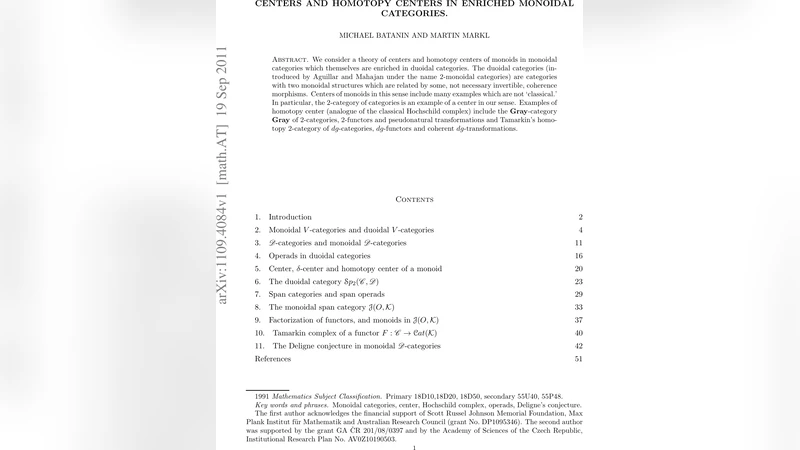
We consider a theory of centers and homotopy centers of monoids in monoidal categories which themselves are enriched in duoidal categories. Duoidal categories (introduced by Aguillar and Mahajan under the name 2-monoidal categories) are categories with two monoidal structures which are related by some, not necessary invertible, coherence morphisms. Centers of monoids in this sense include many examples which are not `classical.’ In particular, the 2-category of categories is an example of a center in our sense. Examples of homotopy center (analogue of the classical Hochschild complex) include the Gray-category Gray of 2-categories, 2-functors and pseudonatural transformations and Tamarkin’s homotopy 2-category of dg-categories, dg-functors and coherent dg-transformations.
💡 Research Summary
The paper develops a unified theory of centers and homotopy centers for monoids living in monoidal categories that are themselves enriched over duoidal categories. A duoidal category, originally introduced by Aguillar‑Mahajan (also called a 2‑monoidal category), carries two monoidal structures ((\otimes_0, e)) and ((\otimes_1, v)) together with a non‑invertible interchange transformation and coherence data linking the two tensor products and units. The authors work over a fixed closed symmetric monoidal base (V); the duoidal category (D) is assumed to be (V)-enriched, and a monoidal (V)-category (K) enriched in (D) is considered.
A key observation is that the usual notion of a monoid in a monoidal category is insufficient when the ambient monoidal structure is only duoidal. The authors therefore define a monoid in (K) as an object equipped with two unit maps (one for each tensor product) and two associative multiplications, subject to compatibility conditions that make the two monoid structures interact via the interchange law of (D). When (D) is braided, these extra operations collapse to the classical case, but in general they give a genuinely richer structure.
For any such monoid (M) the authors construct a cosimplicial object (\operatorname{CH}_\delta(M,M)) in (D). Here (\delta) is a chosen cosimplicial object in the base (V) (for example the standard cosimplicial simplex or the constant cosimplicial object (I)). The realization of this cosimplicial object yields what they call the (\delta)-center of (M); when (\delta) is constant, this is simply called the center. Importantly, the center lives in (D), not in the underlying monoidal category (K).
When a suitable model structure is present (e.g. (V) is a model category and (D) inherits a compatible model structure), the authors replace (\delta) by a contractible cofibrant cosimplicial object and replace (M) by a cofibrant replacement. The resulting object (\operatorname{CH}(M,M)) is the homotopy center, a direct analogue of the classical Hochschild complex for associative algebras.
A central structural result is that the (\delta)-center of a monoid is a duoid in (D); that is, it is simultaneously a monoid with respect to both (\otimes_0) and (\otimes_1) and the two structures are compatible via the interchange map. This generalizes the familiar fact that the ordinary center of a monoid is a commutative monoid.
The homotopy center enjoys a higher‑dimensional Deligne‑type action: the authors prove (or conjecture, to be proved in a sequel) that a contractible 2‑operad acts canonically on (\operatorname{CH}(M,M)). This is precisely the analogue of Deligne’s conjecture for Hochschild cochains, and it recovers Tamarkin’s theorem that the Hochschild complex of a dg‑category carries an action of the little 2‑discs operad.
The paper supplies a rich collection of examples. The 2‑category of (small) categories (\mathbf{Cat}) appears as a center of a suitable monoid; the Gray category of 2‑categories, 2‑functors and pseudonatural transformations provides an example of a (\delta)-center; Tamarkin’s homotopy 2‑category of dg‑categories furnishes a homotopy center. Other examples include the strict duoidal categories of Balteanu‑Fiedorowicz‑Schwänzl‑Vogt, Forcey’s 2‑fold monoidal categories, and the duoidal category (\mathrm{Sp}_2(C,K)) of spans enriched in a monoidal category (K).
Finally, the authors outline a program of generalization to (n)-fold monoidal (or (n)-oidal) categories. They conjecture an ((n+1))-operadic Deligne action on the homotopy center of an (n)-oid, which would provide a systematic framework for constructing semistrict (n)-categories and for understanding higher‑dimensional algebraic structures.
Overall, the work establishes a comprehensive framework that unifies classical Hochschild theory, higher‑category centers, and operadic actions within the setting of duoidal enrichment, opening new avenues for research in higher algebra, homotopical category theory, and related areas.
Comments & Academic Discussion
Loading comments...
Leave a Comment