A Markovian growth dynamics on rooted binary trees evolving according to the Gompertz curve
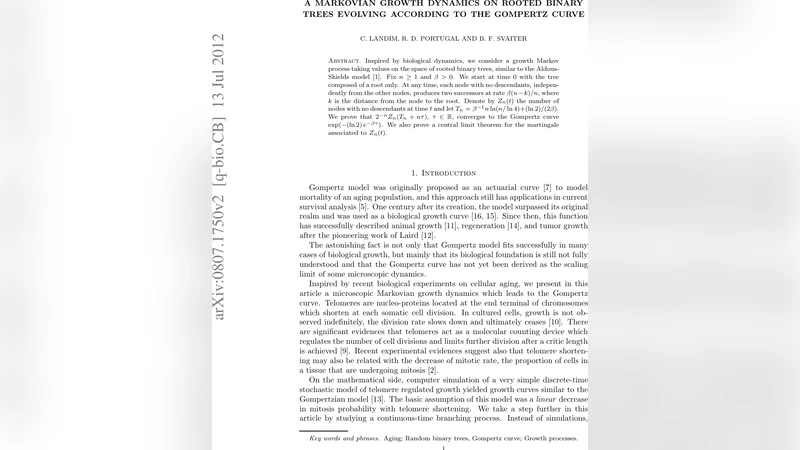
Inspired by biological dynamics, we consider a growth Markov process taking values on the space of rooted binary trees, similar to the Aldous-Shields model. Fix $n\ge 1$ and $\beta>0$. We start at time 0 with the tree composed of a root only. At any time, each node with no descendants, independently from the other nodes, produces two successors at rate $\beta(n-k)/n$, where $k$ is the distance from the node to the root. Denote by $Z_n(t)$ the number of nodes with no descendants at time $t$ and let $T_n = \beta^{-1} n \ln(n /\ln 4) + (\ln 2)/(2 \beta)$. We prove that $2^{-n} Z_n(T_n + n \tau)$, $\tau\in\bb R$, converges to the Gompertz curve $\exp (- (\ln 2) e^{-\beta \tau})$. We also prove a central limit theorem for the martingale associated to $Z_n(t)$.
💡 Research Summary
The paper introduces a continuous‑time Markov growth model on rooted binary trees that is motivated by cellular aging and telomere shortening. The model is parameterised by a positive integer n (the maximal number of divisions a cell can undergo) and a rate constant β>0. Starting from a single root node, each leaf (node with no descendants) at depth k independently splits into two children after an exponential waiting time with rate λ_k = β (n−k)/n. Consequently the tree can grow at most n generations, after which it reaches an absorbing full binary tree of depth n.
The state of the system is described by the vector X(t) = (X(0,t),…,X(n,t)), where X(k,t) counts the number of active leaves in generation k at time t. The generator Q of the Markov process is a lower‑triangular matrix with diagonal entries –λ_k and sub‑diagonal entries 2λ_{k−1}. This structure is a linear‑rate analogue of the Aldous‑Shields model, which uses exponentially decreasing rates.
Two principal results are proved.
- Convergence to the Gompertz curve. Define the deterministic time shift
T_n = β⁻¹ n ln( n / ln 4 ) + (ln 2)/(2β).
For any real τ, set the rescaled process
X_n(τ) = 2^{-n} Z_n( T_n + nτ ), where Z_n(t)=∑_{k=0}^n X(k,t) is the total number of active leaves. The authors show that as n→∞, X_n(τ) converges in probability to
G(τ) = exp
Comments & Academic Discussion
Loading comments...
Leave a Comment