Crossed interval groups and operations on the Hochschild cohomology
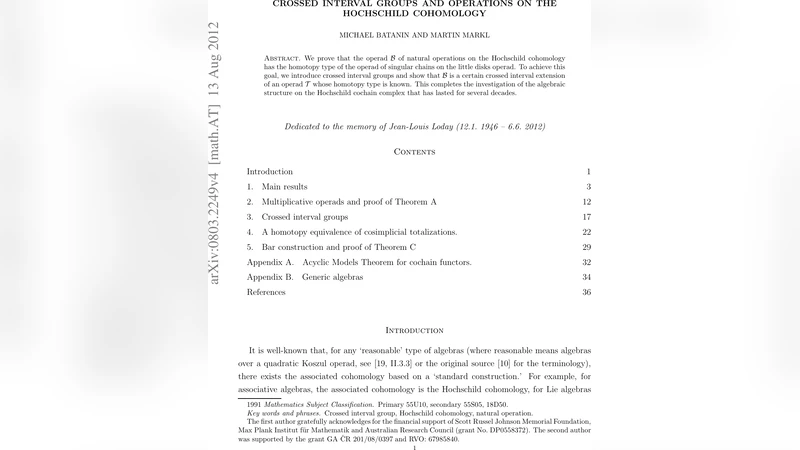
We prove that the operad B of natural operations on the Hochschild cohomology has the homotopy type of the operad of singular chains on the little disks operad. To achieve this goal, we introduce crossed interval groups and show that B is a certain crossed interval extension of an operad T whose homotopy type is known. This completes the investigation of the algebraic structure on the Hochschild cochain complex that has lasted for several decades.
💡 Research Summary
The paper establishes that the operad B, which encodes all natural multilinear operations on the Hochschild cochain complex of an associative algebra, has the homotopy type of the singular chains on the little disks operad D. Two equivalent definitions of B are given: an “intuitive” one built from elementary operations (insertions, multiplication, unit, identity and permutations) and a “coordinate‑free” categorical definition using natural transformations in the category SymCat· of symmetric monoidal categories with a distinguished monoid. Theorem A proves these definitions coincide.
The authors introduce crossed interval groups, a generalisation of crossed simplicial groups, and construct the category IS, an analogue of the symmetric category ΔS where the simplicial category Δ is replaced by Joyal’s interval category I. Within this framework, B is shown to be the free IS‑module generated by a sub‑operad T that contains only the “white” vertices. The operad T is already known to be homotopy equivalent to the chains on the little disks operad (via earlier work of Kontsevich‑Soibelman and others). Theorem 4.4 demonstrates that the free‑module construction preserves homotopy type, leading to Theorem B: B ≃ C₍*₎(D).
Further, the paper analyses several important sub‑operads of B, such as the brace operad Br, its non‑unital version bB, and various normalised versions. Theorem C identifies the homotopy types of these sub‑operads, showing they are either equivalent to D or to natural variants (e.g., non‑unital or normalised little disks).
Technical tools include a double totalisation of a cosimplicial–multisimplicial functor, explicit tree‑based combinatorics for operations, and acyclic models arguments for chain functors (Appendix A). Appendix B proves the existence of “generic” algebras (free associative algebras on countably many generators) for which the natural map from the free operad of trees to the concrete operad of operations is an isomorphism.
Overall, the work completes the long‑standing program of describing the algebraic structure on Hochschild cochains, confirming that the operad of all natural operations is homotopically the same as the little disks operad, and providing a robust categorical framework (crossed interval groups) that may be applied to other cohomology theories.
Comments & Academic Discussion
Loading comments...
Leave a Comment