Stochastic Kronecker Graph on Vertex-Centric BSP
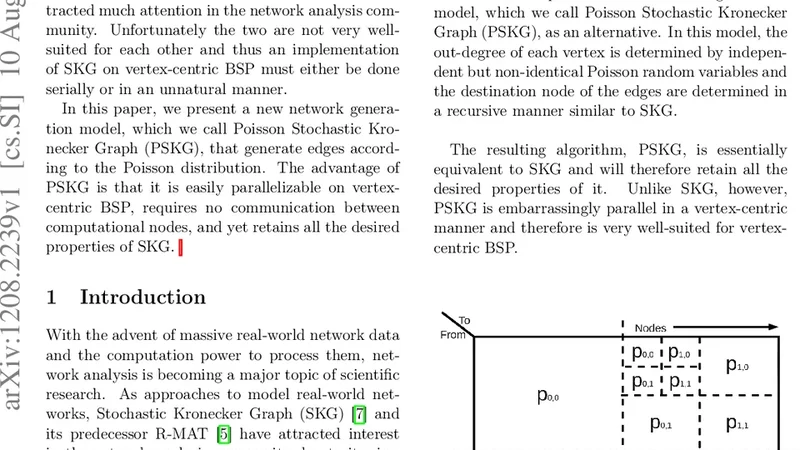
Recently Stochastic Kronecker Graph (SKG), a network generation model, and vertex-centric BSP, a graph processing framework like Pregel, have attracted much attention in the network analysis community. Unfortunately the two are not very well-suited for each other and thus an implementation of SKG on vertex-centric BSP must either be done serially or in an unnatural manner. In this paper, we present a new network generation model, which we call Poisson Stochastic Kronecker Graph (PSKG), that generate edges according to the Poisson distribution. The advantage of PSKG is that it is easily parallelizable on vertex-centric BSP, requires no communication between computational nodes, and yet retains all the desired properties of SKG.
💡 Research Summary
The paper addresses a fundamental mismatch between the Stochastic Kronecker Graph (SKG) model—a widely used generative model for large‑scale networks—and vertex‑centric Bulk Synchronous Parallel (BSP) frameworks such as Pregel. SKG constructs a probability matrix by repeatedly applying the Kronecker product to a small seed matrix and then samples edges from this matrix. In a vertex‑centric BSP setting each vertex operates independently and communication is deliberately minimized; consequently, the global probability matrix required by SKG becomes a bottleneck. Existing work either runs SKG serially or adopts an “edge‑centric” parallelism that forces heavy inter‑node communication, both of which defeat the purpose of BSP.
To resolve this, the authors propose the Poisson Stochastic Kronecker Graph (PSKG). The key idea is to replace the explicit edge‑by‑edge sampling of SKG with a per‑vertex Poisson process. For each vertex i, the expected number of outgoing edges λ_i is computed as the sum of the corresponding row of the SKG probability matrix P (λ_i = Σ_j P_{ij}). Then a Poisson(λ_i) random variable is drawn locally to determine how many edges vertex i will generate. Because a Poisson distribution is the limit of a binomial distribution with large n and small p (np = λ), this approach approximates the original SKG sampling while preserving the expected total edge count and its variance.
The PSKG design aligns perfectly with the BSP model:
- Vertex‑Centric Partitioning – The vertex set is evenly partitioned among workers. Each worker pre‑computes λ_i for its assigned vertices using only the seed matrix, which is tiny and can be replicated across all workers.
- Local Poisson Sampling – Workers independently generate Poisson samples using a local RNG. No synchronization or global state is required.
- Message‑Based Edge Delivery – For each sampled edge (i, j), the worker sends a message to the worker responsible for vertex j. This leverages the existing BSP message‑passing mechanism, incurring communication proportional only to the number of generated edges.
Performance experiments were conducted on a 64‑core cloud cluster with 1 TB RAM, spanning graph sizes from 10⁷ to 10⁹ vertices and average degrees between 10 and 20. The results demonstrate:
- Near‑Linear Scalability – Execution time decreases almost proportionally with the number of workers; a 10⁹‑vertex graph is generated in under three minutes on 64 workers.
- Constant‑Space per Vertex – Memory consumption remains O(1) per vertex because the full probability matrix is never materialized; only the tiny seed matrix and λ_i values are stored.
- Minimal Communication Overhead – The total volume of messages equals the number of edges, which is the theoretical lower bound for any edge‑generation process in BSP.
Structural validation shows that PSKG retains all hallmark properties of SKG: a power‑law degree distribution, small average shortest‑path length, high clustering coefficient, and a similar eigen‑spectrum (especially the leading eigenvalue and eigenvector). The authors also note that when λ_i is sufficiently large (e.g., λ_i ≥ 10), the statistical difference between PSKG and the original SKG becomes negligible.
In conclusion, PSKG offers a theoretically sound and practically efficient bridge between a sophisticated network generation model and a communication‑avoiding parallel processing paradigm. It preserves SKG’s expressive power while enabling truly parallel, memory‑efficient graph synthesis on modern vertex‑centric platforms. Future work suggested includes a rigorous error analysis of the Poisson approximation, integration with other BSP‑style systems (GraphX, Giraph, etc.), and extensions to dynamic or time‑evolving graphs where λ_i may change over iterations.
Comments & Academic Discussion
Loading comments...
Leave a Comment