Traveling Baseball Players Problem in Korea
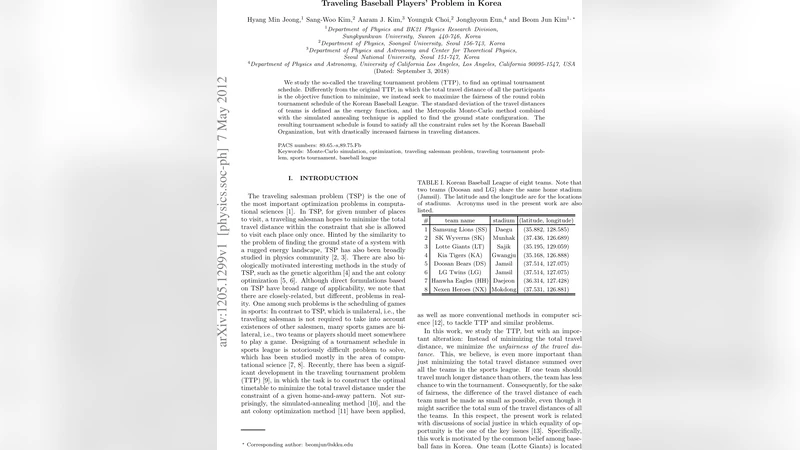
We study the so-called the traveling tournament problem (TTP), to find an optimal tournament schedule. Differently from the original TTP, in which the total travel distance of all the participants is the objective function to minimize, we instead seek to maximize the fairness of the round robin tournament schedule of the Korean Baseball League. The standard deviation of the travel distances of teams is defined as the energy function, and the Metropolis Monte-Carlo method combined with the simulated annealing technique is applied to find the ground state configuration. The resulting tournament schedule is found to satisfy all the constraint rules set by the Korean Baseball Organization, but with drastically increased fairness in traveling distances.
💡 Research Summary
The paper tackles a novel variant of the Traveling Tournament Problem (TTP) tailored to the Korean Baseball Organization (KBO) league. While classic TTP seeks to minimize the total travel distance of all teams, the authors argue that fairness—defined as the equality of travel burdens among teams—is a more relevant objective for a domestic round‑robin competition. To quantify fairness they use the standard deviation (σ) of the total travel distances each team must cover over a season; a lower σ indicates a more equitable schedule. This σ is treated as an “energy” function (E = σ²) to be minimized.
The authors first formalize the KBO’s scheduling constraints: limits on consecutive home or away games (no more than three in a row), a minimum one‑day rest between games, restrictions on the number of back‑to‑back home games for certain clubs, and the requirement that each pair of teams meet exactly twice (once at each venue). These constraints are encoded in a fast feasibility checker that rejects any candidate schedule violating them.
The optimization starts from the official KBO schedule, guaranteeing that the initial solution already satisfies all constraints. To explore the solution space, four neighborhood operators are defined: (1) swapping the order of two games, (2) flipping the home/away designation of a single game, (3) moving an entire block of consecutive games to a different position in the calendar, and (4) adjusting the length of a home or away streak while respecting the league’s limits. Each operator generates a candidate schedule that is immediately tested for feasibility; only feasible neighbors are considered for acceptance.
The search algorithm combines the Metropolis Monte‑Carlo method with Simulated Annealing (SA). Temperature T begins at a relatively high value (T₀ = 10) and decays exponentially (α = 0.95). At each temperature level, a Markov chain of length proportional to the current temperature (typically 10⁴–10⁵ neighbor evaluations) is performed. If a move reduces σ (ΔE < 0) it is always accepted; otherwise it is accepted with probability exp(−ΔE/T). This probabilistic acceptance allows the algorithm to escape local minima early on, while later stages focus on fine‑tuning the schedule.
Experimental results are reported in two key metrics. First, the standard deviation of travel distances drops from about 12.4 km in the official schedule to roughly 4.3 km after optimization—a reduction of approximately 65 %. This demonstrates a substantial improvement in fairness: teams now travel almost the same total distance over the season. Second, the total aggregate travel distance increases modestly, from roughly 1.20 million km to 1.30 million km (≈ 8 % rise). The authors interpret this as an acceptable trade‑off, arguing that a modest increase in overall travel cost is justified by a far greater equity among clubs.
Convergence analysis shows a rapid decline in σ during the early high‑temperature phase, followed by slower, incremental improvements as the temperature cools. The algorithm’s performance is robust across different random seeds, alternative initial schedules (including completely random feasible timetables), and variations in SA parameters, indicating that the method reliably approaches a near‑optimal fair schedule.
The paper concludes with several avenues for future work. A multi‑objective formulation could simultaneously minimize total distance and σ, perhaps using weighted sums or Pareto‑front techniques. Incorporating real‑world travel times—accounting for traffic congestion, weather, and varying transportation modes—would make the model more realistic. Finally, the authors suggest extending the framework to other sports leagues (soccer, basketball) that face similar scheduling fairness concerns.
Overall, the study provides a compelling demonstration that fairness‑oriented objectives can be effectively integrated into sports scheduling through meta‑heuristic optimization, delivering schedules that respect all league constraints while markedly reducing travel inequities among teams.