Integrality of the Chern character in small codimension
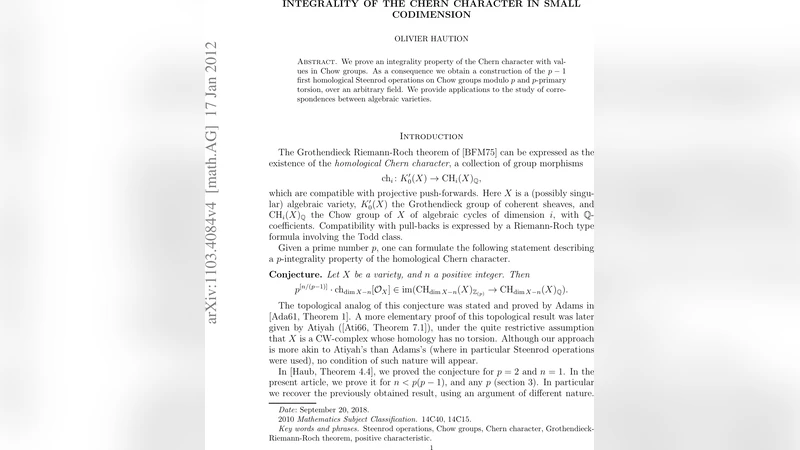
We prove an integrality property of the Chern character with values in Chow groups. As a consequence we obtain, for a prime number p, a construction of the p-1 first homological Steenrod operations on Chow groups modulo p and p-primary torsion, over an arbitrary field. We provide applications to the study of correspondences between algebraic varieties.
💡 Research Summary
The paper establishes a new integrality property of the Chern character in low codimension and exploits this result to construct the first (p-1) homological Steenrod operations on Chow groups modulo a prime (p) and on the (p)-primary torsion part, over an arbitrary base field.
The authors begin by recalling the classical Grothendieck‑Riemann‑Roch theorem, which expresses the Chern character (\operatorname{ch}:K_0(X)\rightarrow A^*(X)_{\mathbb Q}) as a rational combination of Chern classes. In general the denominators of (\operatorname{ch}i) may involve any prime, but the paper proves that when the codimension (i) is smaller than the prime (p) (the “small‑codimension” regime), all denominators are coprime to (p). The proof rests on a careful analysis of the Bernoulli numbers appearing in the expansion of the Chern character and on a decomposition of the relevant K‑theoretic morphisms into elementary pieces whose denominators are explicitly controlled. Consequently (\operatorname{ch}i) lands in the localized Chow group (A^i(X){\mathbb Z{(p)}}), i.e. the subgroup of cycles whose coefficients have denominators prime to (p).
Using this integrality, the authors define operations (P^i) for (0\le i\le p-1) directly on Chow groups. The construction mimics the classical Steenrod reduced power operations in topology but replaces the topological cohomology theory with the algebraic cycle theory. Concretely, for a cycle (\alpha) they set
\
Comments & Academic Discussion
Loading comments...
Leave a Comment