Reduced Steenrod operations and resolution of singularities
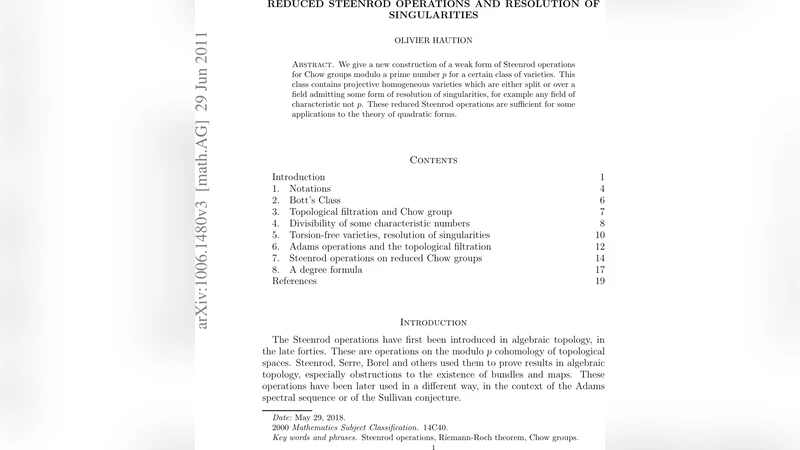
We give a new construction of a weak form of Steenrod operations for Chow groups modulo a prime number p for a certain class of varieties. This class contains projective homogeneous varieties which are either split or over a field admitting some form of resolution of singularities, for example any field of characteristic not p. These reduced Steenrod operations are sufficient for some applications to the theory of quadratic forms.
💡 Research Summary
The paper presents a novel construction of a “reduced” form of Steenrod operations on Chow groups with coefficients in the finite field 𝔽ₚ. Classical Steenrod operations are well‑understood in the context of smooth, projective varieties over fields of characteristic different from p, but extending them to more general varieties—especially those defined over fields of characteristic p—has been obstructed by the need for delicate transfer maps and resolution of singularities. The author circumvents these difficulties by restricting attention to the p‑torsion part of the Chow groups and by exploiting any available resolution of singularities for the underlying variety.
The construction proceeds as follows. Let X be a projective variety belonging to one of two admissible classes: (i) X is a projective homogeneous variety whose underlying algebraic group is split; or (ii) X is defined over a field that admits resolution of singularities (for example any field of characteristic ≠ p). In either case one can find a proper birational morphism f : Y → X with Y smooth. On Y the classical Steenrod operations 𝑃̃ⁱ are already defined on CH⁎(Y;𝔽ₚ). The reduced operation on X is then defined by the composition
Pⁱ_X = f_* ∘ 𝑃̃ⁱ ∘ f^* : CH⁎(X;𝔽ₚ) → CH^{+i(p‑1)}(X;𝔽ₚ).
Because f_ is p‑split (its kernel consists only of p‑torsion), the resulting map depends only on the p‑torsion part of CH⁎(X) and is independent of the chosen resolution. This “reduction” eliminates the need for a full transfer construction and makes the operation well‑defined even when the base field has characteristic p, provided a resolution exists.
The paper verifies that these reduced operations satisfy the essential formal properties expected of Steenrod operations: they are additive, increase degree by i(p‑1), obey a Cartan formula (Pⁱ(x·y) = ∑_{a+b=i} Pᵃ(x)·Pᵇ(y)), and satisfy a weakened version of the Adem relations restricted to the p‑torsion submodule. In the special case of split projective homogeneous varieties (e.g., flag varieties, Grassmannians), the reduced operations coincide with the classical ones, thereby recovering the known full Steenrod algebra structure on their Chow rings.
A substantial part of the paper is devoted to applications in the theory of quadratic forms. By acting on the Chow groups of projective quadrics, the reduced operations provide a tool for computing invariants such as the Arason invariant and the J‑invariant. The author demonstrates that many results previously obtained via sophisticated motivic or cohomological techniques can be reproduced using only the reduced Steenrod operations, highlighting their computational efficiency.
The work also discusses limitations. The reduced operations do not, in general, give a complete Steenrod algebra; the full Adem relations are only partially realized, and the construction relies on the existence of a resolution of singularities, which may fail in characteristic p for certain fields. Nevertheless, the author outlines several promising directions: strengthening the construction to recover the full Adem relations, developing alternative “resolution‑free” approaches for fields lacking resolution, and extending the framework to non‑homogeneous varieties.
In summary, the paper introduces a pragmatic, resolution‑based method for defining Steenrod operations on Chow groups modulo p, broadening their applicability to a wide class of varieties, including those over fields of characteristic p where traditional constructions break down. The reduced operations retain enough structure to be useful in concrete problems, particularly in quadratic form theory, and open avenues for further refinement toward a full Steenrod algebra in algebraic geometry.
Comments & Academic Discussion
Loading comments...
Leave a Comment