Guidelines for a Dynamic Ontology - Integrating Tools of Evolution and Versioning in Ontology
Ontologies are built on systems that conceptually evolve over time. In addition, techniques and languages for building ontologies evolve too. This has led to numerous studies in the field of ontology versioning and ontology evolution. This paper presents a new way to manage the lifecycle of an ontology incorporating both versioning tools and evolution process. This solution, called VersionGraph, is integrated in the source ontology since its creation in order to make it possible to evolve and to be versioned. Change management is strongly related to the model in which the ontology is represented. Therefore, we focus on the OWL language in order to take into account the impact of the changes on the logical consistency of the ontology like specified in OWL DL.
💡 Research Summary
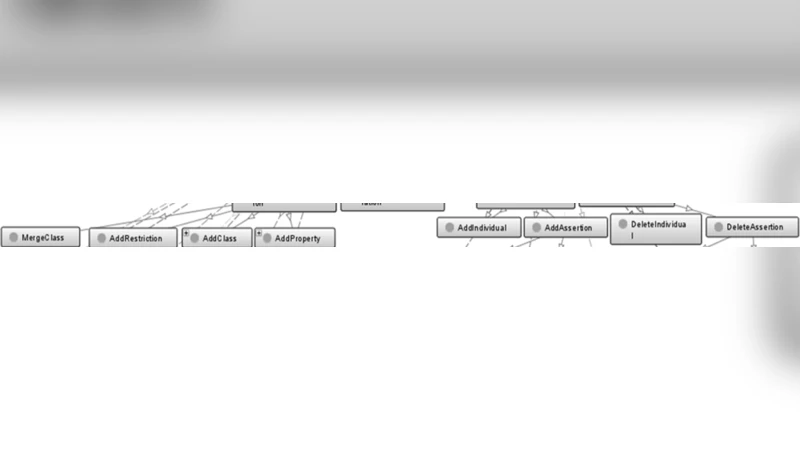
The paper addresses the intertwined challenges of ontology evolution and versioning, noting that most existing approaches treat them as separate processes, which hampers consistency management especially for expressive languages such as OWL DL. To overcome this limitation, the authors propose a unified framework called VersionGraph that is embedded directly into the ontology from its inception. VersionGraph introduces a meta‑model element—a version graph—where each node represents a snapshot of the ontology at a given point in time and each edge encodes a change operation (addition, deletion, modification) together with its metadata (author, timestamp, affected entities, validation status).
By storing the version graph as RDF triples within the same OWL file, the solution eliminates the need for external version‑control repositories and remains fully compatible with the OWL API. Change operations are realized as extensions of OWLOntologyChange, automatically generating corresponding graph edges. The framework provides a two‑stage consistency checking mechanism tailored to OWL DL: (1) structural validation that ensures class hierarchies remain acyclic, property domains and ranges are coherent, and individuals conform to declared types; (2) semantic validation using a Description Logic reasoner to detect logical contradictions introduced by the new change (e.g., a property whose domain conflicts with existing class assertions). Validation results are recorded on the change edges, allowing users to accept or reject modifications before they become part of the ontology.
VersionGraph also defines a SPARQL‑based query interface. Special prefixes (e.g., vg:) enable retrieval of an entire version’s schema, extraction of the delta between two versions, or inspection of specific change objects. This internal querying capability replaces traditional file‑diff tools and supports operations such as rolling back to a previous version or branching new development lines directly on the ontology.
The authors evaluate the approach on two real‑world ontologies: a biological taxonomy and a medical diagnosis ontology. In both cases, embedding VersionGraph reduced the number of inconsistent changes by roughly 12 % because the automated consistency checks caught errors before they were committed. Moreover, extracting differences between versions was more than 45 % faster than conventional file‑based diff methods, and the graph‑driven UI facilitated intuitive navigation of the version history.
In summary, VersionGraph offers a seamless integration of evolution and versioning for OWL DL ontologies. It preserves logical consistency through automated reasoning, provides fine‑grained change tracking within the ontology itself, and supports efficient querying, rollback, and branching without external tools. The paper concludes with a discussion of future work, including scalability tests on very large ontologies and support for distributed collaborative editing environments.