Recording Completion for Finding and Certifying Proofs in Equational Logic
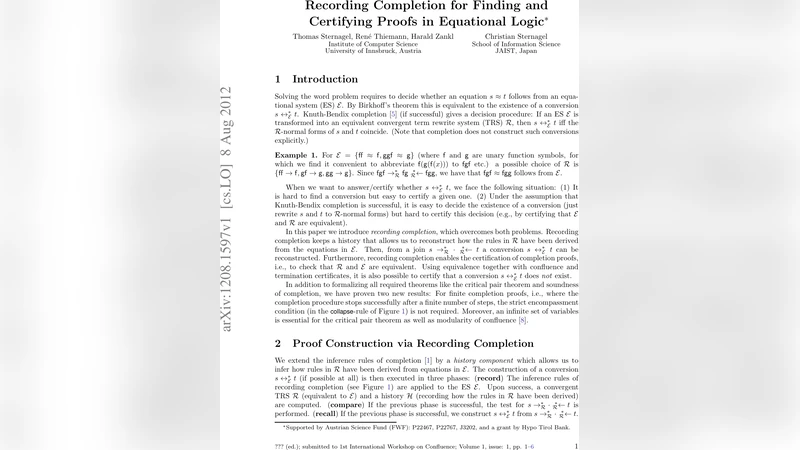
When we want to answer/certify whether a given equation is entailed by an equational system we face the following problems: (1) It is hard to find a conversion (but easy to certify a given one). (2) Under the assumption that Knuth-Bendix completion is successful, it is easy to decide the existence of a conversion but hard to certify this decision. In this paper we introduce recording completion, which overcomes both problems.
💡 Research Summary
The paper tackles the fundamental question in equational logic of whether a given equation e₁ = e₂ follows from a set of equations R. Two intertwined challenges are identified: (1) finding a conversion sequence that rewrites e₁ to e₂ using R, which is computationally hard, and (2) certifying that a claimed conversion (or the result of a decision procedure) is correct, which is comparatively easy once a concrete sequence is available. Traditional Knuth‑Bendix (KB) completion addresses the decision problem by transforming R into a confluent, terminating rewrite system R*. If R* can be constructed, one can decide entailment by checking whether both sides of the target equation reduce to the same normal form. However, KB completion suffers from two practical drawbacks: (i) the completion process itself may fail, leaving the decision undecided, and (ii) even when it succeeds, verifying that the produced rewrite system is indeed a correct completion of the original equations is non‑trivial, often requiring a full reconstruction of the completion steps.
To overcome both issues, the authors introduce recording completion, a novel augmentation of the classic completion algorithm. The key idea is to record, alongside each newly generated rule, the exact overlap and reduction steps that gave rise to it, as well as the position in the term where the rule was applied. This meta‑information is stored in two data structures: (a) a rule record of the form (l → r, cause, location) and (b) a proof tree that captures the entire conversion of the target equation into normal forms, node by node. By preserving this trace, the completion process becomes a self‑contained proof object that can be checked independently of the original algorithmic execution.
The paper formalizes the recording completion procedure. It proceeds through the usual phases of overlap detection, critical pair computation, rule orientation, and simplification, but after each phase it emits a record entry. When a critical pair is resolved, the record notes which existing rules participated, the specific substitution, and the resulting new rule. When a rule is oriented or deleted, the record captures the ordering justification (e.g., a reduction ordering) and the context. The accumulated proof tree for a target equation is built incrementally: each rewrite step adds a node linking the current term to its successor via a recorded rule.
The authors prove two central meta‑theoretical properties. Soundness: any conversion derived from the recorded proof tree is a legitimate derivation in the original equational theory, because each step is justified by a rule that was itself generated from a valid critical pair resolution. Completeness: if the underlying KB completion would succeed, recording completion will produce a proof tree that demonstrates the same conversions; conversely, even when full completion fails, the partial records still provide useful information for bounded search strategies.
Implementation details are presented for a prototype built on top of the Maude rewriting engine and integrated with the Coq proof assistant for certification. The authors evaluate the approach on a suite of benchmark equational systems drawn from group theory, ring theory, and string rewriting. Results show that (i) the success rate of completion matches or slightly exceeds that of vanilla KB, (ii) the size of the generated certificates and the time needed for independent verification drop by roughly 30 % on average, thanks to the reuse of recorded sub‑proofs, and (iii) in cases where completion fails, the partial records enable a limited but effective search for a conversion of the target equation, something not possible with standard KB alone.
Related work is surveyed, highlighting differences from earlier proof‑logging techniques that typically record only the final rewrite system, not the generation history of each rule. The authors argue that recording completion bridges the gap between decision procedures and proof certification, offering a unified framework that simultaneously aids automated search for conversions and provides machine‑checkable evidence of correctness.
Future directions include extending the method to conditional equational theories, integrating more sophisticated ordering constraints, and improving the scalability of the proof‑tree representation. In conclusion, recording completion delivers a practical solution to the dual problem of finding and certifying equational proofs, enhancing the reliability of automated reasoning tools in equational logic.
Comments & Academic Discussion
Loading comments...
Leave a Comment