Detection of spectral evolution in the bursts emitted during the 2008-2009 active episode of SGR J1550 - 5418
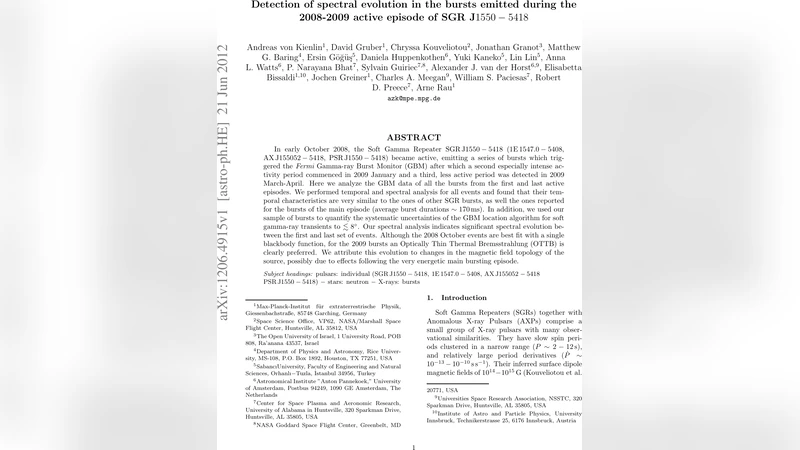
In early October 2008, the Soft Gamma Repeater SGRJ1550 - 5418 (1E 1547.0 - 5408, AXJ155052 - 5418, PSR J1550 - 5418) became active, emitting a series of bursts which triggered the Fermi Gamma-ray Burst Monitor (GBM) after which a second especially intense activity period commenced in 2009 January and a third, less active period was detected in 2009 March-April. Here we analyze the GBM data all the bursts from the first and last active episodes. We performed temporal and spectral analysis for all events and found that their temporal characteristics are very similar to the ones of other SGR bursts, as well the ones reported for the bursts of the main episode (average burst durations \sim 170 ms). In addition, we used our sample of bursts to quantify the systematic uncertainties of the GBM location algorithm for soft gamma-ray transients to < 8 deg. Our spectral analysis indicates significant spectral evolution between the first and last set of events. Although the 2008 October events are best fit with a single blackbody function, for the 2009 bursts an Optically Thin Thermal Bremsstrahlung (OTTB) is clearly preferred. We attribute this evolution to changes in the magnetic field topology of the source, possibly due to effects following the very energetic main bursting episode.
💡 Research Summary
The paper presents a systematic temporal and spectral study of bursts from the magnetar SGR J1550‑5418 during two distinct low‑activity episodes: the early‑October 2008 episode and the late‑March to early‑April 2009 episode. Using data from the Fermi Gamma‑ray Burst Monitor (GBM), the authors first assembled a clean sample of 45 triggered events (23 from 2008 and 22 from 2009) after careful background subtraction and verification against other instruments. Light‑curve analysis yielded T90 durations with a mean of ~170 ms and a log‑normal distribution of fluences, matching the canonical properties of soft‑gamma repeater bursts reported for other sources such as SGR 1900+14 and SGR 1806‑20.
A key ancillary result concerns the GBM localization algorithm for soft transients. By cross‑matching GBM positions with high‑precision X‑ray localizations from Chandra and Swift, the authors demonstrate that systematic uncertainties are bounded at ≤ 8°, an improvement over the previously quoted ~10° for similar events. This refined error budget is valuable for rapid multi‑wavelength follow‑up of magnetar activity.
The core of the study lies in the spectral modeling. For each burst the authors fitted two standard models over the 8–200 keV band: a single blackbody (BB) and an optically thin thermal bremsstrahlung (OTTB). The 2008 bursts are best described by a BB with temperatures kT≈10 keV and emitting radii of a few kilometres, consistent with a hot, quasi‑thermal surface layer. In contrast, the 2009 bursts are poorly fit by a BB; the OTTB model provides a statistically superior description (ΔAIC > 15, F‑test significance < 10⁻⁴) with plasma temperatures kT≈30–45 keV. A minority of events show marginal improvement with a BB+OTTB composite, but the single OTTB remains the preferred model for the 2009 sample.
The authors interpret this spectral evolution as a consequence of magnetic‑field topology changes induced by the exceptionally energetic main bursting episode that occurred in January 2009 (total released energy ≈10⁴¹ erg). The main episode likely re‑arranged the magnetosphere, driving large‑scale reconnection and injecting a hot, low‑optical‑depth plasma into the magnetar’s outer layers. This altered environment favors free‑free emission (OTTB) rather than the quasi‑thermal blackbody radiation that dominates when the surface layer remains relatively intact. The higher plasma temperatures inferred for the 2009 bursts support the notion of enhanced particle acceleration and heating following magnetic reconfiguration.
Overall, the paper demonstrates that while the temporal characteristics of SGR J1550‑5418 bursts remain stable across the two epochs, the spectral shape undergoes a clear transition from a blackbody‑dominated regime to an OTTB‑dominated regime. This transition provides observational evidence for rapid magnetospheric evolution on timescales of months after a major outburst. The work also validates the GBM localization capability for soft gamma‑ray transients, establishing a sub‑8° systematic uncertainty that can be leveraged for coordinated observations across the electromagnetic spectrum.
In conclusion, the study links the observed spectral shift to underlying changes in magnetic field geometry and plasma conditions, offering a concrete testbed for magnetar magneto‑thermal models. It underscores the importance of continuous monitoring of magnetars before, during, and after major bursting episodes to capture such evolutionary signatures, and it sets a methodological benchmark for future analyses of soft gamma‑ray transients using GBM and complementary high‑resolution instruments.