The Forgiving Graph: A distributed data structure for low stretch under adversarial attack
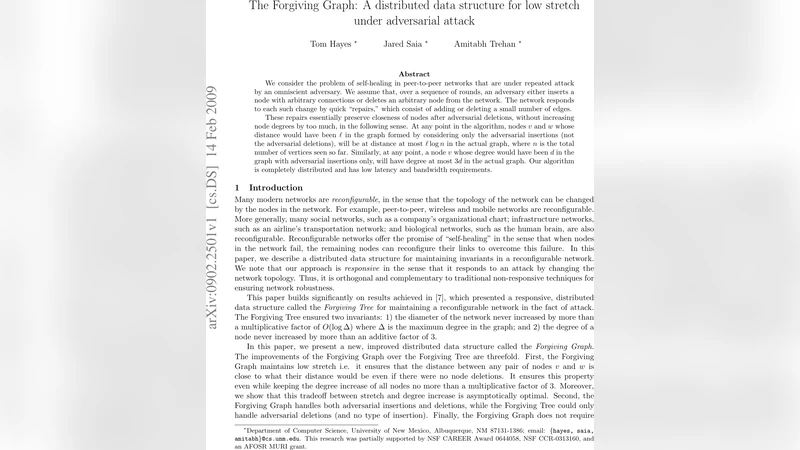
We consider the problem of self-healing in peer-to-peer networks that are under repeated attack by an omniscient adversary. We assume that, over a sequence of rounds, an adversary either inserts a node with arbitrary connections or deletes an arbitrary node from the network. The network responds to each such change by quick “repairs,” which consist of adding or deleting a small number of edges. These repairs essentially preserve closeness of nodes after adversarial deletions, without increasing node degrees by too much, in the following sense. At any point in the algorithm, nodes $v$ and $w$ whose distance would have been $\ell$ in the graph formed by considering only the adversarial insertions (not the adversarial deletions), will be at distance at most $\ell \log n$ in the actual graph, where $n$ is the total number of vertices seen so far. Similarly, at any point, a node $v$ whose degree would have been $d$ in the graph with adversarial insertions only, will have degree at most 3d in the actual graph. Our algorithm is completely distributed and has low latency and bandwidth requirements.
💡 Research Summary
The paper addresses the problem of maintaining connectivity and low stretch in a peer‑to‑peer network that is repeatedly attacked by an omniscient adversary capable of inserting or deleting arbitrary nodes. The adversary operates in discrete rounds; in each round it either adds a new vertex together with any set of incident edges, or it removes an existing vertex together with all its incident edges. After each adversarial operation the network is allowed to perform a “repair” step in which it may add or delete a small number of edges. The goal of the repair algorithm is twofold: (1) to keep the distance between any two vertices v and w that would have been ℓ in the graph consisting only of insertions (the “insertion‑only” graph) bounded by O(ℓ·log n) in the actual graph, where n is the total number of vertices that have ever appeared; and (2) to keep the degree of any vertex v that would have been d in the insertion‑only graph bounded by 3d in the actual graph.
To achieve these guarantees the authors introduce the Forgiving Graph, a fully distributed data structure built around Reconstruction Trees (RTs) and virtual (fake) nodes. Each vertex belongs to an RT that represents the logical hierarchy used for repair. When a vertex x is deleted, all of its immediate neighbors exchange messages and collectively construct a new RT that replaces x. The new RT is organized as a balanced binary tree; internal nodes of this tree are virtual and do not correspond to physical machines. Instead, the physical neighbors become the leaves of the tree and connect to the virtual nodes through a constant‑size set of logical edges. Because virtual nodes have no physical presence, the actual degree increase of any real vertex is limited to at most two additional edges per virtual node it represents.
The repair process is completely local. Only the neighbors of the deleted vertex participate, and they need to know their own degree and the depth of the RT they belong to. They agree on parent‑child relationships, instantiate the necessary virtual nodes (conceptually), and update their adjacency lists. The communication cost per repair is O(deg(x)·log n) bits, and the time (measured in synchronous rounds) is O(log n). No global coordination or central authority is required.
The authors prove two main theorems. Stretch bound: because each RT is a balanced binary tree, any original shortest‑path segment that is “cut” by a deletion can be rerouted through the RT with at most a logarithmic factor increase. Since a shortest path consists of at most ℓ such segments, the total distance inflates to at most ℓ·log n. Degree bound: each real vertex can be incident to at most its original edges plus at most two edges for each virtual node it represents, yielding an overall degree ≤ 3d.
Complexity analysis shows that the number of physical edges added or removed in a repair is proportional to the degree of the deleted vertex, and the per‑node memory overhead is O(log n) to store parent/child pointers for the virtual hierarchy. The algorithm therefore satisfies low‑latency (O(log n) rounds) and low‑bandwidth (polylogarithmic) requirements, making it suitable for large‑scale, dynamic P2P systems.
In the related‑work discussion the paper contrasts its approach with earlier self‑healing overlays, which typically sacrifice either stretch or degree. The Forgiving Graph uniquely achieves both logarithmic stretch and constant‑factor degree blow‑up simultaneously, without requiring global re‑embedding or heavy bookkeeping.
The authors acknowledge limitations: the management of virtual nodes introduces additional logical state that could become cumbersome under extremely high insertion rates, and maintaining perfectly balanced RTs may require occasional rebalancing. Future directions include optimizing the virtual‑node representation to reduce memory, extending the model to asynchronous settings, handling simultaneous multiple deletions, and applying the technique to concrete systems such as distributed hash tables, blockchain peer networks, and real‑time collaborative platforms.
Overall, the paper presents a rigorous, fully distributed self‑healing mechanism that guarantees low stretch and bounded degree growth under an adversarial, dynamic environment, offering a practical foundation for resilient peer‑to‑peer infrastructures.
Comments & Academic Discussion
Loading comments...
Leave a Comment