Lattice operators from discrete hydrodynamics
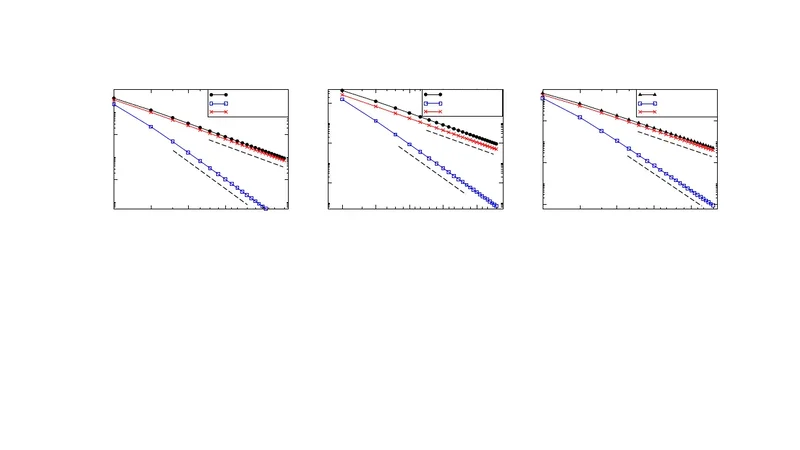
We present a general scheme to derive lattice differential operators from the discrete velocities and associated Maxwell-Boltzmann distributions used in lattice hydrodynamics. Such discretizations offer built-in isotropy and recursive techniques to increase the convergence order. This provides a simple and elegant procedure to derive isotropic and accurate discretizations of differential operators, which are expected to apply across a broad range of problems in computational physics.
💡 Research Summary
The paper introduces a systematic scheme for constructing lattice differential operators directly from the discrete velocity sets and associated Maxwell‑Boltzmann weights that are the foundation of lattice Boltzmann hydrodynamics (LBM). The authors begin by recalling that the discrete velocities (c_i) and their weights (w_i) are chosen precisely to satisfy isotropic tensor identities up to a desired order. For example, the second‑order moment satisfies (\sum_i w_i c_{i\alpha}c_{i\beta}=c_s^2\delta_{\alpha\beta}) and the fourth‑order moment satisfies (\sum_i w_i c_{i\alpha}c_{i\beta}c_{i\gamma}c_{i\delta}=c_s^4(\delta_{\alpha\beta}\delta_{\gamma\delta}+ \delta_{\alpha\gamma}\delta_{\beta\delta}+ \delta_{\alpha\delta}\delta_{\beta\gamma})). These relations guarantee that any linear combination of the discrete velocities weighted by (w_i) automatically respects rotational symmetry, eliminating the directional bias that plagues conventional finite‑difference stencils.
Exploiting these identities, the authors derive compact expressions for the gradient and Laplacian operators on a uniform lattice: \