Gamma Rays from Star Formation in Clusters of Galaxies
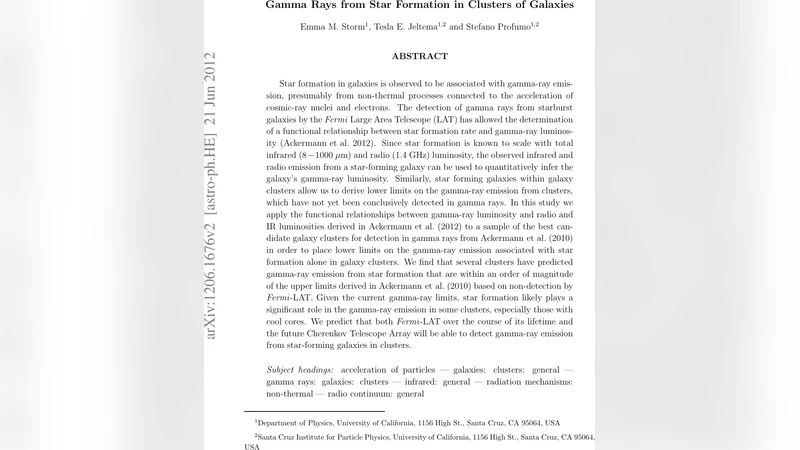
Star formation in galaxies is observed to be associated with gamma-ray emission. The detection of gamma rays from star-forming galaxies by the Fermi Large Area Telescope (LAT) has allowed the determination of a functional relationship between star formation rate and gamma-ray luminosity (Ackermann et. al. 2012). Since star formation is known to scale with total infrared (8-1000 micrometers) and radio (1.4 GHz) luminosity, the observed infrared and radio emission from a star-forming galaxy can be used to quantitatively infer the galaxy’s gamma-ray luminosity. Similarly, star forming galaxies within galaxy clusters allow us to derive lower limits on the gamma-ray emission from clusters, which have not yet been conclusively detected in gamma rays. In this study we apply the relationships between gamma-ray luminosity and radio and IR luminosities derived in Ackermann et. al. 2012 to a sample of galaxy clusters from Ackermann et. al. 2010 in order to place lower limits on the gamma-ray emission associated with star formation in galaxy clusters. We find that several clusters have predicted lower limits on gamma-ray emission that are within an order of magnitude of the upper limits derived in Ackermann et. al. 2010 based on non-detection by Fermi-LAT. Given the current gamma-ray limits, star formation likely plays a significant role in the gamma-ray emission in some clusters, especially those with cool cores. We predict that both Fermi-LAT over the course of its lifetime and the future Cherenkov Telescope Array will be able to detect gamma-ray emission from star-forming galaxies in clusters.
💡 Research Summary
The paper investigates the contribution of star‑forming galaxies within galaxy clusters to the overall gamma‑ray emission expected from those clusters. Building on the empirical relationship established by Ackermann et al. (2012) between star‑formation rate (SFR) and gamma‑ray luminosity, which can be expressed through infrared (8–1000 µm) and 1.4 GHz radio luminosities, the authors use these lower‑energy observables as proxies for the high‑energy output. They select the cluster sample originally examined by Ackermann et al. (2010), comprising 57 galaxy clusters observed with the Fermi Large Area Telescope (LAT). For each cluster they compile infrared and radio fluxes of the member galaxies from archival surveys (e.g., IRAS, NVSS) and apply the Ackermann et al. scaling laws to estimate the gamma‑ray luminosity of each galaxy. Summing over all members yields a lower limit on the cluster‑wide gamma‑ray luminosity that can be attributed solely to star formation.
These lower limits are then compared with the upper limits derived from the non‑detections reported in the 2010 Fermi‑LAT analysis. The comparison shows that several clusters—particularly those hosting cool cores such as Perseus, Abell 2199, and Abell 2029—have predicted star‑formation‑driven gamma‑ray fluxes within an order of magnitude of the current Fermi‑LAT upper limits (typically 0.1–0.3 of the limit). This proximity suggests that star formation could be a dominant or at least a substantial component of any future detection, especially when combined with other possible contributors such as active galactic nuclei or intracluster shock acceleration. In contrast, non‑cool‑core clusters generally have predicted fluxes well below the present limits, implying that star formation alone is unlikely to be detectable there with current instruments.
The authors discuss observational prospects. Continued accumulation of Fermi‑LAT exposure over its operational lifetime will improve sensitivity, potentially bringing the cool‑core clusters above the detection threshold. Moreover, the upcoming Cherenkov Telescope Array (CTA), with its superior sensitivity in the 20 GeV–300 TeV range and improved angular resolution, should be capable of resolving the collective emission from cluster member galaxies and separating it from other high‑energy processes. Detecting this component would provide a new probe of star‑formation activity in dense environments and help quantify the relative importance of different gamma‑ray production mechanisms in galaxy clusters. In summary, the study demonstrates that star formation is a non‑negligible source of gamma‑rays in clusters, especially those with cool cores, and that both extended Fermi‑LAT observations and next‑generation ground‑based gamma‑ray facilities are poised to confirm this prediction.