Kinematic dynamo in spherical Couette flow
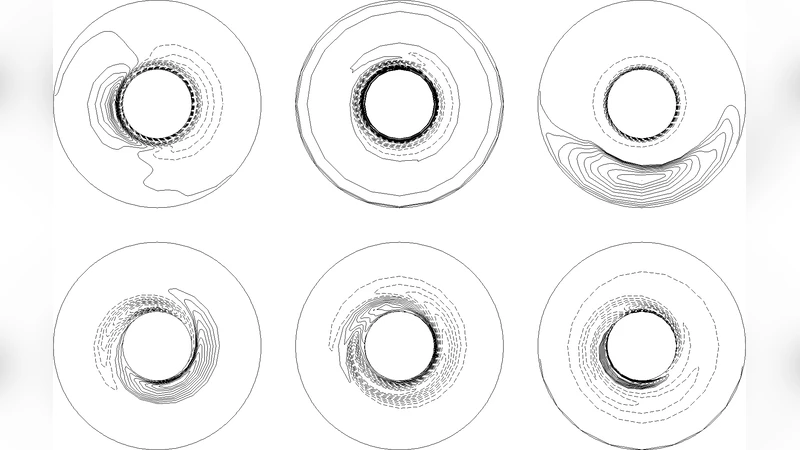
We investigate numerically kinematic dynamos driven by flow of electrically conducting fluid in the shell between two concentric differentially rotating spheres, a configuration normally referred to as spherical Couette flow. We compare between axisymmetric (2D) and fully three dimensional flows, between low and high global rotation rates, between prograde and retrograde differential rotations, between weak and strong nonlinear inertial forces, between insulating and conducting boundaries, and between two aspect ratios. The main results are as follows. Azimuthally drifting Rossby waves arising from the destabilisation of the Stewartson shear layer are crucial to dynamo action. Differential rotation and helical Rossby waves combine to contribute to the spherical Couette dynamo. At a slow global rotation rate, the direction of differential rotation plays an important role in the dynamo because of different patterns of Rossby waves in prograde and retrograde flows. At a rapid global rotation rate, stronger flow supercriticality (namely the difference between the differential rotation rate of the flow and its critical value for the onset of nonaxisymmetric instability) facilitates the onset of dynamo action. A conducting magnetic boundary condition and a larger aspect ratio both favour dynamo action.
💡 Research Summary
The paper presents a comprehensive numerical investigation of kinematic dynamo action in spherical Couette flow, the flow of an electrically conducting fluid confined between two concentric spheres rotating at different angular velocities. By solving the three‑dimensional Navier–Stokes equations together with the magnetic induction equation, the authors explore a wide parameter space that includes the Reynolds number (Re), Ekman number (Ek), magnetic Reynolds number (Rm), aspect ratio (inner‑to‑outer radius), and magnetic boundary conditions (insulating versus conducting). They also compare axisymmetric (2‑D) and fully three‑dimensional (3‑D) flows, low versus high global rotation rates, prograde versus retrograde differential rotation, and weak versus strong inertial forcing.
A central finding is that non‑axisymmetric Rossby waves, which arise from the destabilisation of the Stewartson shear layer, are essential for dynamo action. These waves drift azimuthally under the influence of the Coriolis force and acquire a helical structure that couples toroidal and poloidal magnetic field components, thereby providing an α‑like effect without any imposed external field. In purely axisymmetric simulations the magnetic field decays, confirming that the helicity supplied by the Rossby waves is the key ingredient.
The study distinguishes two regimes of global rotation. At slow global rotation (large Ekman number), the direction of differential rotation strongly influences dynamo onset. Retrograde differential rotation (inner sphere rotating faster than the outer sphere) generates Rossby waves that penetrate deeper into the Stewartson layer, producing stronger toroidal‑poloidal coupling and lowering the critical Rm. Prograde rotation yields waves that remain near the outer boundary, resulting in a higher dynamo threshold. At rapid global rotation (small Ekman number), the super‑criticality of the non‑axisymmetric instability—i.e., how far the imposed differential rotation exceeds the linear stability limit—dominates. When the flow is far above the critical shear, the Rossby waves become more vigorous, the induced currents increase in scale, and dynamo action can be achieved at considerably lower Rm values.
Boundary conditions also play a decisive role. Conducting outer boundaries allow magnetic field lines to be reflected back into the fluid, effectively providing magnetic “feedback” that reduces the critical Rm by roughly 30 % compared with insulating boundaries, where magnetic energy leaks out of the domain. The aspect ratio influences the thickness of the Stewartson layer; a larger inner‑to‑outer radius ratio (e.g., 0.7 instead of 0.5) thins the shear layer, concentrates the Rossby wave activity, and further facilitates dynamo onset.
The authors systematically map out the dynamo threshold in the (Re, Rm) plane for each configuration, showing that the lowest critical Rm is obtained for the combination of rapid global rotation, strong super‑critical differential shear, retrograde rotation, a conducting outer shell, and a large aspect ratio. They discuss the relevance of these results to planetary and stellar dynamos, noting that the Rossby‑wave‑driven helicity mechanism resembles processes thought to operate in planetary cores where strong rotation and shear coexist.
In the concluding section the paper offers practical guidelines for laboratory dynamo experiments based on spherical Couette flow: (1) use a conducting outer shell, (2) select a relatively large inner sphere to increase the aspect ratio, (3) operate at high rotation rates to minimise Ek, (4) impose a retrograde differential rotation that exceeds the linear stability threshold by a comfortable margin, and (5) ensure that the magnetic Reynolds number is above the reduced critical value identified in the simulations. By highlighting the interplay between Stewartson‑layer shear, Rossby‑wave helicity, and magnetic boundary conditions, the work advances our understanding of how purely hydrodynamic instabilities can sustain magnetic fields in rotating spherical shells, with implications for both laboratory dynamo design and the interpretation of natural astrophysical dynamos.
Comments & Academic Discussion
Loading comments...
Leave a Comment