A proposal for factorization using Kerr nonlinearities between three harmonic oscillators
We propose an alternative method to factorize an integer by using three harmonic oscillators. These oscillators are coupled together via specific Kerr nonlinear interactions. This method can be applied even if two harmonic oscillators are prepared in mixed states. As simple examples, we show how to factorize N=15 and 35 using this approach. The effect of dissipation of the harmonic oscillators on the performance of this method is studied. We also study the realization of nonlinear interactions between the coupled oscillators. However, the probability of finding the factors of a number is inversely proportional to its input size. The probability becomes low when this number is large. We discuss the limitations of this approach.
💡 Research Summary
The paper introduces a novel quantum‑inspired algorithm for integer factorisation that relies on three coupled harmonic oscillators (HOs) interacting through a specific Kerr‑type nonlinear term. Unlike conventional digital quantum computers that manipulate discrete qubits, this scheme uses continuous‑variable systems. The authors consider three modes, labelled a, b and c, and engineer a triple‑product Hamiltonian
(H = \chi,\hat n_a\hat n_b\hat n_c),
where (\hat n_j) is the photon‑number operator of mode j and (\chi) is a controllable Kerr coefficient. This interaction generates a phase rotation proportional to the product of the photon numbers in the three modes, effectively implementing a multiplication operation in the quantum dynamics.
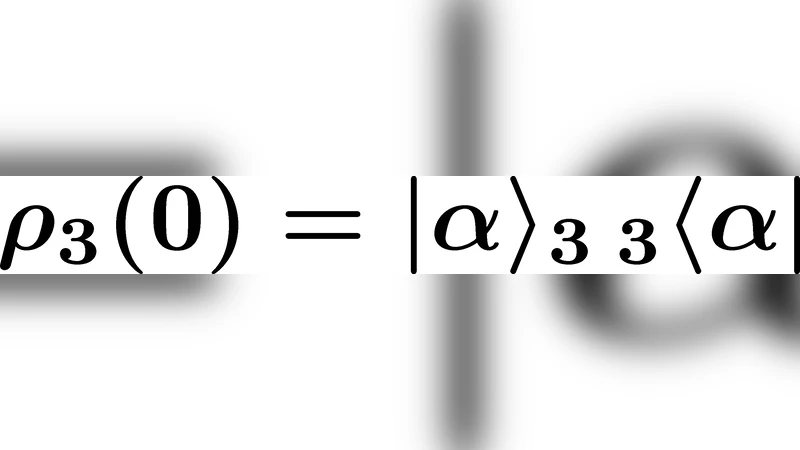
The factorisation protocol proceeds as follows. Candidate factors i and j are encoded into the photon‑number states of modes a and b respectively. The encoding can be binary (each bit mapped to a photon‑number occupation) and does not require pure states; mixed (thermal) states are admissible because the triple‑product phase depends only on the expectation values of the number operators. Mode c is prepared in the vacuum (|0\rangle). The system then evolves under the Hamiltonian for a time t, producing the unitary (\exp(-i\chi t\hat n_a\hat n_b\hat n_c)). Acting on the initial product state this yields
(|i\rangle_a|j\rangle_b|0\rangle_c \rightarrow |i\rangle_a|j\rangle_b| \chi t, i j\rangle_c).
By choosing (\chi t) such that (\chi t, i j = N) for the target integer N, the photon number of mode c becomes exactly N only when the pair (i, j) satisfies (i\times j = N). A subsequent photon‑number measurement on mode c therefore reveals whether the chosen pair is a correct factor pair.
The authors illustrate the method with two small examples, N = 15 and N = 35. For each case they enumerate all possible candidate pairs up to (\sqrt{N}), apply the evolution, and show that the measurement outcome N occurs with a probability proportional to the number of correct pairs (typically two for a semiprime).
A central result of the analysis is that the success probability scales as (1/\sqrt{N}). Consequently, as the integer size grows the algorithm becomes exponentially unlikely to succeed in a single run, requiring many repetitions. This scaling is intrinsic to the random selection of candidate pairs and is not mitigated by quantum parallelism because the scheme does not generate entanglement across a superposition of all candidates.
The paper also investigates the impact of dissipation. Using a Lindblad master equation with loss rate (\kappa) for each oscillator, the authors numerically compute the fidelity of the factor‑retrieval process. They find that the algorithm tolerates only modest loss ((\kappa t \ll 1)); larger loss dephases the Kerr‑induced phase and dramatically reduces the probability of obtaining the correct photon number in mode c.
Regarding physical implementation, three platforms are discussed: (i) superconducting circuit QED, where Josephson junctions provide strong Kerr nonlinearities; (ii) nonlinear optics in fibers or photonic crystal cavities, where effective photon‑photon interactions can be engineered; and (iii) optomechanical systems, where mechanical and optical modes couple via radiation pressure to produce cross‑Kerr terms. In all cases, achieving a genuine three‑mode product interaction is challenging; the authors suggest that sequential two‑mode Kerr interactions combined with ancillary control fields might approximate the desired Hamiltonian.
Finally, the authors acknowledge the limitations of their approach. The inverse‑size probability, the need for relatively strong and low‑loss Kerr couplings, and the absence of a true quantum speed‑up (the algorithm remains essentially probabilistic) restrict its practicality for large‑scale factorisation. They propose future directions such as extending the scheme to more modes to increase the combinatorial space, incorporating error‑correction techniques, or searching for materials with enhanced third‑order nonlinearities.
In summary, the work presents a creative use of continuous‑variable quantum dynamics for a classic number‑theoretic problem. While it does not compete with Shor’s algorithm in terms of asymptotic efficiency, it offers a test‑bed for exploring multi‑mode Kerr interactions, mixed‑state processing, and hybrid quantum‑classical algorithms in platforms that are currently more accessible than full‑scale fault‑tolerant qubit processors.
Comments & Academic Discussion
Loading comments...
Leave a Comment