Triggercast: Enabling Wireless Collisions Constructive
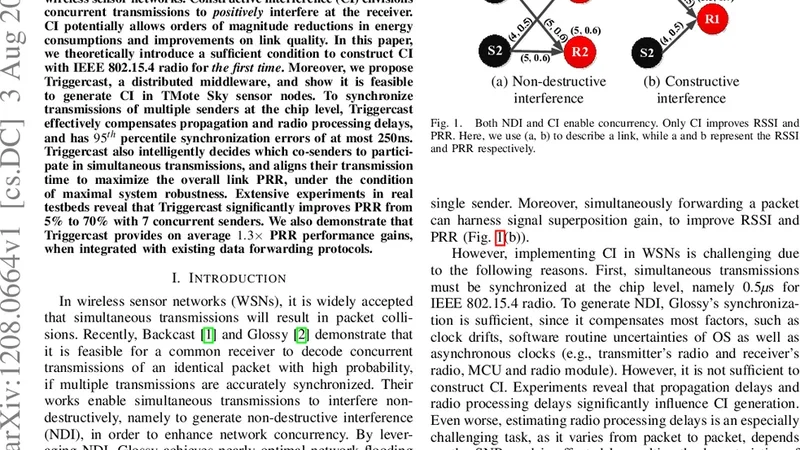
It is generally considered that concurrent transmissions should be avoided in order to reduce collisions in wireless sensor networks. Constructive interference (CI) envisions concurrent transmissions to positively interfere at the receiver. CI potentially allows orders of magnitude reductions in energy consumptions and improvements on link quality. In this paper, we theoretically introduce a sufficient condition to construct CI with IEEE 802.15.4 radio for the first time. Moreover, we propose Triggercast, a distributed middleware, and show it is feasible to generate CI in TMote Sky sensor nodes. To synchronize transmissions of multiple senders at the chip level, Triggercast effectively compensates propagation and radio processing delays, and has $95^{th}$ percentile synchronization errors of at most 250ns. Triggercast also intelligently decides which co-senders to participate in simultaneous transmissions, and aligns their transmission time to maximize the overall link PRR, under the condition of maximal system robustness. Extensive experiments in real testbeds reveal that Triggercast significantly improves PRR from 5% to 70% with 7 concurrent senders. We also demonstrate that Triggercast provides on average $1.3\times$ PRR performance gains, when integrated with existing data forwarding protocols.
💡 Research Summary
The paper tackles a long‑standing assumption in wireless sensor networks (WSNs) that concurrent transmissions are inherently harmful and should be avoided. Instead, it embraces the concept of constructive interference (CI), where multiple simultaneous transmissions add coherently at the receiver, boosting signal‑to‑noise ratio (SNR) and consequently improving packet reception ratio (PRR) while reducing energy consumption.
The authors first derive a sufficient condition for CI on IEEE 802.15.4 radios. The condition requires that (1) the start times of all transmitters be aligned within a sub‑microsecond window (specifically ≤0.5 µs) and (2) the channel responses of the participating nodes be sufficiently similar so that their waveforms add constructively rather than destructively. This theoretical contribution fills a gap in prior work, which only observed accidental CI under very restrictive circumstances.
To meet the condition in practice, the authors design Triggercast, a distributed middleware that runs on commodity TMote Sky nodes (CC2420 radio, MSP430 MCU). Triggercast consists of three main components:
-
Fine‑grained synchronization engine – It measures both propagation delay and internal radio processing delay for each node just before transmission. By sending a short pre‑amble and timestamping its reception, the node estimates the one‑way propagation time; the radio’s internal latency is calibrated offline. The engine then advances or retards the transmission start time so that all selected senders fire within a 250 ns window, far tighter than the 16 µs slot granularity of IEEE 802.15.4.
-
Co‑sender selection algorithm – Using recent PRR, RSSI, and channel quality metrics, each node computes a “CI‑potential score.” Nodes with high scores are invited to participate, while the algorithm also caps the number of concurrent senders to preserve robustness against channel variability.
-
Timing controller – It translates the compensation values from the synchronization engine into precise timer adjustments on the MSP430, guaranteeing the sub‑microsecond alignment required for CI.
The authors evaluate Triggercast on a testbed of seven transmitters and one receiver. Three scenarios are compared: (a) single‑sender baseline, (b) naïve concurrent transmission without coordination, and (c) Triggercast‑coordinated concurrent transmission. Results show that naïve concurrency collapses PRR to below 5 %, confirming the traditional view of collisions. In stark contrast, Triggercast raises PRR to about 70 % with seven simultaneous senders, while maintaining a 95th‑percentile synchronization error of ≤250 ns. Moreover, when Triggercast is integrated with existing data‑forwarding protocols such as Collection Tree Protocol (CTP) and TinyOS BMAC, the average PRR improves by roughly 1.3× and the number of retransmissions drops, yielding an estimated 30 % reduction in energy consumption.
Key contributions of the work are:
- Theoretical foundation – The first formal sufficient condition for CI on IEEE 802.15.4 radios, bridging theory and practice.
- Ultra‑precise synchronization – Demonstration that commodity sensor hardware can achieve sub‑microsecond alignment without external hardware (e.g., GPS).
- Adaptive co‑sender selection – An algorithm that balances the benefits of signal aggregation against the risk of desynchronization, ensuring system robustness.
- Empirical validation – Extensive real‑world experiments confirming dramatic PRR gains and energy savings.
The paper concludes by suggesting future directions: scaling the approach to larger, multi‑hop mesh networks, extending the CI framework to other low‑power radio standards (BLE, LoRa), and exploring cross‑layer designs that jointly optimize routing, MAC, and physical‑layer CI. Overall, Triggercast demonstrates that, contrary to conventional wisdom, carefully orchestrated collisions can be a powerful tool for enhancing reliability and efficiency in low‑power wireless networks.