Multidimensional extension of the Morse--Hedlund theorem
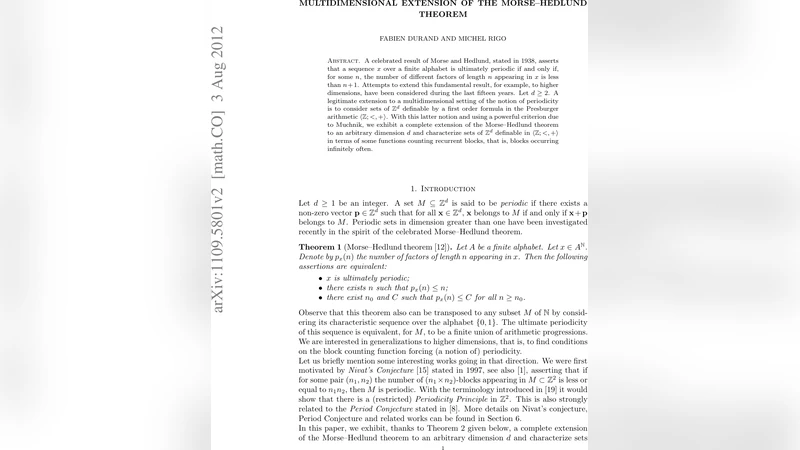
A celebrated result of Morse and Hedlund, stated in 1938, asserts that a sequence $x$ over a finite alphabet is ultimately periodic if and only if, for some $n$, the number of different factors of length $n$ appearing in $x$ is less than $n+1$. Attempts to extend this fundamental result, for example, to higher dimensions, have been considered during the last fifteen years. Let $d\ge 2$. A legitimate extension to a multidimensional setting of the notion of periodicity is to consider sets of $\ZZ^d$ definable by a first order formula in the Presburger arithmetic $<\ZZ;<,+>$. With this latter notion and using a powerful criterion due to Muchnik, we exhibit a complete extension of the Morse–Hedlund theorem to an arbitrary dimension $d$ and characterize sets of $\ZZ^d$ definable in $<\ZZ;<,+>$ in terms of some functions counting recurrent blocks, that is, blocks occurring infinitely often.
💡 Research Summary
The paper presents a full multidimensional generalization of the classic Morse–Hedlund theorem, which in one dimension characterizes ultimately periodic sequences by the existence of a length n for which the number of distinct factors of length n is at most n + 1. The authors argue that the naïve extension of periodicity to ℤᵈ—requiring a single non‑zero period vector p such that x∈M ⇔ x + p∈M for all x—fails to capture the richness of higher‑dimensional structures. Instead, they adopt the notion of periodicity given by definability in Presburger arithmetic ⟨ℤ;<,+⟩: a set M⊆ℤᵈ is “periodic” precisely when it can be described by a first‑order formula over this structure. Such sets are exactly the semilinear sets, i.e., finite unions of linear sets of the form a + ℕ·v₁ + … + ℕ·v_k.
The central technical tool is Muchnik’s local periodicity condition. Roughly, a finite set V⊂ℤᵈ{0} is a set of local periods if, beyond some radius L, every point x has a neighbourhood of fixed size K in which one of the vectors v∈V acts as a period (i.e., M is v‑periodic inside that neighbourhood). Muchnik proved that a subset of ℤᵈ is Presburger‑definable iff it is semilinear, iff every coordinate‑section is Presburger‑definable and the set satisfies this local periodicity condition.
The main result (Theorem 2) states that a set M⊆ℤᵈ is Presburger‑definable if and only if two conditions hold:
- The recurrent block complexity R_M(n) grows at most like O(n^{d‑1}). Here R_M(n) counts the number of distinct n×…×n blocks that appear infinitely often in the characteristic word of M; it is a refinement of the usual block complexity p_M(n) which counts all distinct blocks.
- Every (d‑1)‑dimensional section of M (obtained by fixing one coordinate) is itself Presburger‑definable.
Condition 1 is a natural multidimensional analogue of the Morse–Hedlund bound (in dimension 1, R_M(n)≤n is equivalent to ultimate periodicity). Condition 2 is essential: the authors exhibit examples (e.g., a set built from the Fibonacci word) where R_M(n) satisfies the bound but some sections are not Presburger‑definable, showing that the section requirement cannot be omitted.
The proof splits into two parts. For d = 2 the authors adapt lemmas from earlier works (e.g.,
Comments & Academic Discussion
Loading comments...
Leave a Comment