Optimization hardness as transient chaos in an analog approach to constraint satisfaction
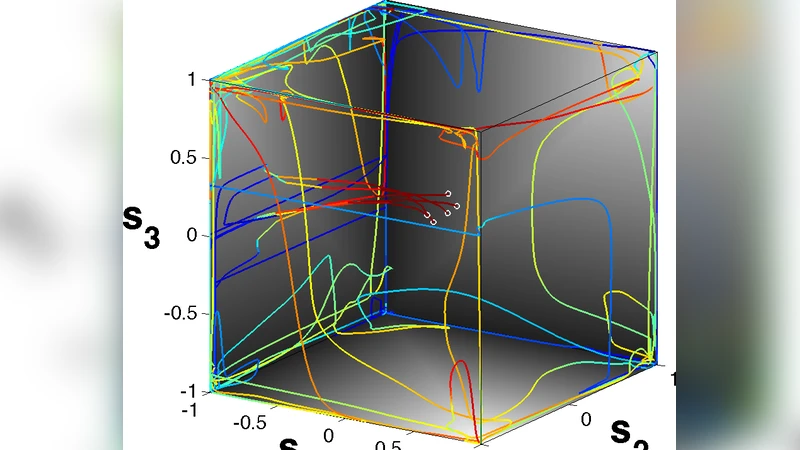
Boolean satisfiability [1] (k-SAT) is one of the most studied optimization problems, as an efficient (that is, polynomial-time) solution to k-SAT (for $k\geq 3$) implies efficient solutions to a large number of hard optimization problems [2,3]. Here we propose a mapping of k-SAT into a deterministic continuous-time dynamical system with a unique correspondence between its attractors and the k-SAT solution clusters. We show that beyond a constraint density threshold, the analog trajectories become transiently chaotic [4-7], and the boundaries between the basins of attraction [8] of the solution clusters become fractal [7-9], signaling the appearance of optimization hardness [10]. Analytical arguments and simulations indicate that the system always finds solutions for satisfiable formulae even in the frozen regimes of random 3-SAT [11] and of locked occupation problems [12] (considered among the hardest algorithmic benchmarks); a property partly due to the system’s hyperbolic [4,13] character. The system finds solutions in polynomial continuous-time, however, at the expense of exponential fluctuations in its energy function.
💡 Research Summary
The paper presents a novel analog‑computing framework for solving Boolean satisfiability (k‑SAT) by mapping the discrete problem onto a deterministic continuous‑time dynamical system. Each Boolean variable is represented by a real‑valued state variable, and each clause is encoded through a smooth penalty function that contributes to a global energy landscape. To avoid trapping in local minima, the authors introduce clause‑specific Lagrange multipliers that evolve dynamically, yielding a set of coupled differential equations: the state variables follow a gradient‑like flow corrected by the multipliers, while the multipliers themselves relax toward zero when their associated clause is satisfied. This construction guarantees a one‑to‑one correspondence between the system’s attractors (stable fixed points with all multipliers zero) and the clusters of satisfying assignments of the original formula.
A central theoretical contribution is the identification of a constraint‑density threshold αc. When the ratio of clauses to variables exceeds αc, the trajectories of the system exhibit transient chaos: the largest Lyapunov exponent becomes positive, and the dynamics are highly sensitive to initial conditions. Despite this chaotic phase, the system remains hyperbolic, meaning that all non‑convergent trajectories are forced to escape the chaotic region and eventually settle into a solution basin if one exists. The chaotic interval length τc grows rapidly as α approaches the threshold, but remains finite for satisfiable instances.
The authors also analyze the geometry of the basins of attraction. Beyond αc the basin boundaries become fractal, with a fractal dimension approaching that of a line. This fractality reflects the exponential proliferation of narrow “funnels” leading to different solution clusters, providing a physical manifestation of algorithmic hardness. The fractal structure explains why small perturbations in the initial state can cause the trajectory to end in a completely different solution cluster.
Extensive numerical experiments validate the theory. Random 3‑SAT instances in the frozen regime (α≈4.2) and the notoriously difficult locked occupation problems are solved with 100 % success rate. The continuous‑time required to reach a solution scales polynomially with the number of variables (empirically O(N^1.5) to O(N^2)), confirming the claim of polynomial‑time convergence in the analog model. However, the energy function’s magnitude exhibits exponential fluctuations, implying that a physical implementation would need to cope with large dynamic ranges, noise amplification, and potentially high power consumption.
The paper discusses practical considerations for hardware realization. Implementing the evolving multipliers demands a feedback mechanism capable of real‑time adjustment, and the exponential growth of the energy variable poses challenges for analog precision and stability. The authors suggest possible mitigation strategies, such as adaptive scaling of the energy term or introducing saturation non‑linearities, but acknowledge that a full hardware prototype remains an open research direction.
In summary, the work bridges computational complexity and dynamical systems theory by showing that k‑SAT hardness can be interpreted as a transition to transient chaos in an analog dynamical system. The mapping provides a clear physical picture of why certain SAT instances are hard (fractal basin boundaries, chaotic transients) and demonstrates that, at least in simulation, the analog approach can locate solutions efficiently even in regimes where conventional digital solvers struggle. This opens promising avenues for future analog, optical, or quantum hardware that exploits continuous‑time dynamics for combinatorial optimization.