Axiomatizing first order consequences in dependence logic
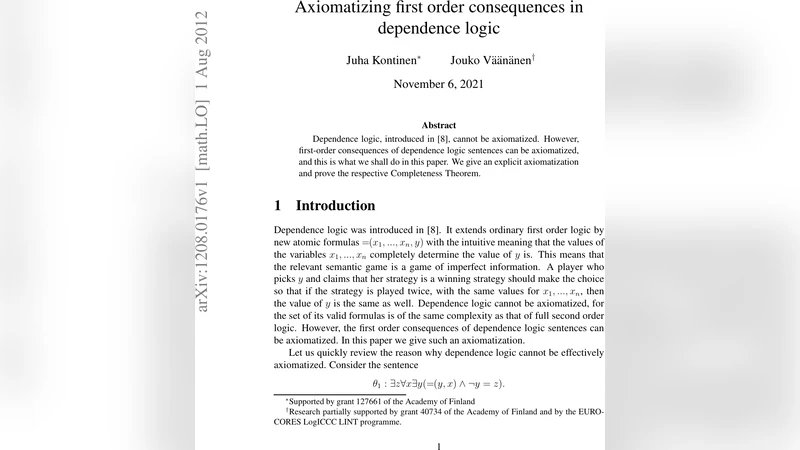
Dependence logic, introduced in [8], cannot be axiomatized. However, first-order consequences of dependence logic sentences can be axiomatized, and this is what we shall do in this paper. We give an explicit axiomatization and prove the respective Completeness Theorem.
💡 Research Summary
The paper addresses a long‑standing obstacle in the study of Dependence Logic (DL): the fact that DL, interpreted via team semantics, cannot be captured by any effective axiomatization because it is equivalent in expressive power to existential second‑order logic (Σ₁¹). Rather than attempting to axiomatize the full logic, the authors focus on a more modest but still highly relevant fragment – the set of first‑order consequences of DL sentences. In other words, they ask: given a DL sentence φ and a first‑order formula ψ, can we develop a proof system that derives ψ from φ exactly when φ semantically entails ψ under team semantics?
The authors begin by recalling the syntax of DL, which extends ordinary first‑order logic with dependence atoms of the form = (𝑥̄, y) expressing that the value of y is functionally determined by the tuple 𝑥̄. The semantics is given in terms of teams, i.e., sets of assignments, and satisfaction is defined pointwise for first‑order literals but globally for dependence atoms. This team‑based semantics makes DL non‑compact and non‑axiomatizable in the usual sense.
To isolate the first‑order fragment, the paper introduces a normal‑form translation that converts any DL sentence into an equivalent prenex first‑order formula together with a collection of auxiliary dependence constraints. The translation proceeds in two stages: (1) each dependence atom = (𝑥̄, y) is replaced by a fresh relation symbol R𝑥̄y together with axioms that enforce functional dependence, and (2) the resulting formula is pushed into prenex form using standard quantifier manipulation. Crucially, the translation preserves the entailment relation between the original DL sentence and any first‑order formula: φ ⊨ ψ iff the translated version of φ entails ψ in ordinary first‑order semantics.
Building on this translation, the authors propose a Hilbert‑style proof system. The core of the system is the usual axioms and inference rules of first‑order logic. On top of that, they add three families of rules tailored to dependence:
- Team‑Extension Rule – allows the introduction of new variables into a team while preserving existing dependencies.
- Dependence‑Transitivity Rule – from = (𝑥̄, y) and = (𝑥̄ y, z) infer = (𝑥̄, z).
- Quantifier‑Transfer Rule – governs how existential and universal quantifiers may be moved across dependence atoms without breaking the functional relationship.
Each rule is proved sound with respect to team semantics; that is, any formula derived by the system is indeed a first‑order consequence of the original DL sentence.
The completeness proof is divided into a model‑construction phase and a proof‑reconstruction phase. In the first phase, assuming φ ⊨ ψ, the authors build a Henkin‑style team model that satisfies φ and witnesses ψ. The construction uses Skolem functions to represent the functional dependencies encoded by the dependence atoms, thereby turning the team into a structure where the dependence constraints become ordinary functional equations. In the second phase, they show that the same Skolem functions can be used to derive ψ from φ within the proof system. A key auxiliary lemma – the “Normal‑Form Preservation Lemma” – guarantees that the translation does not alter the entailment relationship, allowing the authors to lift a standard first‑order completeness argument to the team‑semantic setting.
The main theorem, therefore, states: for any DL sentence φ and any first‑order formula ψ, φ ⊨ ψ (team semantics) if and only if φ ⊢ ψ (in the proposed axiomatization). This establishes a full completeness result for the first‑order fragment of DL.
In the concluding section, the authors discuss the significance of their result. While the full DL remains non‑axiomatizable, the ability to axiomatize its first‑order consequences provides a powerful tool for both theoretical investigations and practical applications such as database theory, where functional dependencies are central. Moreover, the proof system offers a template for extending axiomatizations to related logics that also employ team semantics, such as inclusion logic or independence logic. The paper suggests several avenues for future work, including complexity analysis of the proof system, implementation of automated theorem provers for the fragment, and exploration of whether similar axiomatizations can be obtained for higher‑order consequences.
Overall, the work makes a substantial contribution by carving out a tractable, axiomatizable core of Dependence Logic and by delivering a rigorous completeness theorem that bridges the gap between team‑semantic semantics and classical proof theory.