Linear kernels and single-exponential algorithms via protrusion decompositions
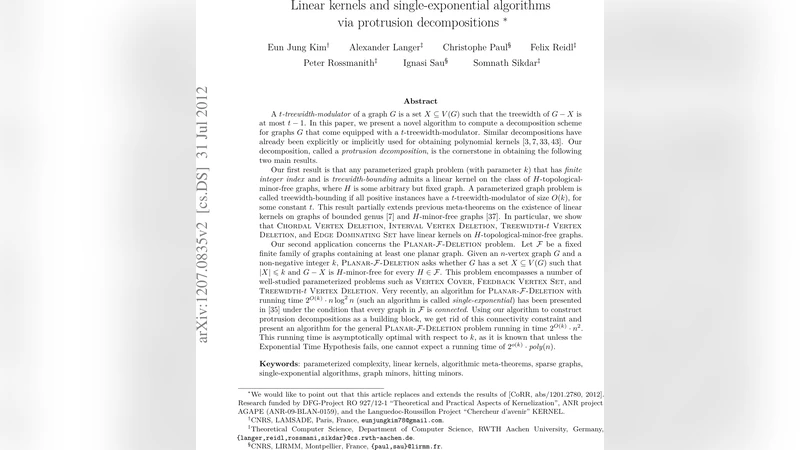
A \emph{$t$-treewidth-modulator} of a graph $G$ is a set $X \subseteq V(G)$ such that the treewidth of $G-X$ is at most some constant $t-1$. In this paper, we present a novel algorithm to compute a decomposition scheme for graphs $G$ that come equipped with a $t$-treewidth-modulator. This decomposition, called a \emph{protrusion decomposition}, is the cornerstone in obtaining the following two main results. We first show that any parameterized graph problem (with parameter $k$) that has \emph{finite integer index} and is \emph{treewidth-bounding} admits a linear kernel on $H$-topological-minor-free graphs, where $H$ is some arbitrary but fixed graph. A parameterized graph problem is called treewidth-bounding if all positive instances have a $t$-treewidth-modulator of size $O(k)$, for some constant $t$. This result partially extends previous meta-theorems on the existence of linear kernels on graphs of bounded genus [Bodlaender et al., FOCS 2009] and $H$-minor-free graphs [Fomin et al., SODA 2010]. Our second application concerns the Planar-$\mathcal{F}$-Deletion problem. Let $\mathcal{F}$ be a fixed finite family of graphs containing at least one planar graph. Given an $n$-vertex graph $G$ and a non-negative integer $k$, Planar-$\mathcal{F}$-Deletion asks whether $G$ has a set $X\subseteq V(G)$ such that $|X|\leq k$ and $G-X$ is $H$-minor-free for every $H\in \mathcal{F}$. Very recently, an algorithm for Planar-$\mathcal{F}$-Deletion with running time $2^{O(k)} n \log^2 n$ (such an algorithm is called \emph{single-exponential}) has been presented in [Fomin et al., FOCS 2012] under the condition that every graph in $\mathcal{F}$ is connected. Using our algorithm to construct protrusion decompositions as a building block, we get rid of this connectivity constraint and present an algorithm for the general Planar-$\mathcal{F}$-Deletion problem running in time $2^{O(k)} n^2$.
💡 Research Summary
The paper introduces a powerful structural tool for parameterized graph algorithms: a protrusion decomposition built from a t‑treewidth‑modulator. A t‑treewidth‑modulator is a vertex set X such that removing X leaves a graph of treewidth at most t‑1. The authors present an algorithm that, given a graph G together with a modulator of size O(k), partitions G into O(k) “protrusions”. Each protrusion has a constant‑size boundary and bounded treewidth, making it amenable to finite‑state dynamic programming and to the machinery of finite integer index (FII) problems.
Using this decomposition, the authors prove two meta‑theorems. The first states that any parameterized graph problem that (i) has finite integer index and (ii) is treewidth‑bounding (i.e., every yes‑instance possesses a t‑modulator of size O(k) for some constant t) admits a linear kernel on the class of H‑topological‑minor‑free graphs, where H is any fixed graph. This extends earlier results that were limited to bounded‑genus or H‑minor‑free graph families. The proof follows the classic “reduce‑to‑representative‑set” paradigm: each protrusion is replaced by a constant‑size representative that preserves the answer for the whole instance, and because there are only O(k) protrusions, the total size shrinks to O(k).
The second application focuses on the Planar‑𝔽‑Deletion problem. Given a graph G, an integer k, and a finite family 𝔽 containing at least one planar graph, the task is to delete at most k vertices so that the remaining graph excludes every H ∈ 𝔽 as a minor. Prior work achieved a single‑exponential algorithm (running time 2^{O(k)} · n log² n) only when every graph in 𝔽 is connected. By employing the protrusion decomposition, the authors remove this connectivity restriction. They first compute a t‑modulator of size O(k) (for a suitable constant t) and then decompose the graph into protrusions. Because each protrusion has bounded treewidth, a dynamic program can solve the deletion problem on it in time exponential only in the boundary size, which is constant. Combining the solutions of all protrusions yields an overall algorithm with running time 2^{O(k)} · n². Although the polynomial factor is quadratic rather than near‑linear, the algorithm is truly single‑exponential in k and works for arbitrary (possibly disconnected) families 𝔽.
The technical contributions can be summarized as follows:
- Protrusion decomposition from a t‑modulator – a constructive method that guarantees a linear number of protrusions with constant‑size interfaces.
- Linear‑kernel meta‑theorem for FII and treewidth‑bounding problems – applicable to the broad class of H‑topological‑minor‑free graphs, thus unifying and extending previous kernelization results.
- Generalized single‑exponential algorithm for Planar‑𝔽‑Deletion – eliminates the connectivity assumption on 𝔽 and achieves 2^{O(k)} · n² time using the decomposition as a core subroutine.
Overall, the work bridges structural graph theory (modulators, protrusions, topological minors) with algorithmic meta‑theorems, providing a versatile framework that can be reused for many other parameterized problems where bounded treewidth after a small vertex deletion is guaranteed.
Comments & Academic Discussion
Loading comments...
Leave a Comment