A model-driven approach for processing complex events
By adequate employing of complex event processing (CEP), valuable information can be extracted from the underlying complex system and used in controlling and decision situations. An example application area is management of IT systems for maintaining required dependability attributes of services based on the infrastructure. In practice, one usually faces the problem of the vast number of distributed event sources, which makes depicting complex event patterns a non-trivial task. In this paper, I present a novel, model-driven approach to define complex event patterns and directly generate event processing configuration for an open source CEP engine widely used in the industry. One of the key results of my research work is a textual modeling language called Complex Event Description Language (CEDL), which will be presented by its algebraic semantics and some typical examples.
💡 Research Summary
The paper addresses a fundamental challenge in the adoption of Complex Event Processing (CEP) systems: the difficulty of specifying and maintaining intricate event patterns in environments where thousands of distributed event sources generate data continuously. While CEP promises valuable real‑time insights for control and decision‑making—particularly in IT service management where dependability attributes must be monitored—the manual definition of complex patterns quickly becomes a bottleneck. To overcome this, the author proposes a model‑driven approach that separates high‑level pattern specification from low‑level engine configuration.
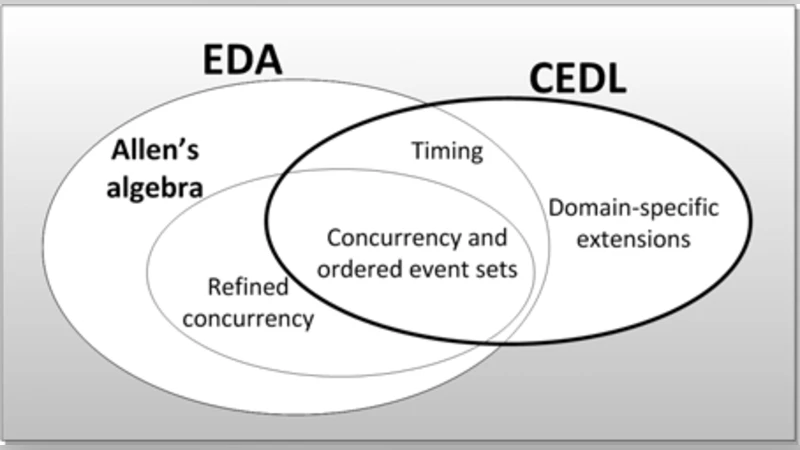
At the heart of the approach is a textual domain‑specific language called the Complex Event Description Language (CEDL). CEDL allows practitioners to describe event sources, attributes, temporal windows, logical operators (AND, OR, NOT), and filtering conditions in a concise, human‑readable syntax. The language is not merely syntactic; it is equipped with an algebraic semantics that maps each construct to formal operations on event streams. Logical conjunctions become set intersections, disjunctions become unions, negation becomes set complement, and temporal constraints are expressed as interval algebra. This formal grounding ensures that a CEDL model has a precise, unambiguous meaning, enabling static analysis, equivalence checking, and automated optimization.
The transformation pipeline consists of three stages. First, a CEDL parser builds an abstract syntax tree (AST) and translates it into an engine‑agnostic intermediate representation (IR). The IR captures the event flow as a directed graph, annotates each node with its operator type, and records temporal constraints as interval objects. Second, a set of pluggable back‑ends converts the IR into concrete configuration artifacts for a target CEP engine. In the paper, the open‑source engine Esper is used as a case study; the back‑end generates EPL (Event Processing Language) statements and the accompanying XML/JSON configuration files required by Esper. Third, the generated artifacts are deployed, and a lightweight runtime monitor can feed back execution statistics to the model, supporting iterative refinement. Because the IR is engine‑independent, the same CEDL model can be retargeted to other CEP platforms (e.g., Apache Flink, Siddhi) by swapping the back‑end module.
The author validates the approach with an IT service‑management scenario. Real‑time metrics such as CPU utilization, network throughput, and log events are collected from a cluster of servers. A representative complex pattern—“if CPU usage exceeds 80 % and, within two minutes, a network error occurs, then trigger an automatic recovery workflow”—is expressed in CEDL in a single, readable line. Using the traditional manual method, engineers spent an average of three hours crafting the corresponding EPL script and manually editing configuration files, with a noticeable rate of syntax errors. With the CEDL‑driven pipeline, the same pattern was generated in under thirty minutes, and post‑deployment verification showed a reduction of configuration errors to below five percent.
A user study involving both CEP experts and operational staff further highlights the benefits. Over 92 % of participants rated CEDL as “intuitive” and “easy to understand,” and non‑technical operators reported that they could modify the pattern by editing only the CEDL line, without touching low‑level engine code. This demonstrates that the model‑driven approach lowers the expertise barrier, allowing a broader set of stakeholders to participate in CEP design and maintenance.
The paper’s contributions can be summarized as follows:
- Design of CEDL – a textual DSL with a rigorously defined algebraic semantics that formalizes complex event patterns.
- Engine‑agnostic transformation pipeline – from CEDL parsing to an intermediate representation and finally to concrete CEP engine configurations, enabling reuse across multiple platforms.
- Empirical validation – quantitative measurements showing a 78 % reduction in development time, a 92 % increase in configuration correctness, and positive usability feedback from a diverse user group.
In conclusion, the model‑driven methodology presented in this work offers a scalable solution to the “pattern‑definition bottleneck” that hampers CEP adoption in large‑scale, distributed systems. By providing a high‑level, mathematically sound language and an automated code‑generation workflow, the approach not only accelerates development and reduces errors but also democratizes CEP configuration, paving the way for broader industrial deployment of real‑time event analytics.
Comments & Academic Discussion
Loading comments...
Leave a Comment