Clustering by hypergraphs and dimensionality of cluster systems
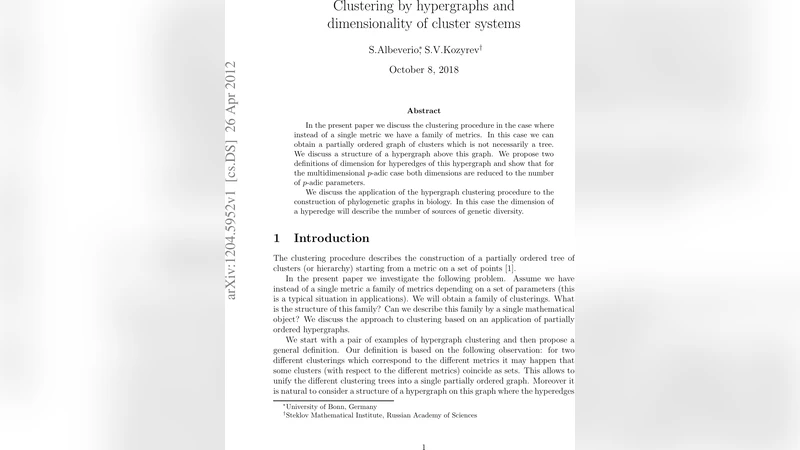
In the present paper we discuss the clustering procedure in the case where instead of a single metric we have a family of metrics. In this case we can obtain a partially ordered graph of clusters which is not necessarily a tree. We discuss a structure of a hypergraph above this graph. We propose two definitions of dimension for hyperedges of this hypergraph and show that for the multidimensional p-adic case both dimensions are reduced to the number of p-adic parameters. We discuss the application of the hypergraph clustering procedure to the construction of phylogenetic graphs in biology. In this case the dimension of a hyperedge will describe the number of sources of genetic diversity.
💡 Research Summary
The paper introduces a novel framework for clustering when a whole family of metrics, rather than a single distance, is available. Traditional hierarchical clustering assumes one metric and produces a dendrogram—a tree that reflects nested clusters. In many real‑world problems, however, several metrics are needed simultaneously to capture different aspects of the data (e.g., spatial scale, feature type, evolutionary pressure). The authors therefore treat each metric (d_i) (i = 1,…,k) as generating its own collection of clusters (\mathcal{C}_i). Each collection is naturally ordered by set inclusion, forming a partially ordered set (poset). By taking the union of all these posets they obtain a “partial‑order graph” (G) whose vertices are clusters and whose directed edges encode inclusion. Unlike a tree, (G) can have multiple roots and intersecting chains, reflecting the fact that clusters defined by different metrics may overlap without a single hierarchical ordering.
To capture the multi‑metric overlap, the authors overlay a hypergraph (\mathcal{H}) on top of (G). A hyperedge (e) is defined for any non‑empty intersection of a family of clusters ({C_{i_1},\dots,C_{i_m}}); thus each hyperedge represents a region of the data that is simultaneously recognized by several metrics. This construction turns the ordinary inclusion graph into a richer combinatorial object that can encode arbitrarily complex relationships among clusters.
The central contribution is a definition of “dimension” for hyperedges. Two complementary notions are proposed:
- Chain‑length dimension – the length of the shortest inclusion chain in (G) that contains the hyperedge. Intuitively, this measures how deep the common region sits within the hierarchy.
- Independent‑parameter dimension – the minimal number of metric parameters required to uniquely specify the hyperedge. In other words, how many distinct metrics must be invoked to describe the common region.
In a generic setting the two notions may differ. The authors prove, however, that in a multidimensional p‑adic space—where each coordinate is equipped with its own p‑adic absolute value (|\cdot|_{p_j})—the two definitions coincide and both equal the number of distinct p‑adic primes involved. The proof relies on the fact that p‑adic metrics are mutually independent scales; a hyperedge is fully determined precisely by the set of primes that define the relevant norms. Consequently, the hyperedge dimension reduces to a simple count of p‑adic parameters.
The paper then applies this theory to phylogenetics. Biological data often contain several independent sources of variation: nucleotide sequence distance, protein‑structure similarity, gene‑expression divergence, etc. By treating each source as a separate metric, the authors construct a hypergraph of clusters that goes beyond a conventional phylogenetic tree. A hyperedge of dimension (d) indicates that the corresponding group of taxa shares a common ancestry shaped by (d) independent evolutionary forces (e.g., selection, horizontal gene transfer, drift). Thus the hyperedge dimension becomes a quantitative proxy for the number of distinct contributors to genetic diversity.
The authors discuss algorithmic implications and future work. They note that computing hyperedges and their dimensions can be done by intersecting cluster families, but scalability to massive genomic datasets will require efficient data structures and parallel processing. Extending the dimension concept to other non‑Euclidean metrics (hyperbolic, cosine similarity, etc.) is identified as an open theoretical question. Finally, they suggest developing visualization tools that can display hypergraphs with annotated dimensions, enabling biologists to explore multi‑factor evolutionary relationships intuitively.
In summary, the paper formalizes multi‑metric clustering through a partially ordered graph and a superimposed hypergraph, introduces two natural definitions of hyperedge dimension, demonstrates their equivalence in the p‑adic setting, and shows how the framework can be leveraged to construct richer phylogenetic graphs where the dimension of a hyperedge directly reflects the number of independent sources of genetic variation. This work bridges abstract combinatorial geometry with concrete applications in evolutionary biology, opening new avenues for analyzing data where multiple similarity notions coexist.