Filamentary Extension of the Mem-Con theory of Memristance and its Application to Titanium Dioxide Sol-Gel Memristors
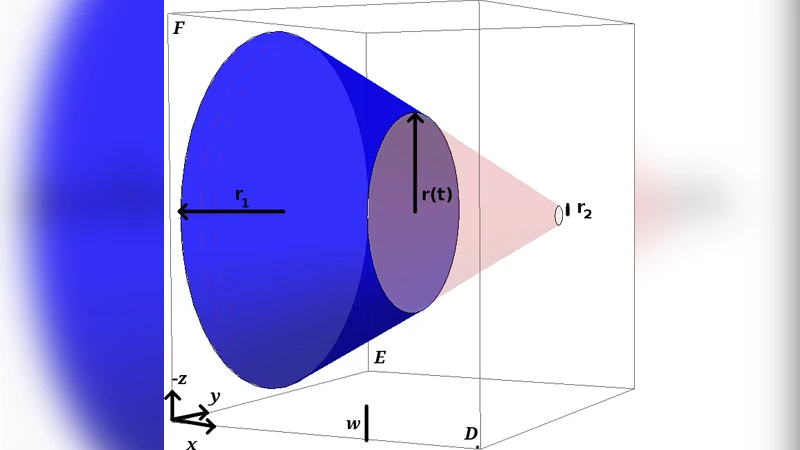
Titanium dioxide sol-gel memristors have two different modes of operation, believed to be dependent on whether there is bulk memristance, i.e. memristance throughout the whole volume or filamentary memristance, i.e. memristance caused by the connection of conducting filaments. The mem-con theory of memristance is based on the drift of oxygen vacancies rather than that of conducting electrons and has been previously used to describe bulk memristance in several devices. Here, the mem-con theory is extended to model memristance caused by small filaments of low resistance titanium dioxide and it compares favorably to experimental results for filamentary memristance in sol-gel devices.
💡 Research Summary
The paper addresses the dual‑mode operation observed in titanium‑dioxide (TiO₂) sol‑gel memristors: a bulk mode in which the entire device volume exhibits a gradual resistance change, and a filamentary mode in which a low‑resistance conductive filament forms and ruptures, producing abrupt switching. The authors extend the previously proposed mem‑con (memory‑conservation) theory, which attributes memristance to the drift of oxygen vacancies rather than to electronic conduction, to capture the filamentary behavior.
In the original mem‑con framework, the device is treated as a homogeneous medium; the vacancy concentration evolves under an electric field according to a drift velocity v = μ_v E, where μ_v is the vacancy mobility. This leads to a continuous, monotonic change of the device resistance as the vacancy front advances. However, sol‑gel TiO₂ films are highly defective and support the spontaneous nucleation of conductive pathways when a sufficient electric field is applied. The authors therefore introduce a “conductive nucleus” that grows into a filament by collecting vacancies from the surrounding matrix. The filament’s cross‑sectional area A(t) expands exponentially with the time‑integrated electric field, A(t) = A₀ exp