A survey of graphical languages for monoidal categories
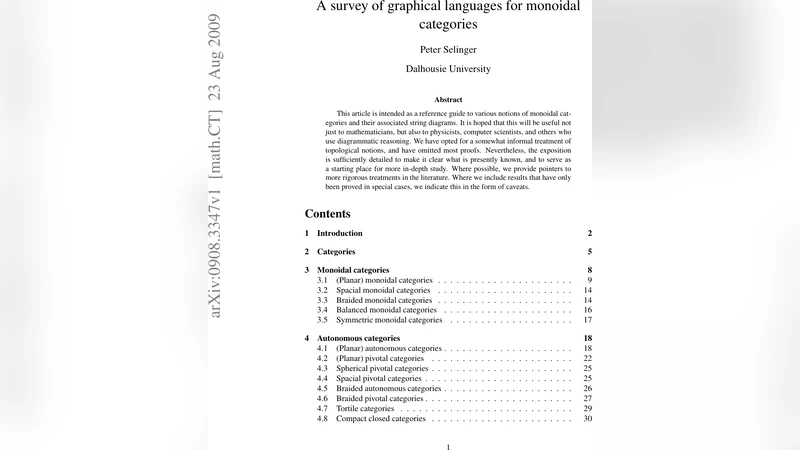
This article is intended as a reference guide to various notions of monoidal categories and their associated string diagrams. It is hoped that this will be useful not just to mathematicians, but also to physicists, computer scientists, and others who use diagrammatic reasoning. We have opted for a somewhat informal treatment of topological notions, and have omitted most proofs. Nevertheless, the exposition is sufficiently detailed to make it clear what is presently known, and to serve as a starting place for more in-depth study. Where possible, we provide pointers to more rigorous treatments in the literature. Where we include results that have only been proved in special cases, we indicate this in the form of caveats.
💡 Research Summary
The paper serves as a comprehensive reference guide to the myriad graphical languages that have been developed for monoidal categories and their various extensions. It begins with a concise review of the basic categorical notions—objects, morphisms, functors, and natural transformations—before focusing on the monoidal structure itself, i.e., a tensor product ⊗ together with a unit object I. The authors distinguish between strict monoidal categories, where associativity and unit laws hold on the nose, and weak (or general) monoidal categories, where these laws are mediated by natural isomorphisms (the associator and left/right unitors).
The core of the survey is the introduction of string diagrams (also called string or graphical calculus) as a visual syntax for morphisms in monoidal categories. In this syntax, objects are represented by wires, morphisms by boxes, tensor product by parallel juxtaposition of wires, and composition by sequential connection. The authors adopt the Joyal‑Street framework, emphasizing the pivotal coherence theorem: two diagrams denote the same morphism precisely when they are related by planar isotopy (continuous deformation without cutting or gluing). This result underpins the claim that diagrammatic reasoning can replace many algebraic calculations.
The paper then systematically surveys the main families of monoidal categories and the corresponding extensions of the diagrammatic language:
- Braided monoidal categories – a braiding β_{A,B}: A⊗B → B⊗A is introduced, allowing wires to cross. The braid relations (hexagon equations) become the coherence conditions for crossing manipulations.
- Symmetric monoidal categories – the braiding is involutive (β_{B,A}∘β_{A,B}=id), which means wires may be swapped freely. This is the setting for most classical applications in computer science and physics.
- Ribbon (or balanced) categories – a twist θ_A is added to the braiding, giving rise to ribbon diagrams that can be interpreted in three‑dimensional topology.
- Compact closed categories – each object A possesses a dual A* together with unit (η: I → A⊗A*) and counit (ε: A*⊗A → I) morphisms. Diagrammatically, wires can be bent upward or downward, forming cups and caps, a feature essential for modelling quantum entanglement and teleportation.
- Traced monoidal categories – a trace operation Tr^U_A allows feedback loops to be drawn, capturing notions of recursion and fixed‑point semantics. The trace satisfies the sliding, vanishing, and yanking axioms, which are reflected in the permissible diagram deformations.
- Pivotal and autonomous categories – a natural isomorphism φ_A: A → A** provides a way to reverse wire direction while preserving semantics, enabling a uniform treatment of covariant and contravariant positions.
For each of these extensions the authors present the associated completeness theorem: the graphical language is sound and complete with respect to the algebraic axioms of the corresponding category. In other words, any equation derivable from the axioms can be obtained by a sequence of planar isotopies, and conversely any isotopic diagrams represent equal morphisms. The paper cites Selinger’s and other researchers’ proofs, noting where results are known only for special cases (e.g., finite‑dimensional Hilbert spaces) and marking such instances with explicit caveats.
The survey proceeds to discuss concrete applications. In quantum information theory, specialized graphical calculi such as the ZX‑calculus and ZW‑calculus are highlighted; they provide a powerful tool for circuit simplification, error‑correction analysis, and reasoning about entanglement. In computer science, string diagrams appear in process algebras, concurrent systems, and the semantics of linear and functional programming languages, where they give an intuitive picture of resource flow and composition. The authors also mention connections to linear logic, where the proof‑nets of Girard can be seen as a particular instance of string diagram syntax.
Finally, the paper outlines open problems and future directions. While the two‑dimensional graphical languages are well understood, higher‑dimensional extensions (e.g., for 3‑categories) lack a fully developed coherence theory. Non‑strict or non‑symmetric variants, as well as categories with additional structure such as enrichment or internal homs, present challenges for diagrammatic representation. The authors call for the development of automated tooling that can manipulate diagrams, check coherence conditions, and integrate with proof assistants, thereby bridging the gap between informal visual reasoning and formal verification.
Overall, the article provides a thorough, albeit informal, map of the landscape of graphical languages for monoidal categories. By omitting detailed proofs but supplying extensive references, it offers both a quick entry point for newcomers and a solid scaffold for experts seeking deeper study.
Comments & Academic Discussion
Loading comments...
Leave a Comment