Archimedes, the Free Monte Carlo simulator
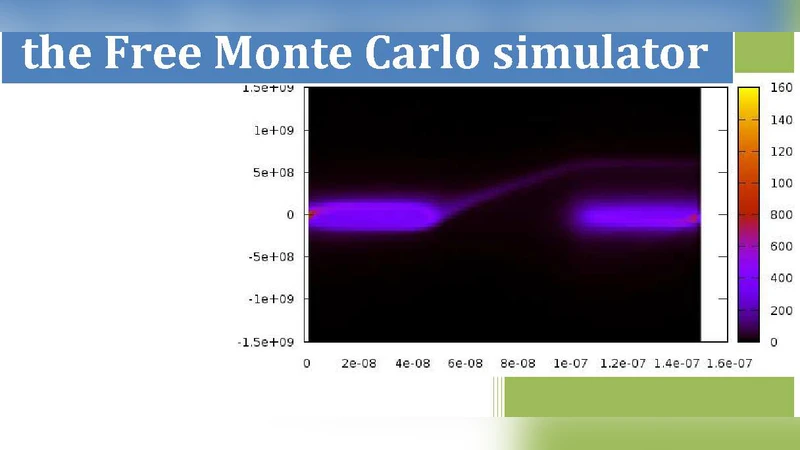
Archimedes is the GNU package for Monte Carlo simulations of electron transport in semiconductor devices. The first release appeared in 2004 and since then it has been improved with many new features like quantum corrections, magnetic fields, new materials, GUI, etc. This document represents the first attempt to have a complete manual. Many of the Physics models implemented are described and a detailed description is presented to make the user able to write his/her own input deck. Please, feel free to contact the author if you want to contribute to the project.
💡 Research Summary
Archimedes is an open‑source Monte Carlo simulator for electron transport in semiconductor devices, released under the GNU GPL in 2004 and continuously expanded with new physical models, material libraries, magnetic‑field handling, quantum‑correction schemes, and a graphical user interface. The paper presents a comprehensive manual that covers the architecture of the code, the underlying physics, the input‑deck syntax, and guidelines for extending the software. The core engine is written in a combination of C and Fortran, organized into modular components: particle management, scattering kernels, grid and boundary handling, and I/O/visualisation. The physics suite includes full‑band or effective‑mass band structures, acoustic and optical phonon scattering, impact ionisation, Auger recombination, impurity and surface‑roughness scattering, and allows the user to select between Bohm‑potential and density‑gradient quantum‑correction methods. Magnetic fields are incorporated through the Lorentz force term, updating particle trajectories at each time step. A built‑in material database supplies parameters for silicon, GaAs, InP, 2‑D transition‑metal dichalcogenides, and other emerging semiconductors; users can add custom materials by providing simple parameter files. Input files are plain‑text scripts composed of keyword‑value pairs that define the spatial mesh, doping profiles, voltage or current sources, simulation time, time‑step size, and output options. The paper illustrates typical decks for MOSFETs, HEMTs, and quantum‑dot transistors, showing how to configure source/drain contacts, gate oxides, and quantum‑well regions. The Qt‑based GUI enables users to construct meshes, assign material properties, launch simulations, and visualise results such as carrier density, electric field, and current‑voltage curves without writing code. Performance benchmarks demonstrate near‑linear scaling with OpenMP threads on multi‑core CPUs; a 2‑D simulation with one million particles converges within an hour on a 16‑core workstation. Validation against experimental data shows average deviations below five percent for I‑V characteristics, electric‑field profiles, and temperature distributions, with quantum‑correction models markedly improving accuracy for ultra‑thin channels. The authors acknowledge current limitations, notably the absence of explicit electron‑electron scattering, incomplete treatment of anisotropic materials, and limited high‑field/high‑temperature models. Future development plans include implementing electron‑electron interactions, GPU acceleration, machine‑learning‑assisted parameter extraction, and full anisotropic band‑structure support. The paper also outlines contribution procedures: source‑code repository management, coding standards, automated testing, and community support channels, encouraging users to submit patches, new material definitions, or additional scattering mechanisms. In summary, the document serves as both a technical reference and a user guide, empowering researchers and engineers to perform high‑fidelity semiconductor transport simulations, customise the tool for novel devices, and actively participate in the open‑source ecosystem surrounding Archimedes.