Fundamental Principles of Theoretical Physics and Concepts of Quasiaverages, Quantum Protectorate and Emergence
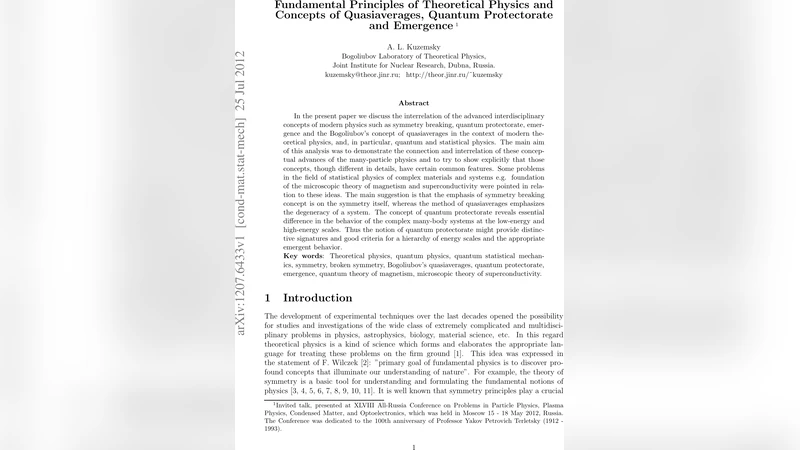
In the present paper we discuss the interrelation of the advanced interdisciplinary concepts of modern physics such as symmetry breaking, quantum protectorate, emergence and the Bogoliubov’s concept of quasiaverages in the context of modern theoretical physics, and, in particular, quantum and statistical physics. The main aim of this analysis was to demonstrate the connection and interrelation of these conceptual advances of the many-particle physics and to try to show explicitly that those concepts, though different in details, have certain common features. Some problems in the field of statistical physics of complex materials and systems e.g. foundation of the microscopic theory of magnetism and superconductivity were pointed in relation to these ideas. The main suggestion is that the emphasis of symmetry breaking concept is on the symmetry itself, whereas the method of quasiaverages emphasizes the degeneracy of a system. The concept of quantum protectorate reveals essential difference in the behavior of the complex many-body systems at the low-energy and high-energy scales. Thus the notion of quantum protectorate might provide distinctive signatures and good criteria for a hierarchy of energy scales and the appropriate emergent behavior.
💡 Research Summary
The paper undertakes a systematic comparison of four advanced concepts that have shaped modern many‑body physics: spontaneous symmetry breaking, Bogoliubov’s method of quasi‑averages, the notion of a quantum protectorate, and the broader idea of emergence. While each concept originated in a different subfield, the authors argue that they share a common purpose – to explain how collective behavior in complex quantum systems can be understood in terms of symmetry, degeneracy, energy‑scale separation, and the appearance of new effective degrees of freedom.
The discussion begins with the traditional view of symmetry breaking, emphasizing that the loss of a symmetry in the ground state is usually presented as a property of the Hamiltonian’s invariance group. The authors contrast this with the quasi‑average approach, which does not merely note that a symmetry is absent but explicitly selects one of the degenerate vacua by introducing an infinitesimal external field (or “source”) that lifts the degeneracy. After the limit of vanishing source is taken, the resulting expectation values define the quasi‑average. In this way, quasi‑averages provide a mathematically rigorous prescription for handling spontaneous symmetry breaking in statistical ensembles, especially when the order parameter is not uniquely defined by the Hamiltonian alone.
Next, the paper introduces the quantum protectorate concept, originally coined by Laughlin and Pines, to describe situations where low‑energy collective excitations are “protected” from the microscopic details of the underlying Hamiltonian. Typical examples include spin‑wave modes in ferromagnets, phonons in crystals, and the superconducting gap in BCS theory. The authors argue that a protectorate signals a hierarchy of energy scales: at high energies the full microscopic interactions dominate, while at low energies a reduced set of emergent variables obeys universal laws that are insensitive to the microscopic complexity. This separation is crucial for constructing effective field theories and for justifying why phenomenological models can be extremely successful despite incomplete knowledge of the underlying interactions.
The emergence framework is then placed in dialogue with the protectorate idea. Emergence is defined as the appearance of new macroscopic laws or quasiparticles that cannot be straightforwardly inferred from the microscopic equations of motion. The authors contend that protectorates are concrete realizations of emergence: the low‑energy protected modes constitute new degrees of freedom whose dynamics are governed by emergent symmetries or topological constraints. In this sense, emergence is not a vague philosophical claim but a concrete, testable statement about the existence of distinct, scale‑dependent effective theories.
Having laid out the conceptual landscape, the authors apply the four‑fold framework to concrete problems in condensed‑matter physics. In magnetism, the spontaneous alignment of spins creates a manifold of degenerate ground states. A tiny symmetry‑breaking field (e.g., an infinitesimal magnetic field) selects a particular direction, which is precisely the quasi‑average procedure. The resulting spin‑wave excitations are protected by the rotational symmetry of the ordered phase, illustrating a quantum protectorate. The macroscopic magnetic order itself is an emergent phenomenon that cannot be deduced from the bare Heisenberg Hamiltonian without invoking the hierarchy of scales.
In superconductivity, the U(1) gauge symmetry is broken when Cooper pairs condense. The quasi‑average method formalizes the selection of a particular phase of the order parameter by adding an infinitesimal pairing field. The resulting energy gap and the collective Anderson‑Bogoliubov mode are low‑energy excitations that are robust against microscopic details of the electron‑phonon interaction, exemplifying a quantum protectorate. The BCS theory itself is an emergent effective description that captures the universal features of a wide class of superconductors, regardless of the specific pairing mechanism.
The paper also discusses more complex materials such as high‑temperature superconductors and heavy‑fermion compounds, where multiple competing orders and strong correlations blur the simple separation of scales. Here the authors argue that a combined use of quasi‑averages (to resolve degeneracies among competing orders) and protectorate analysis (to identify which low‑energy modes are universal) can guide the construction of appropriate emergent theories.
Finally, the authors propose a research agenda based on their synthesis. They suggest systematic studies in which infinitesimal symmetry‑breaking fields are experimentally controlled (e.g., using strain, pressure, or weak magnetic fields) to probe quasi‑average selection mechanisms. They also advocate for spectroscopic investigations aimed at identifying protected low‑energy excitations, thereby providing empirical signatures of quantum protectorates. By mapping out the hierarchy of energy scales and the associated emergent degrees of freedom, one can develop more accurate effective Hamiltonians for complex materials.
In conclusion, the paper demonstrates that symmetry breaking, quasi‑averages, quantum protectorates, and emergence are not isolated ideas but interlocking components of a unified theoretical framework. This framework clarifies why certain macroscopic phenomena—magnetism, superconductivity, and other collective states—appear robustly across diverse microscopic realizations, and it offers concrete methodological tools for future theoretical and experimental work in many‑body physics.
Comments & Academic Discussion
Loading comments...
Leave a Comment