Customer Empowerment in Healthcare Organisations Through CRM 2.0: Survey Results from Brunei Tracking a Future Path in E-Health Research
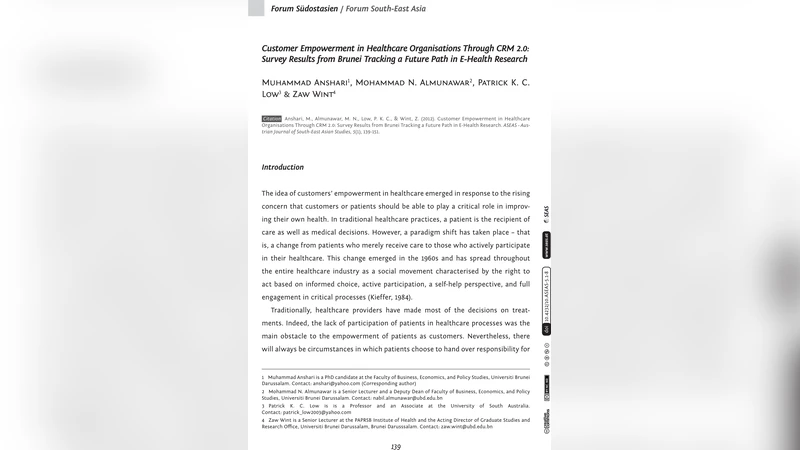
Customer Relationship Management (CRM) with the Web technology provides healthcare organizations the ability to broaden services beyond its usual practices, and thus provides a particular advantageous environment to achieve complex e-health goals. This paper discusses and demonstrates how a new approach in CRM based on Web 2.0 namely CRM 2.0 will help customers to have greater control in the sense of controlling the process of interaction (empowerment) between healthcare organizations with its customers, and among customers themselves. A survey was conducted to gather preliminary requirements and expectations on empowerment in Brunei. The survey revealed that there is a high demand for empowering customers in Brunei through the Web. Regardless of the limitations of the survey, the general public has responded with a great support for the capabilities of empowerment listed from the questionnaires. The data were analyzed to provide initial ideas and recommendation to a future direction on research for customers’ empowerment in e-health services.
💡 Research Summary
The paper investigates how a Web 2.0‑enhanced Customer Relationship Management system—referred to as CRM 2.0—can empower patients within health‑care organisations and facilitate richer interaction among patients themselves. The authors begin by critiquing traditional CRM, which largely treats the patient as a passive recipient of information, and argue that the interactive, user‑generated content capabilities of Web 2.0 provide a natural foundation for a more participatory model. They define “empowerment” as giving patients direct control over their health data, the ability to schedule and modify appointments online, and the opportunity to share experiences with peers through community platforms.
A mixed‑method survey was carried out in Brunei, a country with high broadband penetration (≈85 %) and mobile phone usage (≈92 %). The quantitative phase involved an online questionnaire completed by 350 adults aged 18‑65, covering five dimensions: data access and edit rights, online consultation/booking, peer‑to‑peer knowledge exchange, privacy/security concerns, and perceived value of the services. The qualitative phase comprised semi‑structured interviews with 15 stakeholders (health‑care providers, patient representatives, and IT officials) to contextualise the quantitative findings.
Key results show a strong demand for empowerment: 78 % of respondents want the ability to view and modify their electronic health records, and 71 % favour a mobile‑first interface for real‑time consultations and appointment management. Peer support features received a 65 % approval rate, indicating that patients value social interaction as part of their care journey. Privacy concerns, while present, were relatively modest (42 % expressed notable worries), suggesting a baseline trust in Brunei’s digital infrastructure but also highlighting the need for transparent data‑handling policies. Health‑care providers identified cost, staff training, and integration with legacy systems as primary barriers to implementation.
From these findings, the authors derive a set of design principles for a CRM 2.0‑based e‑health platform. First, patient data sovereignty must be embedded through a “data‑owner” model, potentially leveraging blockchain to create immutable access logs. Second, community modules should incorporate AI‑driven content moderation to prevent misinformation while encouraging peer‑generated knowledge. Third, a mobile‑centric user experience, with push notifications and personalized health tips, is essential for sustained engagement. Fourth, a multi‑layer security architecture—encryption at rest and in transit, regular penetration testing, and compliance with national privacy legislation—must be instituted to address the residual security concerns.
The discussion acknowledges several limitations: the sample skewed toward urban, technologically literate participants, and the questionnaire itself may have primed respondents toward favorable views of digital tools. Consequently, the authors recommend future work that includes rural populations, longitudinal studies to measure health outcomes over time, and cross‑institutional data‑standardisation efforts. They also propose exploring advanced analytics, such as machine‑learning‑driven treatment recommendation engines, and evaluating blockchain‑based consent management frameworks.
In conclusion, the study demonstrates a clear appetite among Brunei’s public for greater control over their health‑care interactions via CRM 2.0. By aligning policy support, health‑care provider readiness, and robust IT architecture, Brunei can pioneer a patient‑centred digital health ecosystem that may serve as a model for other emerging economies seeking to modernise their health‑care delivery. The paper thus provides both empirical evidence and a strategic roadmap for researchers, practitioners, and policymakers aiming to harness CRM 2.0 for empowered, collaborative e‑health services.
Comments & Academic Discussion
Loading comments...
Leave a Comment