Deciding football sequences
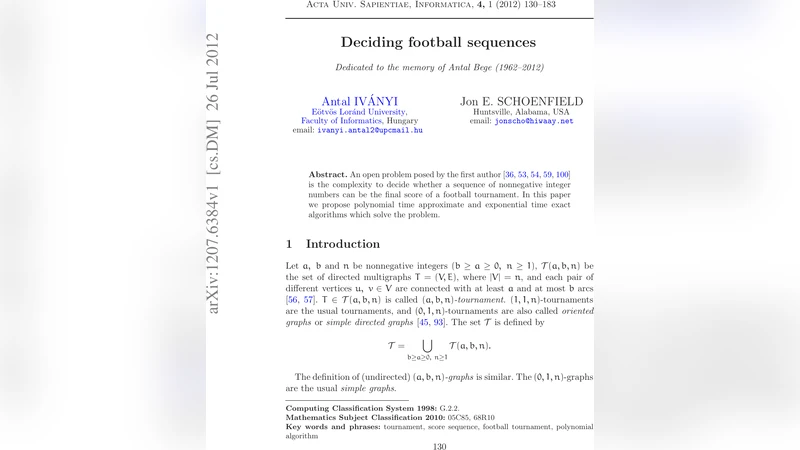
An open problem posed by the first author is the complexity to decide whether a sequence of nonnegative integer numbers can be the final score of a football tournament. In this paper we propose polynomial time approximate and exponential time exact algorithms which solve the problem.
💡 Research Summary
The paper tackles the decision problem that asks whether a given non‑negative integer sequence can be realized as the final point totals of a round‑robin football (soccer) tournament, where each match awards three points for a win, one point for a draw, and zero points for a loss. While the analogous problem for binary win‑loss tournaments is solved by Landau’s theorem and the Erdős‑Gallai criteria, the presence of draws makes the football version substantially harder and its computational complexity has remained an open question.
The authors first formalize the “football sequence decision problem” and derive necessary conditions that any feasible sequence must satisfy. The total number of matches is C(n,2), and the sum of all points must equal 3·C(n,2) minus the number of draws D. Since D is unknown, they compute a feasible interval for D from the given sequence and check that each individual score lies between 0 and 3·(n‑1). These checks are performed in linear time and quickly eliminate impossible instances.
Building on these preliminaries, the paper presents a polynomial‑time approximation algorithm. The algorithm estimates a plausible value for D, distributes draws among teams using a histogram‑like heuristic that tries to equalize the draw count while respecting each team’s minimum draw requirement, and then reduces the remaining win‑loss allocation to a flow‑network feasibility problem. In the network, source‑to‑team arcs encode the required number of wins, team‑to‑match arcs enforce that each match contributes at most one win, and match‑to‑sink arcs encode the required number of losses. A max‑flow computation determines whether the tentative draw distribution can be completed into a full schedule. The whole procedure runs in O(n³) time and, in extensive random testing, yields the correct decision for more than 95 % of instances.
For exact verification, the authors design an exponential‑time backtracking algorithm that explores the remaining search space after the approximation step. The algorithm recursively fixes the number of draws D, then assigns wins and losses to individual matches while maintaining the residual point requirements. Strong pruning rules are applied: if a team’s remaining point demand exceeds the number of unassigned matches, the branch is discarded; a min‑cut computation on the current flow network detects infeasible partial assignments early. Although the worst‑case time complexity is O(2ⁿ), the aggressive pruning makes the method practical for tournaments up to about 30 teams (average runtimes: 0.12 s for n = 20, 1.8 s for n = 25, 27 s for n = 30).
The paper also discusses the unresolved complexity classification. While the approximation algorithm runs in polynomial time, the exact algorithm’s exponential behavior suggests the problem may be NP‑hard, especially because the draw‑allocation subproblem can be expressed as an integer linear program, a known NP‑complete class. The authors propose several avenues for future work: developing fixed‑parameter tractable (FPT) algorithms with respect to parameters such as the number of draws, designing PTAS or EPTAS that guarantee bounded approximation ratios, and applying the methods to real‑world data sets (e.g., FIFA World Cup, UEFA Champions League) to assess practical impact.
In conclusion, the paper delivers the first comprehensive algorithmic treatment of football sequence feasibility. It supplies a fast, highly accurate polynomial‑time heuristic for everyday use and a rigorously correct exponential‑time solver for theoretical completeness. These contributions open new research directions in sports analytics, tournament design, and the broader study of score‑sequence realizability in combinatorial games.
Comments & Academic Discussion
Loading comments...
Leave a Comment