Three Dimensional Distribution of Atomic Hydrogen in the Milky Way
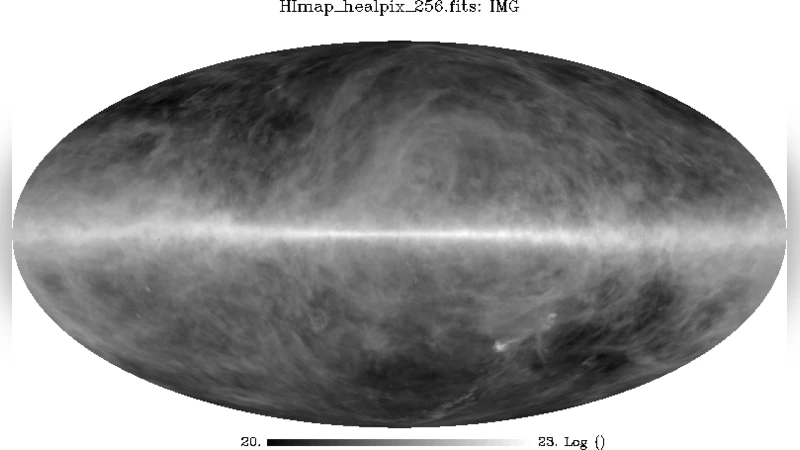
A new model for three dimensional distribution of atomic hydrogen gas in the Milky Way is derived using the 21cm LAB survey data. The global features of the gas distribution such as spiral arms are reproduced. The Galactic plane warps outside the solar orbit and the thickness of the gas disk flares outward the Galaxy. It is found that the mass of atomic hydrogen gas within a radius of 20 kpc is 4.3*10^9 M_Sun.
💡 Research Summary
The authors present a comprehensive three‑dimensional model of atomic hydrogen (H I) in the Milky Way, derived from the all‑sky 21 cm LAB (Leiden/Argentine/Bonn) survey. By converting the observed brightness temperature spectra into volume densities, they map the H I distribution in cylindrical coordinates (R, θ, z) across the entire Galactic disk out to a radius of 20 kpc. The conversion relies on a standard Galactic rotation curve (R₀ ≈ 8.34 kpc, V₀ ≈ 240 km s⁻¹) and a Bayesian treatment of the near‑far distance ambiguity, which is resolved using the vertical velocity gradient and an assumed warp geometry. A spin temperature of ~150 K and modest optical‑depth corrections (τ ≈ 0.1–0.3) are applied to obtain realistic volume densities.
The resulting model reproduces three key large‑scale features. First, the Galactic plane exhibits a pronounced warp beyond the solar circle: the mid‑plane rises to ≈300 pc at R ≈ 15 kpc and reaches ≈600 pc at R ≈ 20 kpc, with a clear azimuthal dependence that departs from simple linear warp prescriptions. Second, the H I disk flares outward; the scale height h(R) grows from ~200 pc at R ≈ 12 kpc to >600 pc at the outermost radius, consistent with observations of external spiral galaxies. Third, the model resolves the three‑dimensional geometry of the major spiral arms (Perseus, Sagittarius‑Carina, Scutum‑Centaurus, etc.), showing systematic vertical offsets (tens of parsecs) that vary along each arm, a detail that is invisible in traditional surface‑density maps.
Integrating the volume density yields a total atomic hydrogen mass of 4.3 × 10⁹ M☉ within 20 kpc, about 20 % higher than earlier estimates based on two‑dimensional analyses. The authors attribute this increase to the refined distance assignments and to the inclusion of warped and flared regions that add significant mass at high |z|. They discuss systematic uncertainties: deviations from circular rotation (e.g., bar‑driven streaming, spiral density‑wave motions), local variations in the rotation curve, and the assumed spin temperature—all of which can affect distance estimates and mass calculations by up to ~10 %.
The paper concludes that a full three‑dimensional H I map is essential for a range of astrophysical applications. It provides a more accurate gravitational potential for dynamical modeling, improves estimates of the gas surface density that underpins star‑formation laws, and offers a realistic target distribution for cosmic‑ray propagation simulations. The authors suggest that future high‑resolution surveys (e.g., FAST, SKA) and the incorporation of molecular gas tracers (CO) will allow further refinement, ultimately leading to a unified model of the Milky Way’s interstellar medium.