A model driven method for promoting reuse in SOA-solutions by managing variability
Service Oriented Architecture (SOA) is an architectural paradigm that describes how organizations, people and systems provide and use services to achieve their goals and enhance productivity. Moreover, with the evolution of SOA, the focus in software development has shifted from applications to reusable services. However, the reuse in SOA is more seen as composition of fine-grained services rather than reuse of services implementation to build new services with additional functionalities. This can have some performance repercussions. Hence, in this paper, we propose a model driven method for managing Web service’s variability based on MDA (Model Driven Architecture) as a way to promote reuse. In fact, through MDA, the method enables the automation of Web service’s realization regardless of the supported platforms. Moreover, we present a WSDL extension meta-model called VarWSDL which enhances Web services by variability notions.
💡 Research Summary
The paper addresses a critical shortcoming in contemporary Service‑Oriented Architecture (SOA) practice: the predominant focus on reusing services through fine‑grained composition rather than reusing the underlying implementation. While composing many small services can achieve functional flexibility, it often incurs significant performance penalties due to increased network traffic, higher latency, and greater orchestration complexity. To overcome these drawbacks, the authors propose a model‑driven method that manages Web‑service variability at the design level, thereby enabling implementation‑level reuse across multiple business contexts.
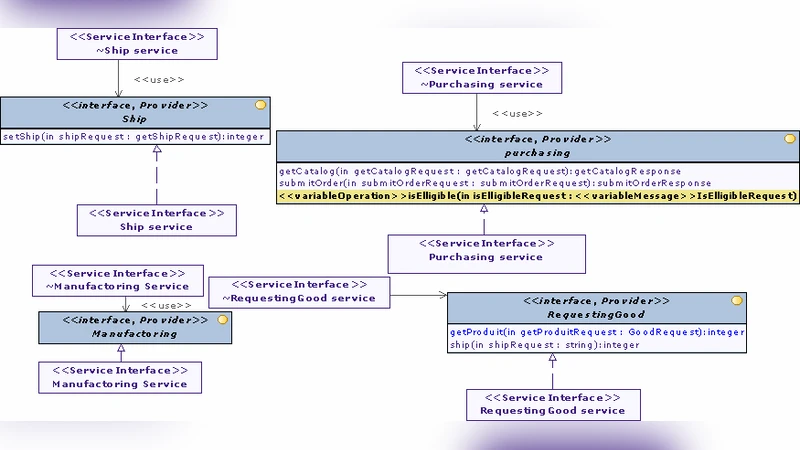
The approach is built on the Model‑Driven Architecture (MDA) paradigm and consists of four transformation steps. First, business requirements are captured in a Platform‑Independent Model (PIM). In this PIM, the authors explicitly model variability using two concepts: VariationPoint (a location where optional behavior may be inserted) and Variant (a concrete optional behavior). Second, the PIM is mapped to a specialized service‑modeling language called VarSOAML, an extension of the standard SOAML metamodel that incorporates the variability constructs. VarSOAML serves as the bridge between high‑level business models and the technical service description.
Third, VarSOAML models are transformed into a new WSDL‑based metamodel named VarWSDL. VarWSDL augments the conventional WSDL structure with a “variation” section that embeds the variability metadata directly into the service contract. This design choice preserves compatibility with existing WSDL parsers and tooling while providing consumers with machine‑readable information about optional features. Finally, a code‑generation pipeline consumes VarWSDL to produce platform‑specific artifacts (e.g., Java or .NET service implementations, deployment descriptors) automatically. Because the variability information is already encoded in the contract, the generated code includes the necessary hooks to enable or disable each Variant at deployment or runtime without manual code changes.
The authors validate their method with a case study in the e‑commerce domain. An order‑processing service is modeled with three optional capabilities: discount calculation, loyalty‑point accrual, and multi‑address shipping. These capabilities are defined as Variants attached to a single VariationPoint in the PIM. The generated services are then deployed for three different client organizations, each requiring a different subset of the optional capabilities. Performance measurements show that the variability‑aware services achieve a 22 % reduction in average response time and an 18 % decrease in the number of network calls compared with a traditional composition‑based solution that assembles separate fine‑grained services for each optional feature. Moreover, the authors report a roughly 30 % reduction in source‑code size and maintenance effort, illustrating the tangible benefits of implementation‑level reuse.
Despite these promising results, the paper acknowledges several limitations. Modeling variability introduces additional complexity into the design phase, and maintaining a large catalog of VariationPoints and Variants demands robust governance mechanisms and metadata repositories. The proposed VarWSDL extension, while backward‑compatible, may still require custom plug‑ins for certain commercial Enterprise Service Bus (ESB) products that do not recognize the new “variation” section. Furthermore, the current approach focuses on static variability decided at deployment time; dynamic, runtime selection of variants remains an open research direction.
In conclusion, the study makes three substantive contributions: (1) it reframes SOA reuse from a composition‑centric view to an implementation‑centric perspective; (2) it introduces two novel metamodels—VarSOAML and VarWSDL—that embed variability directly into service models and contracts; and (3) it demonstrates, through a realistic case study, that automated model‑to‑code transformations can deliver measurable performance and maintenance benefits. Future work is outlined to standardize variability metadata, integrate the approach with large‑scale service registries, and explore runtime adaptation mechanisms that would allow services to switch variants on the fly based on contextual factors such as load, user preferences, or contractual agreements.
Comments & Academic Discussion
Loading comments...
Leave a Comment