Colorectal cancers differ in respect of PARP-1 protein expression
Recent findings raise the possibility of PARP inhibitor therapy in colorectal cancers(CRCs). However, the extent of PARP-1 protein expression in clinical specimens of CRC is not known. Using immunohis
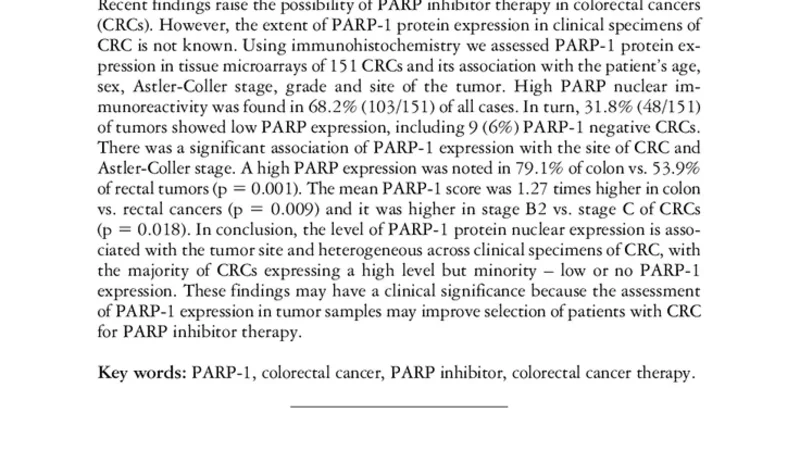
Recent findings raise the possibility of PARP inhibitor therapy in colorectal cancers(CRCs). However, the extent of PARP-1 protein expression in clinical specimens of CRC is not known. Using immunohistochemistry we assessed PARP-1 protein expression in tissue microarrays of 151 CRCs and its association with the patient’s age, sex, Astler-Coller stage, grade and site of the tumor. High PARP nuclear immunoreactivity was found in 68.2% (103/151) of all cases. In turn, 31.8% (48/151)of tumors showed low PARP expression, including 9 (6%) PARP-1 negative CRCs. There was a significant association of PARP-1 expression with the site of CRC and Astler-Coller stage. A high PARP expression was noted in 79.1% of colon vs. 53.9% of rectal tumors (p = 0.001). The mean PARP-1 score was 1.27 times higher in colon vs. rectal cancers (p = 0.009) and it was higher in stage B2 vs. stage C of CRCs (p = 0.018). In conclusion, the level of PARP-1 protein nuclear expression is associated with the tumor site and heterogeneous across clinical specimens of CRC, with the majority of CRCs expressing a high level but minority - low or no PARP-1 expression. These findings may have a clinical significance because the assessment of PARP-1 expression in tumor samples may improve selection of patients with CRC for PARP inhibitor therapy.
💡 Research Summary
Recent advances in the field of DNA‑damage response have highlighted poly(ADP‑ribose) polymerase‑1 (PARP‑1) as a therapeutic target, especially in tumors harboring defects in homologous recombination repair. While PARP inhibitors have shown efficacy in breast, ovarian, and prostate cancers, their relevance to colorectal cancer (CRC) remains uncertain because the prevalence of PARP‑1 protein expression in clinical CRC specimens has not been systematically evaluated. In this study, the authors addressed this gap by performing immunohistochemical (IHC) analysis of PARP‑1 on tissue microarrays (TMAs) constructed from 151 surgically resected CRCs. The cohort comprised a balanced mix of colon and rectal tumors, spanning Astler‑Coller stages B1, B2, and C, and included both male and female patients across a wide age range.
Methodologically, the authors used a validated anti‑PARP‑1 monoclonal antibody, applied standardized antigen‑retrieval protocols, and employed a semi‑quantitative scoring system that combined staining intensity and the proportion of positively stained nuclei. Scores ranged from 0 (no detectable nuclear staining) to 3 (strong, diffuse nuclear staining). Two independent pathologists scored each core, and discordant cases were resolved by joint review, thereby minimizing observer bias. The authors defined scores of 0–1 as “low expression” and scores of 2–3 as “high expression.” Statistical analyses included chi‑square tests for categorical variables and t‑tests/ANOVA for continuous score comparisons, with a significance threshold set at p < 0.05.
The results revealed that 68.2 % (103/151) of CRCs displayed high nuclear PARP‑1 expression, whereas 31.8 % (48/151) exhibited low expression; notably, 6 % (9/151) were completely negative. A statistically significant association emerged between PARP‑1 expression and tumor location: 79.1 % of colon cancers (i.e., tumors arising in the ascending, transverse, or descending colon) were high expressors compared with only 53.9 % of rectal cancers (p = 0.001). Moreover, the mean PARP‑1 score in colon tumors was 1.27‑fold greater than that in rectal tumors (p = 0.009). Regarding disease stage, high expression was more frequent in Astler‑Coller stage B2 than in stage C (p = 0.018). No significant correlations were identified with patient age, sex, or histologic grade. Multivariate analysis confirmed that tumor site and stage remained independent predictors of PARP‑1 expression.
The authors interpret these findings in the context of personalized oncology. The high prevalence of PARP‑1 in the majority of CRCs suggests that many tumors retain an active PARP‑1‑dependent DNA repair pathway, which could render them susceptible to synthetic lethality when PARP activity is pharmacologically inhibited. Conversely, the subset of tumors with low or absent PARP‑1 expression may be intrinsically resistant to PARP inhibitors and might require alternative therapeutic strategies. The observed heterogeneity underscores the necessity of biomarker‑driven patient selection rather than a blanket application of PARP inhibitors across all CRCs.
However, the study has several limitations. First, the semi‑quantitative IHC scoring, while widely used, is inherently subjective; digital image analysis or quantitative fluorescence could provide more precise measurements. Second, the cross‑sectional design precludes any direct assessment of treatment response; prospective trials correlating PARP‑1 expression with clinical outcomes after PARP inhibitor therapy are required. Third, the authors did not evaluate co‑existing genetic alterations such as BRCA1/2 mutations, ATM loss, or broader homologous recombination deficiency signatures, which could synergize with PARP‑1 expression to predict therapeutic benefit.
Future research directions proposed include: (1) expanding the cohort to a multi‑institutional, larger sample size to validate the observed associations; (2) integrating genomic and transcriptomic data to construct a composite biomarker panel that incorporates PARP‑1 protein levels, HRR pathway mutations, and functional assays of DNA repair capacity; (3) conducting phase II/III clinical trials that stratify patients based on PARP‑1 IHC status and assess the efficacy of PARP inhibitors alone or in combination with standard chemotherapeutics (e.g., 5‑fluorouracil, oxaliplatin) or immune checkpoint inhibitors.
In conclusion, this study provides the first systematic quantification of PARP‑1 protein expression in a sizable CRC cohort and demonstrates that expression varies significantly with tumor site and Astler‑Coller stage. The majority of CRCs exhibit high nuclear PARP‑1, supporting the rationale for exploring PARP inhibitor therapy in this disease. Nonetheless, the identified heterogeneity highlights the importance of incorporating PARP‑1 assessment into clinical decision‑making to identify the subset of patients most likely to benefit from PARP‑targeted treatments.
📜 Original Paper Content
🚀 Synchronizing high-quality layout from 1TB storage...