Effects of nanoparticles and surfactant on droplets in shear flow
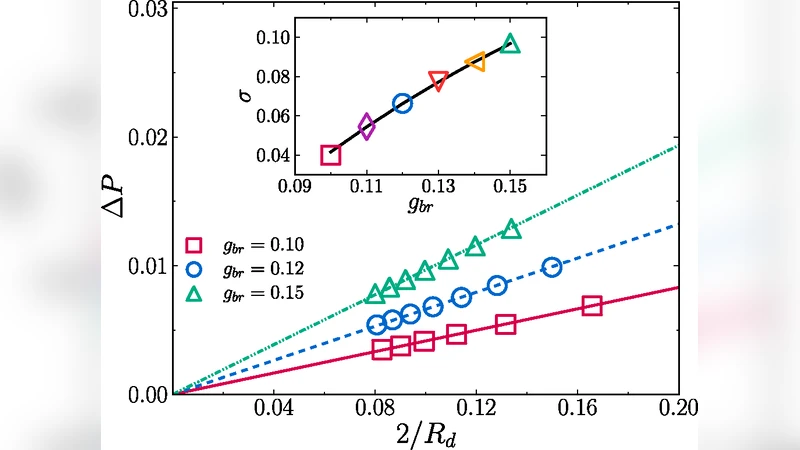
We present three-dimensional numerical simulations, employing the well-established lattice Boltzmann method, and investigate similarities and differences between surfactants and nanoparticles as additives at a fluid-fluid interface. We report on their respective effects on the surface tension of such an interface. Next, we subject a fluid droplet to shear and explore the deformation properties of the droplet, its inclination angle relative to the shear flow, the dynamics of the particles at the interface, and the possibility of breakup. Particles are seen not to affect the surface tension of the interface, although they do change the overall interfacial free energy. The particles do not remain homogeneously distributed over the interface, but form clusters in preferred regions that are stable for as long as the shear is applied. However, although the overall structure remains stable, individual nanoparticles roam the droplet interface, with a frequency of revolution that is highest in the middle of the droplet interface, normal to the shear flow, and increases with capillary number. We recover Taylor’s law for small deformation of droplets when surfactant or particles are added to the droplet interface. The effect of surfactant is captured in the capillary number, but the inertia of adsorbed massive particles increases deformation at higher capillary number and eventually leads to easier breakup of the droplet.
💡 Research Summary
The paper presents a comprehensive three‑dimensional lattice‑Boltzmann study of how surfactants and solid nanoparticles, when adsorbed at a fluid–fluid interface, influence the dynamics of a droplet subjected to simple shear flow. The authors first quantify the effect of each additive on the interfacial tension. As expected, surfactants lower the surface tension, which can be incorporated into the capillary number (Ca = ηγ̇R/σ) by reducing σ. In contrast, the nanoparticles do not modify σ; instead, they alter the interfacial free energy by occupying area on the interface and by contributing inertial mass.
The deformation of the droplet under shear is then examined across a range of Ca. For small Ca the classical Taylor law for droplet deformation (D ≈ 19 Ca/16) is recovered irrespective of whether surfactant or particles are present, confirming that the linear relationship between deformation and Ca is robust. However, at higher Ca the presence of massive particles introduces an additional inertial term that amplifies deformation beyond the Taylor prediction. Consequently, particle‑laden droplets break up at lower shear rates than clean droplets.
A central part of the study focuses on the particle dynamics on the moving interface. Under shear the particles are not homogeneously distributed; they migrate to regions that are roughly perpendicular to the flow direction, forming stable “rings” or clusters that persist as long as the shear is applied. Within these clusters individual particles continue to move, executing revolutions around the droplet surface. The revolution frequency is highest at the mid‑latitude of the droplet (the region normal to the shear plane) and grows monotonically with Ca. This behavior reflects the balance between hydrodynamic drag, interfacial tension forces, and particle inertia.
The authors also discuss the practical implications of their findings. Surfactants can be used to reduce interfacial tension and thereby delay droplet breakup, which is advantageous in emulsification processes that require stable droplets under flow. Nanoparticles, while offering potential benefits such as interfacial rigidity or functionalization, introduce inertia that can promote earlier breakup and cause localized stress concentrations. Designing formulations that combine both additives could exploit the tension‑lowering effect of surfactants while mitigating the inertial amplification caused by particles, for example by tuning particle size, density, or surface coverage.
Overall, the work validates the lattice‑Boltzmann method as a powerful tool for resolving coupled fluid‑structure‑particle interactions at interfaces, provides quantitative benchmarks for Taylor’s deformation law in the presence of additives, and offers clear guidance for engineers and scientists seeking to control droplet stability in microfluidic, coating, or emulsion‑based technologies.