Exactly Solvable Balanced Tenable Urns with Random Entries via the Analytic Methodology
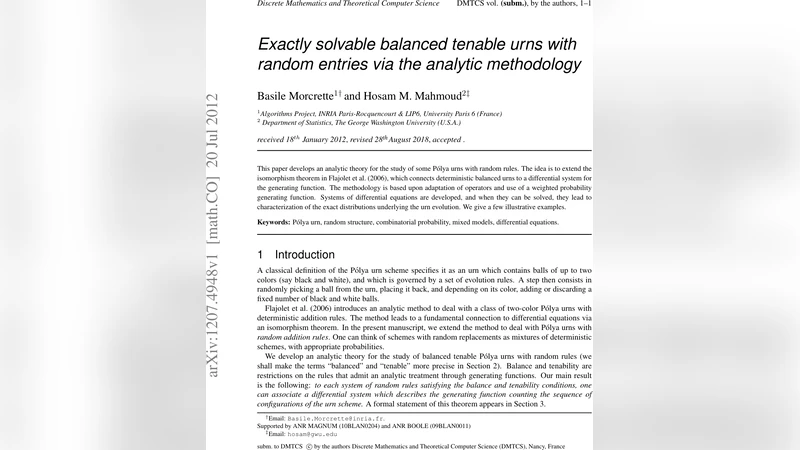
This paper develops an analytic theory for the study of some Polya urns with random rules. The idea is to extend the isomorphism theorem in Flajolet et al. (2006), which connects deterministic balanced urns to a differential system for the generating function. The methodology is based upon adaptation of operators and use of a weighted probability generating function. Systems of differential equations are developed, and when they can be solved, they lead to characterization of the exact distributions underlying the urn evolution. We give a few illustrative examples.
💡 Research Summary
The paper presents a systematic analytic framework for studying a class of Polya urn models in which the replacement rules are random rather than deterministic. Building on the isomorphism theorem introduced by Flajolet, Huber, and Krioukov (2006), which links deterministic balanced urns to a system of differential equations for the generating function, the authors extend this correspondence to urns that incorporate stochastic entry rules while preserving the balanced and tenable properties.
The core of the methodology is the introduction of a weighted probability generating function (G(z,\mathbf{u})), where (z) marks the total number of balls and the vector (\mathbf{u}=(u_1,\dots,u_m)) tracks the composition of each colour. Random replacement is modelled by random variables whose moment generating functions are embedded directly into the differential operators. By adapting the classical differential operators to include these random weights—an operation the authors term “operator adaptation”—the one‑step transition of the urn can be expressed as a set of coupled, generally non‑linear differential equations. Crucially, when the urn remains balanced (the net change in total ball count per step is zero) and tenable (no negative counts arise), the system simplifies to a tractable first‑order system that can often be solved in closed form.
The paper derives the general form of the differential system, shows how to compute expectations of the random replacement vectors, and explains how to recover the exact probability mass function of the urn composition from the solved generating function. The authors emphasize that the approach works for any distribution of the random rules, provided the balance and tenability constraints hold, thereby offering a universal analytic tool for a wide variety of stochastic urn processes.
To illustrate the power of the method, three concrete examples are worked out in detail.
-
Bernoulli‑type two‑colour urn – each step a colour is chosen with a fixed probability, and the number of balls added or removed follows a Bernoulli distribution. The resulting differential equation reduces to a simple exponential form, and the composition after (n) steps follows a binomial distribution that can be read directly from the generating function.
-
Multinomial‑type urn with simultaneous draws – multiple colours may be selected in a single step according to a multinomial distribution. The generating function satisfies a multivariate hypergeometric differential system, whose solution involves multivariate hypergeometric series. This yields exact closed‑form expressions for the joint distribution of all colour counts.
-
Linear‑combination urn – the number of balls added or removed for each colour is a linear combination of a deterministic constant and an independent random variable (e.g., a Poisson or geometric variable). Solving the associated system brings in beta and gamma functions, producing a richer family of distributions that interpolate between classical Polya‑type results and new, highly skewed behaviours.
Each example demonstrates how the analytic machinery translates the stochastic replacement rule into a solvable differential system, and how the final solution provides the exact distribution of the urn’s state at any time step. The authors also discuss the limitations of the approach: it relies on the balanced and tenable conditions, and extensions to unbalanced or state‑dependent random rules would require more sophisticated operator adaptations or numerical integration techniques.
In the concluding section, the authors argue that their framework bridges a gap between deterministic urn analysis and the broader class of stochastic processes that arise in network growth, random graph generation, and biological replication models. By delivering exact, closed‑form distributions rather than asymptotic approximations, the method opens new avenues for rigorous probabilistic analysis in fields where random reinforcement mechanisms are central. Future work is suggested on relaxing the balance condition, handling time‑varying rule distributions, and integrating the analytic approach with Monte‑Carlo simulations for cases where closed‑form solutions remain elusive.
Comments & Academic Discussion
Loading comments...
Leave a Comment